
Hägerstrand
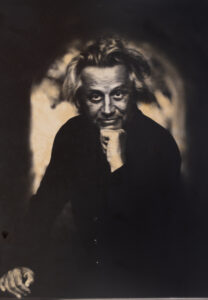
In this interview, Hägerstrand discusses the personal stories, family memories and cinematic influences behind Sjögräs Vol. 3, exploring artistic evolution, creative expression and an ambitious multimedia performance.
1. The Sjögräs project is described as a distillation of everything you have explored throughout your musical career, stripping away everything unnecessary to focus on the essentials. What led you to this artistic turning point, and how did you define what truly needed to remain?
I would imagine that is the goal for all artists and performers. Especially when you’ve been doing it for as long as I have. Just think of Picasso or Helene Scherfbeck. What is it in my music and my musical language that is truly me, and how much can I strip away whilst still retaining that expression?
2. Inspired by photographs from old family albums, Sjögräs tells stories spanning several generations. What fascinated you about these images, and how did they become the starting point for the album’s lyrical and musical world?
There is something about really old photographs that fascinates me. Of course, there is the purely visual aspect – the way they have worn with age and acquired a patina that can only be achieved over a long period of time. Some of them date from the early 1900s. A few are from my mother’s home village in Karelia, Kivitoke. Kivitoke was burnt to the ground during the Karelians’ flight in the Continuation War, so those pictures capture something that has been lost forever. Many of the photographs depict my own relatives whom I have never met, but also people whom no one can now remember who they were or what they were doing there. You can make out the situations in the photographs but do not know the background. They are like secrets captured in the moment and frozen in time. It is very inspiring
3. You describe some of the songs on Sjögräs Vol. 3 as among the most personal you have ever written. Was there anything particularly challenging about turning such intimate memories and emotions into music, and how do you balance personal storytelling with leaving room for listeners to find their own meanings?
I believe that the easiest way to reach another person is through what is most deeply personal. If, instead, I try to guess what other people are thinking and feeling and write about it, there’s a good chance it would fail. True art isn’t created through the greatest common denominator. This applies, of course, to my musical language as well. I must make the music that comes to me. The music that has chosen me as its channel.
4. Your musical background ranges from rock and experimental songwriting to film scores and theatre productions. How have these different experiences shaped the cinematic atmosphere and musical language of the Sjögräs series, and do you consciously approach songwriting differently when working on this project?
Over time, I’ve probably started writing songs in a way that brings to mind the cinematic. It’s not deliberate, but it’s certainly something that has crept in as a result of me working a lot with film music and music for other media. I suppose you’re influenced by both past working processes and the musicians you’ve played with over the years.
5. Sjögräs Vol. 3 will provide the musical foundation for a multimedia performance premiering on 23 January 2027, combining music, visuals and stage presentation. How are you translating the album’s intimate atmosphere into a live theatrical experience, and what new dimensions do you hope this format will bring to the music?
It will probably be something completely different, and it has to be, because the context demands it. The performance will be staged on two stages simultaneously: one at SMI in Stockholm and one at Alandica in Mariehamn. The music has been rearranged to some extent to highlight the interaction between the stages. We’ll be playing together – the band in Mariehamn and the string quartet in Stockholm – but also engaging in a musical dialogue. All of this is made possible by a technology known as Nimbror fibre. This enables latency-free transmission of sound and image over long distances.
It will be a sort of extravaganza featuring projections, props and theatrical elements. However, I hope to retain some of the intimate and personal touch found in the recorded music.
6. Having shared the stage with Nirvana, composed music for Nordic national theatres, scored films and received a Nordic Council Music Prize nomination, you have experienced many different sides of the music industry. Looking back at this journey, what does the Sjögräs project represent for you today, and where would you like to take it next?
I suppose it’s always the project you’re currently working on that engages you the most. I hope to find time to reflect and look back at some point, but right now it’s the next *Sjögräs* rehearsal that’s occupying my thoughts. I’m really fascinated by the Nimbror technique we’re using for the production and would like to continue along those lines. Perhaps writing the music for a piece in collaboration with a playwright, where we start from the outset with the conditions and challenges of creating something for two scenes. Two countries. Or more.