
Carla Marciano
In this heartfelt interview, Carla Marciano reflects on Daydreaming, a deeply personal tribute to her father, exploring love, loss, musical inspiration, and resilience through the universal language of jazz.
1. Your new album Daydreaming: My Beloved Father Giovanni is a deeply personal tribute to your late father, who introduced you to music and encouraged you to follow your dreams. How did your childhood memories of listening to and playing music together influence the emotional and musical direction of this project?
The title Daydreaming holds two deep meanings for me. On one hand, it represents my daily “daydreaming”: I dream of my father and me hugging each other tightly, just as we always did and as seen in the back cover photo I chose for the album. On the other hand, it goes back to the greatest lesson he left me: to dream and follow your dreams with passion, courage, and dedication, as if every day were your last. My father was my true music teacher. My earliest childhood and teenage memories are tied to the songs we listened to together and the times we played at home: he would sing and play the guitar, and I, as a very little girl, would accompany him on the recorder. It was through those songs and shared emotions that my boundless passion for music was born—an art that ignited my soul and gave special value to my life. On this record, my father’s absence has transformed into a very strong presence, and therefore into music. It is an album about love, emotions, and the certainty that he is immortal, and that he is here guiding my heart and my inspiration.
2. In your liner notes, you describe your father as your true music teacher, despite his professional career as a doctor. What are the most important artistic values he passed on to you, and how do you feel his influence continues to shape your identity as a musician today?
Although my father was a renowned doctor, he possessed an extraordinary artistic soul and sensitivity. I had already told him in a letter I gave him for his birthday while he was still alive—and which I later found kept safe in a small chest—that I was sorry I hadn’t carried on his medical profession, but that I was happy to have carried on his artistic soul. I believe it was truly worth it. He was the one who gave me my first saxophone for my sixteenth birthday. I desperately wanted that instrument after being struck by its sound during our countless jazz record listening sessions, but as a doctor, he had waited because I had suffered from asthma since childhood. I still remember when he arrived with that case at our beach house in Agropoli, where we were on vacation for my birthday! Before the sax, I had studied the piano—a complete instrument that served me immensely and on which I still compose today before moving on to the sax. My father passed on to me a love for music understood as truth and pure emotion, and that is the lesson that guides every single note I play.
3. The album features the Philharmonic Orchestra of the Giuseppe Verdi Theater in Salerno on five compositions, alongside your longtime jazz collaborators. What inspired you to combine orchestral arrangements with your distinctive approach to jazz improvisation, and how did you balance these two musical worlds?
The inspiration for the strings came in an almost metaphysical way, from above… it was as if my father were dictating them to me. I would whistle the melodic lines, recording them in voice memos on my phone, and then sit at the piano to find the harmony. For me, it was the first time writing for a string orchestra, and the work was coordinated together with my husband, Alessandro La Corte, the pianist in my quartet, who collaborated with me on some of the arrangements. I owe a special thank you to Antonio Marzullo, artistic secretary of the Giuseppe Verdi Theater in Salerno, for making the Theater’s Philharmonic Orchestra available to me and for putting me in touch with Antonio Sinagra, whom I deeply thank for conducting the orchestra so masterfully. Along with Alessandro La Corte on piano, my longtime regular quartet features Aldo Vigorito on double bass and Gaetano Fasano on drums. On one track, we were joined by Dario Deidda, a great family friend who felt deep affection for my father. I have always believed that a regular lineup gives you the chance to create that musical rapport which becomes a crucial factor for spontaneity and authenticity in musical expression. The balance, therefore, stems right from here: a solid core with a strong connection, enriched by the lyrical and enveloping dimension of the strings.
4. Pieces such as “Giovanni (Your Sweet Smile),” “Flying,” and “Hypnagogic State (Sleep/Wake/Sleep)” suggest different emotional landscapes. How did you approach translating memories, dreams, and personal feelings into compositions while allowing room for spontaneous musical expression?
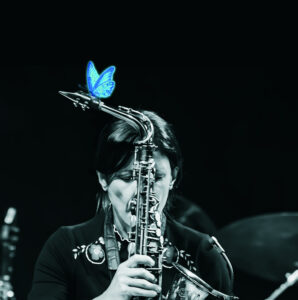
Every track on this album stems from a specific image or a profound life experience. “Giovanni (Your Sweet Smile)” is the most intimate and sentimental moment on the record, composed spontaneously shortly after my father’s passing. I still cannot listen to it without crying. I wanted to present the melody as clear and clean as a prayer, without solos, variations or virtuosity: just a pure theme that reflects the goodness, kindness, and sweetness that shone through his smile. “Flying” comes from my flights of fancy, imagining my father finally free. During his illness, he often said he felt like a prisoner in his own body; when he passed away, we felt he had freed himself like a butterfly from a cocoon. The butterfly you see on the cover resting on my sax is actually him! “Johnny is walking” is a double tribute. I had composed it when my father started walking again after a femur fracture, a few years before leaving us. I thought to play it in the style of Johnny Hodges, one of the first saxophonists I listened to constantly as a young girl, also playing on the assonance between “Johnny” and “Gianni.” “We stay at home” was born from thinking about everyday life, because I am quite a homebody; I have always been at home a lot, close to my parents. The solo sax intro is based on my father’s favorite song, Que reste-t-il de nos amours?, which he always sang and played at home. “Hypnagogic State (Sleep/Wake/Sleep)” because the hypnagogic state is the threshold between waking and sleeping, and in my opinion, it evokes very well the feeling of someone who is physically absent yet remains vivid and present in memory and in a dreamlike dimension.
5. You experienced an extraordinarily difficult period marked by the loss of both parents and a serious road accident that temporarily prevented you from playing. If you feel comfortable sharing, how did returning to your saxophone influence your recovery, and did these experiences change your relationship with music?
It was a devastating period. While I was composing and working on this record for my father, my mother fell ill and passed away two years later, joining him. She was a welcoming and generous woman who lived for her family, giving us the warmth of a loving home. I thought that perhaps I could have dedicated this album to both of them, also including a piece I had spontaneously composed for my mother right after her passing… There will certainly be an album for her too, but I preferred to let these compositions inspired by my Father remain on a record entirely dedicated to Him, just as I had originally conceived it. Just two months after my mother’s passing, I had a terrible scooter accident. My left leg suffered three fractures and other injuries. I remember nothing of the moment of impact; I only know that a car hit my leg head-on, I lost consciousness, was thrown from the scooter, and landed on my head. It was a true miracle that I was still alive, given that—despite wearing a helmet—I suffered a wound that required stitches, though fortunately no brain damage. While I was being taken to the hospital in the ambulance, I thought my time had come… I thought I was joining my parents, but then I saw them there in front of me, telling me: “No, Carletta, it is not your time yet!” I believe they were the ones who snatched me back from death and ensured that my arms and hands remained completely unharmed so I could play again… A long and painful period of immobilization and rehabilitation followed. During the recording sessions, I was still wearing leg braces! I am grateful to my physical therapist, Donato Venutolo, for helping me by pushing me to work with determination and consistency on my leg and my body, while also bringing me so much good humor during the hardest time of my life. After these three tragic events, my life changed radically, and for a long time, I could no longer play. But today I am back! Today, music is the unbreakable bridge that connects me to my parents and proof that love conquers all.
6. From your debut album Trane’s Groove to Daydreaming, your artistic journey has continually evolved. Looking back at this deeply personal recording, what does it represent in your career, and what do you hope listeners will carry with them after experiencing this musical tribute to your father?
This album represents a milestone in my artistic and personal journey. After a long experience with the historic Black Saint label run by the Bonandrini family, this is my second work with Challenge Records, and it is undoubtedly the most intimate and profound record I have ever made. It represents my victory over pain and stands as a testament that absence can be transformed into an eternal presence through music. What I hope listeners take away with them after listening to Daydreaming is a message of hope and unconditional love. I would like this record to help people rediscover the beauty of authentic bonds, the strength to pursue their dreams with courage, and the awareness that the people we love never truly leave us. As long as we cherish their memory and celebrate their lives, their love will continue to resonate forever, just like music.