
Dylan Blackthorn
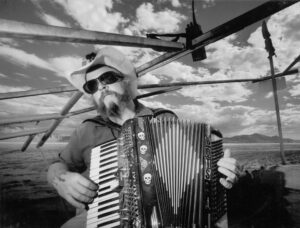
In this interview, Dylan Blackthorn discusses his eclectic album The Riddle Carrys On, unconventional life experiences, accordion-driven music, mystical influences, and his lifelong passion for creativity and collaboration.
1. Your new album, The Riddle Carrys On, brings together traditional jazz, klezmer, Irish folk, vaudeville, and a wonderfully theatrical atmosphere. What was your original vision for this record, and how does it reflect your musical journey so far?
The riddle of life is something we each explore every day, ideally with a sense of wonder. Every new experience is an opportunity to shed the habits and patterns that previously defined who we were. When we can own up to the repercussions of our actions, we wipe our vibrational slate clean and become our more dynamic, empowered selves.
My original vision for the album, that of a 1960s psych-rock aesthetic (but accordion-driven), became shaped by the process of recording and producing this music. By honoring the contributions of these amazingly talented musicians, by the way, some of the best instrumentalists alive today, I followed the flow and then reshaped my own imaginative vision, which is reflected in the themes of this album.
2. Songs like “Whisky & Beer (For the Love Of)” and “Trouble in Moonshine” seem to celebrate adventure, mischief, and old-fashioned storytelling. How much of your songwriting comes from personal experiences, and how much comes from your imagination?
“Whisky & Beer (For the Love Of)” is a song I wrote with a half-Guatemalan chaos shaman named Chains, at an anarchist Mutant-Fest deep in the woods of the Cascadia wilderness of Oregon, some twenty years ago. We made it up on the spot, onstage, while playing a show as Irving’s All-Dwarf Band (in the D&D sense, fantasy dwarves). I codified the verses and structure in the week that followed. How much of that statement can be understood, or believed, is relative to the reader’s own subjective experience of the possibilities of life.
Imagination is our great weapon in the war for reality. As my associate Francis Houston Blakely Suchomel III says, what we imagine to be true can become true. An idea is a real thing, and by our will, we may manifest that idea into reality. That will and passion form the bridge from the imaginary to the real, be it subjective, personal experience or objective experience.
As for the song “Trouble in Moonshine,” it borrows heavily from traditional verses associated with brewing, distilling, and stirring the cauldron. I have known many a moonshiner, and have such characters in my family and personal history. God bless all moonshiners, truly!
The short answer would be: equally.
3. You’ve had an extraordinary journey, from train-hopping and working at Burning Man to co-creating the 999 EYES Freakshow & Surreal Sideshow. How have these unconventional experiences influenced your creativity and the stories you tell through your music?
Experiencing homelessness, living on the edges of society, and feeling fundamentally alienated from institutional forces have deeply informed my perspective and momentum artistically, philosophically, and practically.
When I started working for Burning Man, there were many itinerant laborers involved in the workforce, folks who, like me at the time, were hitchhiking and hopping trains to get from one part of the country to another. Sometimes in search of work or love, but more often seeking adventure. We all shared a wild spirit, a defiant spirit.
That spirit has become somewhat tamed with increasing logistical support from the organization over the past 21 years I have worked there, but the basic experience, from my point of view, is one of being a carnie.
Co-creating the 999 EYES was a miracle of synchronicity and gumption, supported by my wife, Samantha X, the Lobster Girl, Ken Peg-Leg (the Modern-Day Elephant Man), the Dancing Dwarf, the Black Scorpion, and myself. Producing a show that put folks with obviously atypical human forms at the center of the stage really resonated with my experience that the idea of “normal” is a fallacy.
4. The accordion has been your musical companion across countless projects, including Thee Hobo Gobbelins, Mazel Tov Kocktail Hour, and the Joymakers. What makes this instrument so special to you, and how do you adapt your playing to such different musical environments?
The accordion is an instrument that has found a home in many different cultures and contexts. I chose the accordion initially because I loved Weird Al. Ever since I was a small child, I would listen to the Dr. Demento radio show clandestinely, under the covers, when I was supposed to be asleep.
By playing the accordion, I have opened gateways to beautiful musical experiences all over the world, and within myself.
5. Beyond music, you’re also a poet and Tarotlogist, with a strong interest in mystical and spiritual traditions. How do these philosophical influences find their way into your lyrics, particularly on The Riddle Carrys On?
The riddle mentioned in The Riddle Carrys On is the riddle of life. Why are we here? What is my purpose? What should I do with my life? So many aspects to this question, at the heart of our existence.
Each track on the album has numerous references to philosophy, literature, and tarot. These connections are made in my mind and form strong neural pathways aligned with symbolic association, from which my muse draws poetry and music from a divine source, connected to many past and future experiences.
As I say in “Headfull of Song”: “These ghosts are makin’ requests, so you know I’m gonna do my best.”
My audience is limited here and now, but I try to take a wider view, the widest view I can conceive of.
6. 2026 has been an especially productive year for you, with The Riddle Carrys On, Thee Hobo Gobbelins’ For Doom & Drink, and your contributions to the Joymakers’ A Texas-Sized Band. How do you balance these different projects, and what exciting adventures are you planning next?
To be a professional musician, one must be open to many forms of collaboration and innovation, and be ready to play as many gigs as possible. It is required to pay the bills, yes, but beyond that, to offer new creative gifts into the world.
The music we make changes the vibration of this world, resonating into forms we hope will heal the world.
As I am writing this, I am preparing to play a show this Saturday, November 21st, which is a release show for an additional album I contributed to this year, Khuro Ensemble’s Phuro Khuro Vol. 1.
I will play as many gigs and be on as many recordings as possible until the day I die. There is no retirement for me. I will be here singing and playing until my time is done.
Find my bands at the New Braunfels Renaissance Faire in New Braunfels, Texas, December 4–6 and 12–13; at Radio Coffee & Beer in Austin, Texas, December 12; and at the Tiny Minotaur Tavern in Austin, Texas, December 19.
Thanks for the opportunity to share my story!
dylanblackthorn.com – Singer, Songwriter, Composer, Poet, Author, Tarotlogist