
Sacha Mullin
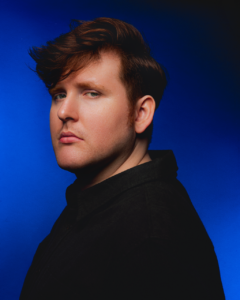
Sacha Mullin discusses his evolving musical identity, the pop influences behind Social Touch, his diverse collaborations, and the experiences that continue to shape his creative journey.
1. Social Touch marks a move towards a more pop-oriented sound compared to your previous album, Casino Wilderness Period. What inspired this change in direction?
I’d say there were a couple of things that encouraged me to lean further into that side of me. One was the honor of being named Best Pop Artist of Chicago 2024 by the Chicago Reader. I felt that if I was going to have such an accolade, I should pursue that actively and in earnest. Another was simply a lifelong love of pop music in general, and I mean that from across the board. There’s a lot of Blondie in my soul, just as there’s a more recent fondness for Slayyyter. I love the idea of pushing the boundaries of accessibility.
2. You’ve explored very different musical styles throughout your solo career, from experimental music to pop, jazz, and rock. Do you enjoy reinventing your sound with every album, or does it happen naturally?
It’s definitely more of an organic thing. I don’t generally set out to do something stylistically specific when I’m writing, unless I’m particularly drawn to something within a certain genre. Even then, I’ll try to follow that direction for a while, almost as a way of presenting my findings to the music I’m making. My music is informed by genres rather than dictated by them. I don’t want to approach something thinking, “This must be (fill in the blank),” and then find myself stuck within a set of boundaries. But I don’t want to be reckless or uninformed either. It’s a balance.
I find a lot of inspiration in inhabiting other people’s songs, almost as an interpreter. Sometimes I’ll even commit to recording a cover version, and that can bring me closer to wherever time and space is telling me to be. I just like to explore!
3. You began recording professionally at just 15, working remotely on projects in Japan. How did those early experiences shape you as a vocalist and songwriter?
When you’re hired to work on a jingle or soundtrack, or to record demonstration vocals, there’s often a very limited turnaround. If you can’t deliver something that reflects what someone is looking for, or what they see in you, you can end up adding time to someone’s marketing campaign, which is an expensive endeavor.
Even though I was very young, I quickly learned to approach things by understanding which reference points might inform my performance, rather than relying on direction that amounts to, “That’s good, but could it be better?” That sort of direction isn’t particularly helpful, but it happens a lot. It’s kind of like telling a graphic designer, “I love what you’ve put together, but can it pop more?” Like, what does that actually mean? (laughs) But anyway, you just have to do your best to sell chocolate in a commercial by bringing that little universe some humanness, thirty seconds at a time.
There’s a lot of professional intuition and aural skill involved. In the present day, whether I’m working on my own music or in a work-for-hire situation, I’ve become pretty good at sussing things out through all sorts of reference points. You kind of have to become a library. Musicians only have so many combinations to work with, so sometimes the initial key to making something your own is inflection and attitude.
4. Your new album features returning collaborator Emily Bindiger. What makes a musical collaboration successful for you, and how do you approach writing and arranging vocals for other singers?
I think for a collaboration to be successful, there first has to be genuine respect between the performers, and I have nothing but high esteem and admiration for Emily as both a singer and a friend.
From there, it’s about understanding what kind of color best suits a song. I know a lot of wonderfully talented musicians, but I don’t want to wedge anybody into a song just for the sake of it. When I approach parts for guests, it’s always from a place of understanding what sort of magnetism I feel in what’s innately coming out of their ability.
Emily’s voice has often come to mind because of its energy, flair, power, and thoughtfulness. Our timbres work really well together, and that feeling of ringing between our sounds is really satisfying.
In the case of “Hypocenter,” I felt it was particularly necessary to ask her to sing on the track because of how propulsive it is. Few singers can handle what I’d need out of a song like that, not strictly because of the acrobatics, but also because she knows how to inhabit so many different kinds of environments and lyrics with great confidence and care.
5. You’ve worked with artists from very different musical backgrounds, including Cheer-Accident, Lovely Little Girls, and Dead Rider. How have these experiences influenced your own solo music?
Those three bands were such different experiences.
There are Cheer-Accident songs for which I was the original singer, which is something I don’t take lightly. However, despite the large cast of characters, the overall experience was less of a collaborative situation and more a circumstance where I had to learn several decades of music and legacy. There was also the responsibility of trying to do right by the songs, the fanbase, and the band itself as it continued to evolve. Things were always dealt with far in advance, and yet always on a whim. You just had to go with the flow, especially because there were often last-minute setlist changes. It was a careful exercise in learning about my own voice while still trying to keep the specialness of the original singers’ intentions alive. I tried my best to honor those recordings while inserting a bit of myself.
Lovely Little Girls, on the other hand, was happening almost concurrently with my time in Cheer-Accident, but the musical responsibilities were entirely different. I was part of a group making huge and risky vocal arrangement decisions with and for three very different singers in a nine-piece ensemble, where everything had to be balanced with extreme care. Dynamics, audibility, taste. LLG pushed me into every part of my range, both literally and expressively.
And then with Dead Rider, I had the privilege of working with Todd Rittmann on two of my solo albums. During the making of one of them, he was also working on a Dead Rider album, and our work together was so open, with such a great amount of camaraderie, that he asked me to sing and write on a few tracks with him. I’m immensely proud of my moments on the Crew Licks album, especially “Bad Humours.” That song sounds like you’re embracing a vortex. Dead Rider has a groundedness to it, even in its surrealism. There’s something very genuine at the heart of it. A lot of the pride I have in my contribution comes not just from the outcome, but from the feeling of immense trust involved in adding to someone else’s work from the ground up.
6. With Social Touch, you’re opening a new chapter in your career. What do you hope listeners discover about you through this album, and what would you like to explore next?
Maybe this sounds a little aloof, but I don’t really think about putting out work as a means of encouraging people to assemble a profile of me. I certainly keep insisting in interviews that I’ve tried to make music for clarity and understanding about my thoughts and intentions, but that also extends to the listener hearing something of themselves in it. People listen to things very differently. Some people are lyrics-driven, some don’t ever glance at a word and just take it in from the sounds, and some are very visual. I hope that however someone takes in my work, they find something to enjoy.
As for the here and now, I’m exploring the experience of almost becoming a Sacha Mullin cover band with a few musicians: Justin Faifer, Matt Precin, and William Parker Wood, the producer of Social Touch. By now, I’ve built a big back catalogue, and so I’m grateful for their time, their talent, and their enthusiasm for performing with me. I love the sounds we’re creating together and the ways we’re interpreting these songs for live performance.
And for what’s next? I can’t show all my cards! I guess we’ll just have to see!