
Michael Moss
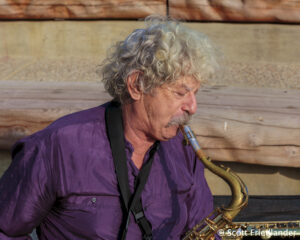
Michael Moss explores the boundaries between jazz, contemporary classical music, and improvisation with Quantum Butterfly, an ambitious four-CD collection celebrating musical freedom, experimentation, and creative discovery.
1. Hello Michael, and welcome to The Interviewist! You’ve spent decades exploring jazz, improvisation, classical music, and musical traditions from around the world. Looking back at your journey, what has kept your curiosity alive, and how has your relationship with music changed over the years?
The jazz musician melds their sound with the sound of the others in the band to improvise in a manner that is faster than thought, at times playing the same note, using the same rhythmic pattern, or the identical musical expression while closing your eyes, listening intently by being one with the sound, going with and shaping the flow. Anticipation is not the secret here. The quantum mechanics concept of superposition metaphorically describes the phenomena more precisely. If there are a multitude of possibilities, and an intensity of energy and concentration, artists interact with their material, their music, their words, their dance partners, their fellow musicians, and the composer’s concept, or the choreographer’s concept, to create elegant art. I am speaking of the psychological, creative process.
The impulse to experience feelings at once old and new has always found its proper receptacle for me in a structure, a concept, a feeling, an image. Energy alone once sustained me, and now a form must grow to nourish fresh lyrical and rhythmic ideas. The music has grown within me and is finding its form within the musicians with whom I play. The concept of “free energy,” energy freed in people playing, creating, requires form. And balance between form and essence permits the flow of the creative spirit to permeate us all. The balance between jazz and contemporary music is the goal, and liberation shall hopefully be the outcome. It was for this reason I first formed Free Energy in 1970, a concept borrowed from both C.G. Jung and the first inception of European orchestras.
2. Your new release, Quantum Butterfly, is an ambitious four-CD collection, with each volume exploring a different musical direction. What inspired you to bring these contrasting projects together, and what connects them in your mind?
I don’t shy away from intensity. I use dissonance, odd meter, and fiery explosive improvisation as well as soft, bluesy, and inside harmonies and meters. Coming from a jazz tradition linked back to the free jazz of the ’60s and ’70s, the musical form is an emergent spiritual energy, mythic in nature, emphasizing the use of orchestral instruments so I call upon the best improvising musicians in New York City today.
It turns out that I love string quintets which inspires me to put together stringed instruments in combination with traditional jazz instrumentation. I love violinists Rosi Hertlein, Elinor Speirs, Jason Hwang, violists Melanie Dyer and Stephanie Griffith, and a pirate’s trove of other modern string players including among others my bassist in ROOTS to SHOOTS Adam Lane. My quest, once I think of it as such— dangerous, innovative, inventive, brand-defying quest—follows a path not traveled by many, into and out of mythos and intensification of the moment.
No boundaries—that’s how I feel about this four cd drop named after a mathematical recursive function, the quantum butterfly, first realized by David Hofstadter in 1976. The objective of the project is to bring jazz icons who formed the roots of today’s jazz into the present. Jazz no longer seems like a cross-over or alternative form of expression to classically trained New York musicians because “the Music” is all-inclusive. Coming from a jazz tradition linked back to the free jazz of the ’60s and ’70s, the musical form is an emergent spiritual energy, mythic in nature, emphasizing the use of orchestral as well as rhythm section Jazz instrumentation. I link together everything I have heard in Sri Lanka and India, Thailand and Hong Kong, Ireland and England, St. Louis, New Orleans, Chicago and the entire musical world found in New York so as to extend the form. If I look at jazz seriously as an animated limb of all music through the ages, as it were, then everything connects from the primitive to the abstract, from animal sounds produced by the ram’s horn (the shofar) to the abstracted musical metamorphic skin enfolding all humanity.
3. Volumes 1 and 4 feature your Roots to Shoots ensemble, performing both original compositions and interpretations of pieces by artists such as Duke Ellington, Charles Mingus, Chick Corea, and John Coltrane. When approaching music with such a rich history, how do you find the freedom to make it your own while respecting what made the original compositions so special?
ROOTS to SHOOTS plays music from the tradition of modern jazz stretching from the ‘30s into the present extending the tradition with my original compositions and arrangements. Pieces include jazz standards by iconic jazz composers Duke Ellington, Charles Mingus and Chick Corea, Eric Dolphy, Mal Waldron, Bill Evans and John Coltrane. By playing South American, African, klezmer and up-tempo jazz we can make a contemporary statement. Playing and improvising with my fellow musicians we can contribute our individual interpretations to the mix and in a sense, imagine how these original artists and composers might relate to the music that has evolved over the past 50 years. I want to bring downtown New York energy to gather us all back together again. We’ve been so spread apart—Covid-19 and a dystopian chaos need to be defeated by creative energy. That is why we are calling this ensemble “Roots to Shoots” to celebrate our musical roots and to bring forth new life.
The question really must be answered from a composer’s fetish with finding new sounds. I heard Giant Steps around the age of 15. I could not at that time play like Coltrane, or hear like Trane, but I could sing to myself the long lines his music inspired within me which I did for hours at a time. I could not fathom the giant intervallic leaps of Eric Dolphy on Iron Man so I turned to Avant Garde classical music to find the connection for myself, and continue to work on his concept in this cd drop. I recently found out that Bird, Dolphy and myself shared an interest in quantum physics. This makes total sense to me now. My music comes from Bartok and folk music, Einstein and bent spacetime, Riemann and Minkowski tensors, Schoenberg and Babbitt. The more complex the better.
Just to keep it simple, my center of the musical universe is dissonance which then extends to just intonation. If you listen to Duke, Trane, Dolphy, even Mingus, and especially Evans from that perspective, you can hear how they, like Bach, Beethoven, and many classical composers played with dissonance. Even an Indian raga has a blue note—that’s the note I want to start from: everything is relative to the blue note. If I can feed jazz’s roots with the concept of decomposition I’m approaching my happy place.
4. Volume 2 takes a very different direction with Ensemble Bows for Strings, Piano and Reeds, bringing together jazz improvisation and contemporary classical influences. Pieces like the 19-minute “Abyss” suggest a real willingness to let music develop beyond conventional structures. How did you approach composing for this ensemble, and what possibilities did the combination of strings and improvising musicians open up for you?
I just have a big range, big ears, a need to explore and a deep love of the blues, modal music, folk music, and world beat and world music, not forgetting Bach, Beethoven, Bartok, Stravinsky and Schoenberg, Babbitt, Nancarrow, Varese, Ellington and Miles. Each of my through-composed compositions can be considered “heads” for which I provide “changes.” Soloists improvise by going holistically in any logical and or intuitive direction to determine the best note to play next in the context of the piece and in relation to the music going on around them and the rhythmic structure.
I began composing Abyss when my wife and I moved into my father-in law’s home (he was a holocaust survivor) to take care of him during the last seven months of his life – it is infused with his spirit. Configured for strings, based on a sestina by Louisa Bieler and Leviticus/Jeremiah in the Third Book of Moses, Abyss expresses the pain and suffering of humanity. I created a piece for a SATB chorus plus string quartet to sing Louisa’s sestina. Her poetry is so intense relating to that suffering, of not only Jews but of all displaced people. This iteration of Abyss does not include the sestina or the chorus. If I ever get a chance to produce Abyss; Forget Being Born Remembering as it was originally intended, I will require a choral leader and a better conductor than I am to bring the essence of the work to life.
5. One of the most intriguing moments on the album is the 25-minute “Quantum Butterfly/Adjacent Possibles,” where you interact with James Dashow’s electronics. How did that collaboration come about, and how does working with electronic sounds change the way you listen, react, and improvise compared with playing alongside acoustic musicians?
ROOTS to SHOOTS presented Quantum Butterfly/Adjacent Possibles: Movement IN Space, Movement OF Space, where your perception of a space actually moves from Here to There, perhaps changing positions. As for our collaboration, Jim Dashow and I grew up on the North Shore of Chicago. Jim had graduated from Princeton, home to electronic compositions and performances by Edgar Varèse. Electronic composer James Dashow creates different kinds of spaces in different parts of the hall, and then sonically moves things around in and among these various spaces—spatial counterpoint coming out of six different speakers in this recording (We couldn’t match up the six speakers we had with two speakers available to us at the time. It is written for eight channels/speakers but here we have six channels.). The audience sits surrounded by six channels so for them spacetime bends and warps as sound takes them into an out-of-body experience—at least that is our objective. Musicians also move around the space during the 15-18 minute composition. A purely abstract pitch structure allows a lot of space for improvisation along with electronics that are derived from or contain the pitch structure. While Dashow provides an electronic phrase, I emphasize what I hear, then compose a sound structure that contains the phrase to provide a platform for improvisation that fits within the entire piece.
6. Throughout your career, you’ve worked with an extraordinary range of musicians and explored musical traditions from different parts of the world. With Quantum Butterfly bringing together so many sides of your musical personality, do you see this release as a reflection of everything you’ve learned so far, or are there still entirely new musical territories you’re eager to explore?
“…sides of (my) musical personality….” Playing is a kind of meditation for me and I go into a trance, eyes closed, one with the music and the musicians around me, working to transport the music and the musicians into an alternate universe. To play A Love Supreme I inhabited the transcribed notes of his album until I no longer needed to play them note for note to express the essence of each movement. I wish I could adequately describe how I do this but I am not a writer.
Yes, Quantum Butterfly is a reflection of everything I have learned so far, and yes, there are unknown paths I am eager to explore just to see what comes up around the next bend or over the next rise. I’ll tell you when I get there—seriously. I will express my aesthetic as my fellow travelers and I are on the path through whatever medium is available to me in that instant.
This release is unique. Every track was played in front of a live audience. None of it was recorded in a studio and you can tell by the way we stretch out and take chances. This is a legacy album of concerts that took place near the end of the pandemic in 2021 to the final concert in 2025. And the level of recording is so high now that amazing sound can be tweaked out of a live recording. I am driven to bring the recording up to that level. In fact, audiophiles who have a high end ATMOS stereo can place themselves in the center of the sound stage of Quantum Butterfly/Adjacent Possibles.
“New musical territories” short list: release Family Threads (working title) cd recorded in 2026 in Portland, Oregon celebrating the 5th Anniversary of my son Ari’s bar, the 13th Moon Gravity Well; record Entanglement::Qaballa with a reconstituted Accidental Orchestra; record Abyss with Bows plus SATB chorus; perform in clubs, festivals in the US and Europe with ROOTS to SHOOTS and Ensemble Bows; basically build incrementally on the structure I have established since Free Energy, and Four Rivers, the New York Free Quartet, the Accidental Orchestra and ROOTS to SHOOTS emerged into consciousness.