
Nicki Adams & Michael Eaton
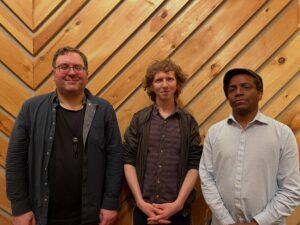
Nicki Adams and Michael Eaton discuss Arrival, exploring adventurous jazz compositions, bassless trio dynamics, improvisation, and the creative chemistry behind their collaboration with drummer Francisco Mela.
1. Nicki, you’ve explored a remarkable range of musical projects throughout your career, from jazz ensembles and film scoring to collaborations with vocalists. How have these different experiences shaped your approach to composition and improvisation, particularly on Arrival?
Nicki Adams: I’ve been exploring the connection between various genres for a long time. I used to play for ballet companies and learned to improvise over Chopin waltzes. Playing with vocalists makes you internalize melody on a different level. You have to hear it so that you can support someone without playing it. I used that ethos to maintain a sense of melodicism within the dense complexity of the album. Film scoring gave me a sense of the power of texture, which is sometimes referred to as the fourth dimension of music, after melody, rhythm, and harmony. In Arrival, Michael and I play with less explored textures.
2. One of the most distinctive aspects of Arrival is the absence of a bassist, with your left hand often providing the rhythmic and harmonic foundation. How did you develop this approach, and how does it influence your interaction with Michael Eaton and Francisco Mela during performances?
Nicki Adams: To build on the idea of texture, the bassless trio offers opportunities for new sound combinations. Because of limitations of the instrument, a bassist would have a harder time playing the rapid succession of eighth note leaps in Arrival or ESP. In ESP, I drew from Messiaen’s Quartet for the End of Time for the bass line, which, in its original form, is played by cello. But it’s not just speed; it’s the sense that both hands carry moving parts, as in a Bach invention. In the Baroque era, keyboardists would improvise bass lines all the time, which was then called basso continuo. I also wanted to explore the possibilities of that register of the piano. And we also wanted the music to swing and be rhythmically compelling. There are several albums without bass that are more ambient and rubato, which can be beautiful as well. We utilized those elements in certain songs (Kupka Disks and Daily Battles), but we were inspired to explore various grooves by the success of the great Lester Young Trio with Nat King Cole and Buddy Rich.
3. Your compositions Arrival and Homage reveal different sides of your musical personality, from exploratory ensemble interplay to freely inspired stride piano. What inspired these two pieces, and what do they tell us about your musical influences and creative identity?
Nicki Adams: For my composition Arrival, there are two contrasting worlds. One is more open and modal, while the other is dense with non-functional harmony, carried by a basso continuo. It’s about tension and release. The modal points allow the soloist to breathe and build. The denser sections create technical hurdles that lead to new forms of interplay. I wanted the piece to have a 12/8 Afro-Cuban feel, partly knowing Mela’s expertise in that style.
Homage is dedicated to the above-mentioned Lester Young Trio. I love swing and was so happy to be able to play with Francisco Mela, who has an incredible swing feel. I wrote that song away from the piano, knowing I wanted some modern harmonic movement in conjunction with an older style. In a sense, it’s a tribute to the unity of this music over time. You can take various 100-year-old stride elements and apply them to modern jazz. The melody was inspired by Joe Henderson, whose compositions often push harmonic boundaries while simultaneously swinging so hard.
4. Michael, you and Nicki previously recorded two duo albums, Paraphrase and The Transcendental. What made you feel that the time was right to expand your musical partnership into a trio, and how did Francisco Mela’s arrival transform the creative dynamic between you?
Michael Eaton : As musicians we like to try different options with instrumentation to explore the possibilities formats generate. We may well have our favorite or preferred formats. Learning about one ensemble format can teach us how to play and write for others. After two recordings, Nicki and I were both thinking along similar lines; whether we might enlarge the duo for our next project. Mela was Nicki’s suggestion, and it was definitely an attractive proposition, because Mela is a master and has had a life in music that gives him a wealth of richness and perspective to draw on.
Adding drums to the trio adds an unpitched sound source. What I might consider is how to use drums to generate another layer of rhythm and color, either in an accompanying role or as its own autonomous part. But then with someone of Mela’s individuality and personality, I ideally want to draw upon his specific voice. Usually this would come after a period of playing together.
At first Mela emphasized the need to integrate his voice into the mix, forming an integrated trio, and although we were only able to do one marathon rehearsal, I think that fusion did take place in the studio. It was palpable towards the end, listening to playback, how things were subtly different than when we started.
5. Your compositions Discursive Formation, Solarity, and Kupka Disks showcase a fascinating range of musical ideas, from angular structures to adventurous swing and extended improvisation. Could you share the inspiration behind these pieces and explain how you balance written composition with spontaneous musical exploration?
Michael Eaton : Thank you sincerely for your interest in these tunes. Discursive Formation is taken from Michel Foucault and “regimes of truth,” and from that, the concept of a discursive formation and later on, a discursive regime. Philosopher John C. Brady defines a discursive formation as “a series of rules of transformation, succession and exclusion for the proliferation of premises, ideas, sentences, etc in a given discourse in a given period” https://epochemagazine.org/25/video-foucaults-discursive-formations/
The idea of a frame of discourse and what it is possible to say in a given time period of culture, politics, science, art, etc; a system of language – these all have applications to twelve tone music. Since one of my more recent musical goals is working with twelve tone music in a jazz setting, I thought of the twelve note totality (symbolically, like a social system) as a musical frame or system of grammar. I also vaguely had Stravinsky’s late music in mind, where the personality and language he was historically known for were integrating into a more serial grammar. Or recall Ornette Coleman’s last recording, Sound Grammar. All the written music of Discursive is twelve tone, but when we reach the improvisation, it is a lot more open. It highlights the interplay between a determined framework versus what happens (spontaneity), and the choices we make, when we improvise.
Solarity is based on a book called Solarities from University of Minnesota Press, and principally the idea of organizing society around solar energy production, which is in my mind very appealing. While I don’t align with everything in the book, the concept opens a door to innumerable possibilities. The tune itself abstracts the jazz standard “Solar” and reworks it with more chromaticism and a twelve tone send off at the end of the melody.
Kupka Disks is inspired by a painting called Disks of Newton by František Kupka. What is interesting to me is how the piece so dynamically depicts motion – a blur of two fast moving discs – so the subject matter has a kind of materiality and realism but also an abstraction in terms of the blur produced by the disks. To me this does two things at once; it ends up being a contemplation on laws or principles of motion but also viscerally physical in effect, and the painting is transitional piece between a realist or representational perspective and the abstraction the historical period was moving towards.
6. Alongside your original compositions, Arrival includes your arrangement of Thom Yorke’s Daily Battles, a particularly intriguing choice for a contemporary jazz album. What drew you to this song, and how did you approach transforming its melancholic atmosphere into the trio’s own musical language?
Michael Eaton : Despite my interest in “art music” or the abstract side of things, I do like the idea of playing and rearranging pop music or music in the air. I was introduced to music from Motherless Brooklyn by someone dear to me, and I immediately felt a resonance with the poignancy and angst in Thom Yorke and Flea’s version of Daily Battles. However, there is another version of Daily Battles on the soundtrack, played as a jazz ballad by a quintet with Wynton Marsalis, and it is, in a word, crushing. I aspire to the level of expression Wynton achieves playing ballads.
The title suggests so many psychological and social interpretations, either living in New York City or anywhere, especially in the late capitalist world. I wanted to do something different with the song, so I changed the chords somewhat, and I added a loop at the Coda (ending) that is atonal, like something by, say, Dave Liebman or Alban Berg. I wanted a change of mood but also a new event that we haven’t heard before to take place at the end, at the point where normally we might think the song is finished, where it could propel us to dig in and burn as improvisers.