
Jason Kao Hwang
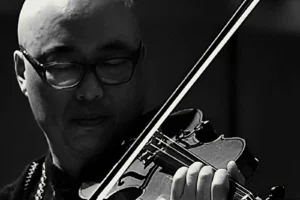
In this interview, Jason Kao Hwang explores Second Life, discussing improvisation, artistic freedom, musical transformation, and the creative chemistry behind the Human Rites Trio’s adventurous sound.
1. Second Life marks your second recording with the Human Rites Trio, alongside Ken Filiano and Andrew Drury. After more than two decades of playing together in different settings, how has your musical relationship evolved, and what new creative possibilities did you discover while making this album?
We continue to build a creative trust and ensemble memory that deepens our musical purpose and opens our creative freedom. We know each other’s voice and language, which deepens our capacity to interact.
With Second Life we found new ways to break through the structures of the score so that the transitions are seamless. We “land” in the next section of notation through improvisational means. In my “classical,” full notated compositions I will write transitional passages with great specificity. For the Human Rites Trio, often the movement forward is as an act of nature generated by the agency of each musician rather than the performance of notation. This has taken years of ensemble experience to reach as far as we have. We have much further to go! Our recent West Coast tour revealed many new possibilities that will inspire my next set of compositions. I heard our individual and collective growth.
2. One of the most fascinating aspects of Second Life is how carefully arranged passages can sound completely spontaneous, while collective improvisations sometimes feel almost composed. How do you approach this balance between structure and freedom, and how much room do you intentionally leave for unexpected developments?
I strive to compose music that is essential. No note can be added or deleted to any melody or passage or riff. The score is a pure entity that propels the improvisations in which we extend the language of what is composed, like the rhythms, intervallic relationships, textures, and harmonic implications. This intention blurs the borders of composition and improvisation and forges the flow that underlies the diverse compositional changes.
We love unexpected developments! Every performance should be different. Living the music rather than executing predeterminations is liberating. The music empowers the individual voice of each musician to explore the unknown. We performed the music on the CD for several years before recording, making many unexpected discoveries that eventually became the language of the composition.
3. Andrew Drury brings an extraordinary collection of percussion instruments to the recording, including gongs, metal bowls, shells, and even unconventional everyday objects. How did these unusual textures influence your compositions and the interaction between violin, bass, and percussion?
In the past few years Andrew has really expanded his palette. All this is his creativity that he offers to The Human Rites Trio. I rarely make specific request. The entire array of sounds is his voice. Andrew experiments in rehearsals. When we record, he might try different percussion instruments on different takes to discover how the musical narrative is impacted. He is very sensitive to range, texture, and sonic image. Sometimes I or we suggest or decide upon instruments for certain passages but more often, he improvises with each performance. When none of us knows exactly what we’re going to play next, the trio is immersed into the spontaneous moment.
4. The four compositions explore remarkably different emotional landscapes, from the rhythmic energy of “Galaxies Twist Under Before It” to the more reflective atmosphere of “What to Keep, What to Let Go” and the intensity of “Ricochet.” What personal experiences, ideas, or artistic questions inspired these pieces?
Sometimes I think of each instrument as a character undertaking a transformational journey. The composition is a landscape. Or the composition is a house with many rooms. It is a poetic form, the workings of the unconscious. It is a film with parallel cuts, close ups, and master shots. I also might think about someone or a personal experience that will drive the compositional process. At a certain stage, the title of the music will come to mind. The implications of the title can be a guiding force.
5. The title Second Life suggests transformation, renewal, or the possibility of experiencing something familiar from an entirely different perspective. What does this title mean to you personally, and how does it connect to the musical journey unfolding throughout the album?
As I enter my senior years, I am reflective of the life I’ve lived. I think of loved ones lost, the years of struggle, both in life and music, as well as cultivating an appreciation of my many blessings. Second Life embodies these reflections while moving forward with determination. Each sonic moment is an affirmation of transformation, a personal revolution.
6. Your career has taken you from classical violin studies into adventurous jazz, free improvisation, chamber opera, and experimental ensemble compositions. Looking back at this remarkable journey, how has your understanding of artistic freedom changed, and what directions are you most interested in exploring next?
Artistic freedom is giving yourself permission to be yourself. Validation from the music business is not important. It will be whatever it is. To give yourself the freedom to create from the heart is the goal. Truth seeking will generate new language, which inspires hope. With hope we can change ourselves and the world. I’m cultivating a total language without fealty to genre, because that is who I am as an Asian American. In my early years, influenced by the free jazz scene, I rejected adherence to traditional music systems. I needed to do that to detach myself from the false narratives society had imposed upon me. Now, my music embraces free improvisation but also utilize harmonic cycles, intervallic constructions, grooves, and other aspects of traditions. Each modality creates a vibration that can contribute to the fulfillment of my vision, my story.
This past summer I recorded with my electric trio, Critical Response, which features Michael T.A. Thompson (drums), Anders Nilsson (electric guitar), and myself on electric violin. I also recorded a new quintet, Resonance, which again features Andrew Drury (drum set) and Ken Filiano (string bass) plus Christopher Gordon Forbes (piano) and Bryan Carrott (vibraphone). I play both violin and viola. Both recordings will be released in 2027.
I’ve composed a new set of music for my old quartet EDGE, which features Ken, Andrew, and Taylor Ho Bynum (cornet/flugelhorn). We’ll record in the next year. I have an idea for a new octet that features Resonance plus pipa, gayageum, and cello. The Momenta String Quartet included my composition “If We Live in Forgetfulness, We Die in A Dream,” on their CD, “New Americana,” which was just released. I hope to compose more string quartets and theater works in the future.