
Elias Dream
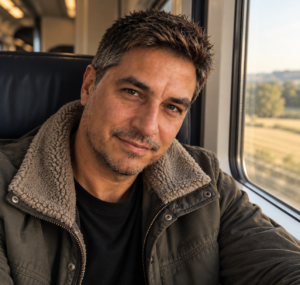
Elias Dream blends pop, soft rock, and cinematic elements into heartfelt storytelling. In this interview, he discusses love, life experiences, Hammond organ, AI, and musical authenticity.
1. “Forever by Your Side” is built around themes of devotion, human connection, and emotional storytelling. What inspired the story behind the song, and what did you want listeners to feel when they reached the end of it?
I think the older you get, the more you realize that love isn’t really about the big romantic moments. Those are wonderful, of course, but they’re not what keeps two people together.
It’s the ordinary days. The difficult conversations. The times when things aren’t going well, but you still choose to stay.
That’s really where “Forever by Your Side” came from.
I’ve reached an age where I’ve seen quite a bit of life. I’ve made mistakes, I’ve hurt people, and there are things I wish I’d handled differently. I can’t change any of that. But I think those experiences have changed the way I look at love.
When I wrote the song, I didn’t want to tell another perfect love story. I wanted to write about a promise that actually means something, even when life gets difficult.
And if someone listens to it and thinks about the person who’s been there for them through everything, then I’ve achieved what I wanted.
2. Your music blends contemporary pop, soft rock, and cinematic elements rather than following a strictly defined genre. How do you decide which musical elements best serve the story you want to tell?
I don’t really sit down and think, “Okay, today I’m going to write a pop song or a rock ballad.”
Usually, I have a story in my head first. Sometimes it’s just a sentence or a situation that won’t leave me alone.
Then I start thinking about how that story should sound.
Some songs don’t need much. Just a piano, maybe a bit of Hammond organ, and a voice that sounds almost like someone talking to you.
Other songs need to build slowly until everything comes together at the end.
I actually like that contrast. Starting with something very simple and letting the music grow as the emotions become stronger.
I also don’t mind mixing different styles. If a spoken passage tells the story better than singing, I’ll use it. If a guitar fits better than a piano, that’s fine too.
I don’t think a song should have to fit into a particular box.
3. The Hammond organ is a particularly important part of “Forever by Your Side,” and you performed those parts yourself. What attracts you to the Hammond sound, and how does it contribute to the identity of Elias Dream?
Oh, the Hammond! That’s a bit of a love story of its own.
I started playing keyboards when I was young and even did a few small live performances back then. Music was always part of my life, although there were years when other things took priority.
I’ve loved the sound of a Hammond organ for as long as I can remember.
There’s something about it that I can’t quite explain. It can sound warm and gentle one moment, and then almost scream the next.
And somehow, it never sounds cold or artificial to me.
A while ago, I actually found an original Hammond organ in the classifieds and bought it for next to nothing. I couldn’t believe my luck.
I still have it, but for my recordings I use a digital Hammond instrument. It’s simply much easier to work with when you’re producing music on a computer.
What matters to me is that I can play those parts myself and put my own feeling into them.
I think the Hammond has become part of the Elias Dream sound. Not because I planned it that way. I just love playing it.
4. You describe songwriting as storytelling first, with melodic vocals, atmospheric instrumentation, and sometimes spoken or rap-influenced passages. How do you approach the balance between lyrics, vocal delivery, and music when building a narrative?
For me, the words have to mean something.
I sometimes spend hours changing just one or two lines because they don’t sound like something a real person would actually say.
And I really dislike lyrics that rhyme perfectly but don’t make any sense.
I’ve written songs where a spoken passage feels much more powerful than a sung chorus. Sometimes a simple sentence, spoken almost quietly, can hit you harder than a whole orchestra.
I try to imagine someone sitting across from me, telling me what happened to them.
How would they speak? Where would they hesitate? Would they really use those words?
That’s what I keep asking myself.
The music should support that feeling, not get in the way of it.
And sometimes that means taking instruments out instead of adding more.
I think silence can be just as important as the notes you play.
5. Generative AI was used during the creation of some of the stems, but you then arranged, developed, performed, mixed, and mastered the track yourself. What was the creative process like, and how important was the hands-on work in shaping the final version?
I don’t make a secret of using AI in my music. But I only use it when I genuinely feel it makes the music better.
I was playing keyboards as a teenager, long before anyone was talking about artificial intelligence in music. And that love of making music myself has never gone away.
Of course, today’s technology gives me possibilities I could only have dreamed of back then. But just because something is technically possible doesn’t mean it’s necessarily right for the song.
I experiment a lot, throw ideas away, change arrangements, and play my Hammond parts myself. I also spend hours on mixing and mastering, sometimes fixing little things that probably nobody else would even notice. But I notice them, and if something bothers me, I have to go back and work on it.
AI can help me explore new ideas or find a sound I might not have been able to create otherwise. But if I don’t like the result, or if it doesn’t add anything to the song, I simply don’t use it.
At the end of the day, what matters to me isn’t which technology was used. It’s whether the music expresses what I’m trying to say.
And one thing is really important to me: I want to be able to stand behind every song I release. Otherwise, it wouldn’t feel like Elias Dream to me.
6. “Forever by Your Side” explores a very human emotional world, while your broader work also touches on love, loss, difficult decisions, and defining moments. Looking ahead, what stories or emotions do you feel compelled to explore in your next releases?
There are still so many stories I’d like to tell.
And to be honest, the older I get, the more interested I become in the things people don’t usually talk about.
Regret, for example.
Those moments when you look back and think, “Why on earth did I do that?”
Or the things you never said to someone when you still had the chance.
I’ve been working on songs that deal with exactly those feelings.
But I don’t want every Elias Dream song to be sad. Life isn’t only about losing people or making mistakes.
There’s also hope. Falling in love when you thought that part of your life was over. Finding happiness in something completely unexpected. Or simply realizing that you still have time to change things.
I think that’s what keeps me writing.
I’m not twenty anymore, and I don’t want to pretend I am.
I’ve lived a little, made my share of mistakes, and hopefully learned a few things along the way.
And I suppose Elias Dream is my way of turning some of those experiences into music.
I don’t know how many people my songs will eventually reach.
But if someone listens to one of them and thinks, “Damn, that’s exactly how I feel. I just never knew how to put it into words,” then that’s worth more to me than any number on a streaming platform.