
David Borgo
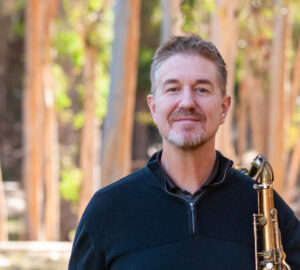
In this interview, saxophonist and composer David Borgo explores Panta Rhei, blending jazz improvisation, Stoic philosophy, diverse musical traditions, and emotional storytelling into a creative journey celebrating change, spontaneity, and artistic discovery.
1. The title Panta Rhei, meaning “everything flows,” draws inspiration from the philosophy of Heraclitus and the idea that change is the only constant in life. What led you to explore this concept through music, and how does it reflect your personal approach to composition and improvisation?
My first important epiphany about jazz music came when I was about 13 years old, as I was practicing out of the Omnibook, a collection of transcriptions of Charlie Parker’s saxophone playing assigned to me by my teacher. I would diligently read the notes on the page as if they were composed études. As I started to dive into Charlie Parker’s recordings, however, I was astonished that he could produce dramatically different yet equally compelling improvisations on the same tune, night after night, or take after take. I think a desire to be “in the musical moment” as much as possible when I’m playing stems from that epiphany.
In a way this album brings together two of my passions: jazz music and Stoic philosophy. These two traditions are also among the most maligned or misunderstood, in my opinion. Jazz music foregrounds spontaneous creation and in-the-moment interactions, but many detractors assumed (often for racist reasons) that the music lacked discipline or skill, or that it relied purely on instinct and unbridled emotion. Stoicism, by contrast, is often misunderstood as “emotionlessness.” But Stoic philosophy is about virtue, happiness, right action, and internal motivation. The Stoics confronted perennial questions about the best way to live, about how to understand our place in the world, and about how to deal with the things we cannot change.
Heraclitus was a pre-Socratic, but his enduring metaphor of the river that remains the same because the water keeps moving resonates with my views on jazz and improvisation. Change is what gives them their identity. I think of my compositions as musical “rivers” with an emergent identity that is inseparable from their ongoing interpretation.
2. For this album, you assembled a remarkable quartet featuring pianist Josh Nelson, bassist Luca Alemanno, and drummer Dan Schnelle. The recording places particular emphasis on dynamics, space, and musical interaction. How did you develop the chemistry within this ensemble, and how much freedom did you give the musicians to reshape your original compositions?
I was very fortunate to record with these three world-class creative musicians. They are consummate artists with big ears and open minds! Knowing how much they always bring to the musical moment, I aimed for compositions that would engage and challenge them while leaving ample space for interpretation, exploration, and interaction.
After Ralph Towner “joined the ancestors” earlier this year, I spent some time exploring his compositions, and his approach to harmony in particular. A few of my compositions owe a debt to this process, although I think any connections are more on an emotional than a technical plane. Over the years I’ve been inspired by the “ECM sound” that places a premium on listening and on musical dynamics and space, among other qualities. I was hoping to capture some of that ‘vibe’ on this album and the musicians brought to the session an incredible level of empathy and intensity of purpose.
3. Several compositions explore contrasting emotions and musical landscapes, from the melancholy opening of “Farewell” to the energetic intensity of “Dark Days,” which reflects the chaos of today’s world. How do personal emotions and contemporary events influence your writing, and what do you hope listeners will experience through these contrasting pieces?
As a music academic, I’ve been exposed to lots of different analytical approaches to musical sound and creativity. However, the academy has tended to downplay the importance of emotions to musical understanding, and to human cognition more generally (despite the fact that most folks would rate emotion very high on a list of why they listen to music!).
When I compose I sometimes begin with a certain music theoretical idea to explore, but I’ve never wanted my music to be abstract for the sake of abstraction. To me, emotions are paramount! I like to compose a variety of material for any given project, which tends to mean the music explores a wide range of emotions (because emotions are influenced by tempos, dynamics, harmonies, melodies, rhythms, and so much more!).
I also find myself sitting down to compose music at particularly emotional times for me. “Farewell,” for example, was composed after my son and I had just spent several days in the mountains before he went off to college. I was grateful that we had the quality time together, but also sad to send him off. I was bidding him farewell, but also happy for him to ‘fare well’ and do good things in the world as an emerging adult, so the music captures, for me, these complex, even conflicting, emotions.
Susanne Langer, an important music philosopher, described music as an “unconsummated symbol.” Music, for Langer, symbolizes the patterns and contours of emotional life—such as tension, release, growth, and decay—without pointing to a specific object or dictionary definition the way words do. And yet we are stuck with words when trying to describe music! (what Charles Seeger called the “linguocentric predicament”)
4. On “Málaga,” you introduce the gaita chuana, an instrument combining Western and Indigenous Colombian flute traditions, while “Longing” features the Irish low whistle. What attracts you to these instruments and their cultural backgrounds, and how do they expand your musical vocabulary beyond the saxophone?
I first became interested in the field of ethnomusicology after hearing recordings of non-Western flutes, such as the Japanese shakuhachi, the Indian bansuri, the Middle Eastern ney, and the Native American flute, among others. There is something sacred about the sound of the breath, and the flute is surely one of the most ancient musical instruments, whether made of bone or bamboo. In a sense, all wind instruments share the idea of modifying or transforming the breath. Learning about these traditions and instruments has given me a greater appreciation of the importance of sound—of timbre—in music. Ultimately, it’s not the notes that matter the most, it’s their sound! (a lesson Miles Davis imparted well)
As an ethnomusicologist, I’ve also developed a certain humility towards other musical traditions. It takes a lifetime to master a single musical tradition, much less several of them! I have spent enough years with Irish whistles to feel relatively at home in that tradition. And I’ve also gravitated toward exploring interesting head joints with the Western concert flute, to expand my timbral palette and to give exposure to instrument makers whom I greatly admire. We often think the world of acoustic musical instruments is somehow closed, but there are many creative folks coming up with new ideas and new designs every day, sometimes drawing on traditional knowledge, sometimes exploring new frontiers! The gaita head joint that I used on the record is made by Julio Alcázar in Medellín, Colombia.
5. Your composition “Stray Thoughts” draws inspiration from Billy Strayhorn’s distinctive harmonic language, while other pieces incorporate Latin, classical, and modern jazz influences. How do you approach integrating these different traditions into your own compositional identity without losing the spontaneity that defines your music?
Where do our influences come from, and how do they express themselves? I’ve been fascinated by this question for some time. It seems clear to me that creativity is never fashioned from whole cloth. We all have a lifetime of exposure to sights, sounds, smells, and more, and these surely come through when we are being creative. Even to evaluate something as ‘creative’ it must exist in an ‘art world,’ so to speak, in which it can be understood in relation to other examples.
I’ve always loved the jazz tradition for the way that it simultaneously honors its past, invites present-tense creativity, and embraces innovation. These things do not have to be in conflict.
Harold Bloom wrote an influential book in 1973 titled The Anxiety of Influence, in which he argued that artists are wrought with anxiety over the fear of being overshadowed by past greats. But ethnomusicologists know that this view of creativity is not universal. In a 1990 article titled “The Joy of Influence,” John Murphy focused on how jazz musicians often make their influences obvious and celebrate their debt to their precursors through musical “quotation,” among other things. And Jonathan Lethem, in a 2007 essay titled “The Ecstasy of Influence,” argued that forms of “sublimated collaboration” are essential to the creative act. I tend to agree.
6. Beyond your career as a saxophonist and composer, you’re a professor at UC San Diego and the author of Sync or Swarm: Improvising Music in a Complex Age. How have your academic research and experiences as an educator influenced your understanding of improvisation, and what new creative questions are you hoping to explore after Panta Rhei?
I imagine a few of my previous answers gave some sense of how important academic study has been to my evolving worldview! Although I certainly appreciate musicians who demonstrate spectacular technique and ability, I have always been most attracted to those artists who are spectacularly interesting and not merely impressive. To be interesting as an artist, for me at least, means one is thinking long and hard about what it is they do and why they (and others!) do it.
A career of the mind seems to suit my disposition well, but one thing that I have learned from my academic studies is that we should continually challenge dichotomous thinking: reason vs. emotion; nature vs. nurture; mind vs. body; individual vs. society, talented vs. untalented, etc. Cognition, and by extension creativity, happens at the nexus of brain, body, and world. Music fundamentally emerges from and engages this nexus. Certain musical examples or forms might seem to speak more strongly to one facet than the others, but if they are inseparable, as I believe them to be, then this may be nothing more than a distortion or illusion. One thing is certain; Music will continue to flow!
I am working on another “suite” of compositions that explore a variety of emotions using what I’ve been calling “art rock” harmony and rhythms. Things are pretty far along and another recording session is already in the works!