
Sufia Giza
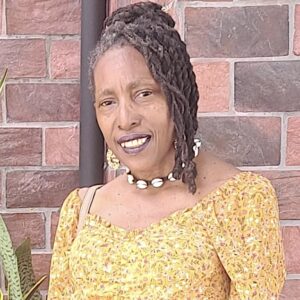
Sufia Giza is an Indigenous author, historical researcher, and dub-poetess whose forthcoming roots reggae album, Echoes of Freedom, pays tribute to her Muskogee Creek and Gullah-Geechee ancestors. Blending poetry, reggae, and historical reflection, her work explores cultural identity, ancestral memory, resilience, and the healing power of storytelling.
1. Your forthcoming album, Echoes of Freedom, brings together your work as an Indigenous author, historical researcher, and dub-poetess. What inspired you to translate your exploration of ancestry, identity, and historical memory into a roots reggae album, and what do you hope listeners will take away from it?
First, Echoes of Freedom is my lyrical homage to my ancestors, both Muskogee and Gullah-Geechee, for without their resilience and sacrifice, there would be no me/we. I’ve always been very connected to my Gullah-Geechee culture and picked up the language at a young age, when my grandmother, Pigeon, and my twin cousins came to California from South Carolina to live with us for a year. They did not speak English, so I picked up the Gullah language and became their translator. They inspire me, and this work is simply an extension of them.
My prayer is that while people listen to and enjoy the smoothness of roots reggae rhythms, they will also hear the words and be encouraged to engage in further conversations. I want folks to think critically about the world we live in, look at the stories that made them who they are, and hold on to memories or feel free to make new, more meaningful ones. I grew up biculturally in the barrio, on the Eastside of Riverside. At the age of nine, I was learning a Spanish word a day from my best friend DeeDee’s mom, my Tia Paulina. Tia is the Spanish word for aunt. She also taught me how to make homemade tortillas and other aspects of the culture. After more than 50 years, I’m still friends with DeeDee.
2. The “Quantum Nonsense” video trailer premieres on Indigenous Peoples’ Day and explores the complex history of Black people in Indian Country. Why was it important for you to address this often-overlooked intersection of Indigenous and African American history, and how does the song challenge conventional historical narratives?
Most of what I do in my art is translate what I’ve observed or experienced. I began charting our family’s genealogy in 1992, using names and family information my mother had gathered from her Aunt Addie. I drew a large family tree showing my great-grandfather Joseph McQueen, his wives, their children, and the generations that followed. That tree is still meaningful to our family; a cousin in Seattle recently asked me for a copy. In my book, I trace our heritage back eight generations, and my Muskogee (Hadjo) genealogy now goes back over 11 generations on Turtle Island.
In 2017, I tested with 23andMe and then AncestryDNA. A paternal uncle and a maternal uncle also tested so I could compare family results. I then used GEDmatch to explore DNA matches, migration patterns, and ancient DNA comparisons. Those explorations helped guide my research into Beringia and Siberia. I discuss the ancient DNA comparisons on page 19 of my book, Moundbuilders of Ancient America: A Legacy Reclaimed. That part of my research is separate from the family genealogy I have been tracing for decades.
In 2020, during the pandemic, I had an eye-opening and deeply humiliating experience in a Social Distance Powwow Facebook group. After sharing a prayer for elders and front-line workers, who were dying in very high numbers at the time, I was questioned about my ancestry and asked what qualified me to offer prayers. Despite sharing my family lineage going back over 11 generations—which I should never have been asked to do—the attacks continued. Then, when I asked who they belonged to, I was blocked from posting and banned from that group. Only one woman came to my defense and asked them to stop “dog mobbing” me, but it was too late. So I have experienced anti-Blackness in Indian Country. In this case, the oppressed became oppressors.
I peel back the layers of history from my Red Stick Creek ancestors’ perspective. My research describes my ancestor, Talmuchees Hadjo, also known as Peter McQueen, as a traditionalist who resisted settler colonialism and the loss of Muskogee land and culture. In researching that history, I also explored Benjamin Hawkins’s role in the Americanization policies of the period. After the 1814 Battle of Tahopeka, known as Horseshoe Bend, Talmuchees fled to Florida, where he continued his resistance alongside the Seminoles.
I discuss the battle on page 33 of my book and the displacement following the 1814 Treaty of Fort Jackson on page 115. The treaty took approximately 23 million acres of Creek land. In my family’s story, I understand that period as the beginning of our ancestors’ displacement—a history that preceded the later Indian Removal Act and the removals associated with the Trail of Tears. My genealogy and historical research have helped me connect with these ancestors and given me a voice to tell their story.
3. Your Muskogee Creek and Gullah-Geechee heritage plays a central role in your artistic identity. How have these two cultural traditions shaped your understanding of belonging, resistance, and storytelling, particularly in the context of your life between Charleston and Tobago?
Despite being the only one in my family born in California, I’m the torchbearer of our Gullah-Geechee culture, so to speak. When I was nine, my grandmother chose me to learn how to make her buttermilk biscuits, which I still make to this day. In the early ’80s, at 19, I went down South on a Greyhound bus to a family reunion at our old homestead in Wassamassaw, South Carolina, a Native American Designated Community. Our McQueen family has owned the land since 1898. That’s when I started actively listening to the stories. In the ’90s, I began videotaping our visits and reunions. When I moved from Southern California to Columbia, South Carolina, in 2005, I spent lots of time with my family in the Lowcountry, near Charleston, gathering more documentation. I also started mound trekking in 2009, taking friends to explore, pray at, and experience South Carolina mounds. In 2013, after burying my mom, we visited Toltec Mounds in Arkansas. My Sistafriend, Schalisa, who had recently lost her husband, and I went to the burial mound and prayed as I burned sage. It was a way of moving through our grief together.
I went to Trinidad and Tobago with a friend for Carnival in 1990, during a tumultuous and painful period in my life that I call the “Struggle Years.” After receiving my master’s degree in cross-cultural counseling and working as a bilingual child protection social worker, I had a terrible car accident on the job that left me with three herniated discs. I had to fight for workers’ compensation benefits and rehabilitation. Bob Marley’s music became my daily mantra. Before depositions, I would listen to “Get Up, Stand Up.” When I finished, I would listen to “No Woman, No Cry.” For years, my Sistafriends and I followed the Southern California reggae circuit. I also produced and hosted SANKOFA Times TV in South Central Los Angeles for 11 years, covering the annual Bob Marley Day Festival and later co-hosting and hosting its pre-concert press conference at the Long Beach Arena.
The warmth and acceptance I found in Trinidad and Tobago helped me heal on so many levels and gave me strength to return to America and keep moving forward. In 1999, I returned to Tobago for Carnival and fell in love with that pristine paradise. I returned to Los Angeles determined to move to Tobago to study medicinal herbs. I sold my furniture and moved in with my Sistafriend, Schalisa, and her family for six months to save for the move. In January 2000, I left LAX for Tobago and stayed for six months before returning home to a sick family member. My mom even visited me there. It was great sharing my island life with mama. Tobago is my “Slice of Paradise.”
On my first visit to Tobago, I had a live poetry radio program, Sufia’s Symphony, from Brotha Angalifu’s KUUMBA show on KPFK radio, digitized from a cassette tape. That became my first CD, which I sold while doing spoken-word and open-mic sets. In 2017 and 2018, I performed poetry with music from my SANKOFA Times album at the Tobago Jazz Experience. For six years, I’ve taught a children’s poetry-art workshop at the Bocas Lit Fest in Port of Spain, Trinidad. I live poetry as much as I love it. Echoes of Freedom is my second roots reggae album on the Unity Works music label, so this is not new to me. At my wedding in 2008, I came out to Wayne Wonder’s “Will You Marry Me.” Reggae is my gospel music, the good news. That gives you some idea of how much reggae is a part of my life.
4. “I Went to Church Today,” scheduled for release on November 2, was written during the grieving process following your mother’s passing. How did creating this deeply personal song help you navigate loss, and what significance does releasing it on the Day of the Dead hold for you?
Writing this piece by the side of the water was so cathartic—to use a term from my psychology days. It was a release of some pain. Not entirely, but it brought a huge feeling of relief. Hearing the water, blended with my tears, felt soothing to me. It shifted some of the grief, and I felt lighter. I had never thought about releasing “I Went to Church Today.” In 2024, after returning from Bahia, Brazil, where I received my Kemetic (Ancient Egyptian) yoga teacher certification, I was home in LA visiting my producer, Jah-Eye. He asked if I had any new poetry. After I shared the piece with him, he thought it was worthy of laying down on a track with one of his beats. And as they say, the rest is history. It was one of those “one-take wonders.” Having grown up biculturally in my barrio/neighborhood around Chicanos, Mexicans, and Latinos, I had seen how they pay respect to their ancestors on the Day of the Dead. In Los Angeles, there are huge celebrations in the cemeteries. Releasing the song on that day just felt right. Reverence is not worshipping our ancestors. Honor is not negative, and that’s why releasing this song on the Day of the Dead resonated with me.
5. Echoes of Freedom features contributions from respected reggae musicians, including Carlton “Santa” Davis and Lesterfari Simbarashe, with production by Jah-Eye. How did these collaborations influence the album’s musical atmosphere, and how did you balance the traditions of roots reggae with your distinctive approach to dub poetry?
In my humble opinion, Jah-Eye is a musical genius whose music collection spans various genres, but his reggae collection is incredible. Because of his early years of listening to those foundation artists, he has an excellent ear for how the music should sound. Our journey developed very organically, starting in 2003. He’s always had such amazing beats that my words have just meshed so perfectly with the music. When we first started recording, many songs on our SANKOFA Times album were ‘one-take wonders’. His production is so solid, and he gives me free rein lyrically. He pulls together such complex, yet sweet rhythms and I’m so honored to be able to express myself so freely. It’s an honor to have legends bless my album, like Carlton “Santa” Davis, whom I’ve listened to from the early days, when he played with Bob Marley and Peter Tosh. And I saw Lesterfari playing all over Southern California and on stages like Long Beach Arena, with some of the biggest reggae bands in the world. Baba Lesterfari also played with the band Boom Shaka, which was like the house band for the pub on the campus of UC Riverside, so we go way back.
6. The album arrives on December 31, coinciding with Kuumba, the Kwanzaa principle of creativity. Looking beyond this release, how do you envision your music, poetry, books, and documentary filmmaking working together to preserve cultural memory, encourage healing, and inspire meaningful conversations between generations?
Great question. My prayer is that this discourse continues between families and friends—that it becomes an intergenerational conversation, with young people asking questions and elders answering them honestly. No matter what it is, you cannot heal it until you feel it. You can’t heal it until you name and/or claim it. So I hope this is a catalyst for self-reflection and growth, whatever that may look like. My goal is to encourage us to reflect upon who we come from and the stories we have been told, both the truths and untruths, and see how we play a part in that story or redefine it for our own benefit. We have the ability to retell the story correctly. We have the ability to center ourselves, reclaim what’s been lost, and move forward. Believe me, I know loss. I spent 10 years in college working toward a career and lost it all after a work-related injury left me permanently disabled in 1989. My first roots reggae album (2009) was called SANKOFA Times for a reason. SANKOFA is an Akan word from West Africa that, to me, means “reclaiming what was lost and moving forward.” That was the name of the TV show I produced in Los Angeles from 1996 to 2007, and that concept continues to inspire my work. During those “Struggle Years,” I reclaimed my ability to walk, one step at a time, moving forward with wisdom from the past. My art is my love offering to this world.
Afro-Indigenous Heritage & Wellness Hub – Sufia Hadjo Giza – Summerville