
Mick Rochford
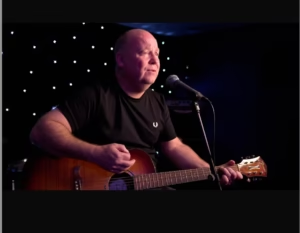
Singer-songwriter Mick Rochford discusses the emotional honesty behind “Loving You,” his journey from drummer to solo artist, and the personal experiences shaping his forthcoming album.
1. “Loving You” explores the painful moment when you can still love someone while realising the relationship may no longer be working. What personal experience or emotion sparked the song, and how did you approach turning something so difficult into music?
“Loving You” came from a very real place. It’s about that point in a long relationship where you can still love somebody deeply, but you start questioning whether love on its own is enough.
I think that’s something a lot of people experience but don’t always talk about. You can have years of memories, a family, good times and bad times together, and still reach a point where things have become incredibly difficult.
Writing the song was my way of processing those emotions. I didn’t want to blame anybody or make one person the villain. The line “Loving you is so hard to do” really captures it for me. You can love someone and at the same time be hurt, exhausted or unsure where the relationship is going. Sometimes the simplest words say the most.
2. The song also looks at the contrast between how relationships appear publicly and what can actually be happening behind closed doors. Why was that idea important for you to explore, particularly in an era dominated by social media?
Social media gives us a snapshot of people’s lives, but it’s usually the snapshot they want us to see. You see the holiday, the anniversary dinner, the smiling photograph or the happy family moment. You don’t see the argument in the car beforehand or two people lying awake at night wondering what happened to their relationship.
I think we’ve created this pressure to present a perfect life, and relationships are part of that. Sometimes the couples who look incredibly happy online can be going through enormous difficulties privately.
That was important to me with “Loving You”. I wanted the song to say that you never really know what someone else is dealing with behind closed doors. There can be love there, but also loneliness and pain.
3. Your previous single “Sticks and Stones” tackled the lasting impact of bullying, while “Loving You” moves into much more intimate territory. What have you learned about yourself as a songwriter through writing about such different kinds of emotional experiences?
Probably that I’m not particularly interested in writing songs just for the sake of writing songs. I need to feel something.
“Sticks and Stones” came from seeing the damage bullying can cause and how something said to somebody when they’re young can stay with them for decades. “Loving You” is obviously much more personal, but they’re connected in a way because they’re both about things people carry around inside them.
I’ve learned that I’m at my best as a songwriter when I’m prepared to be vulnerable. If something makes me slightly uncomfortable to put into a song, that’s often when I know I’m getting somewhere truthful.
And the response to “Sticks and Stones” reinforced that. Millions of people watched it and thousands shared it. That told me that when you write honestly about something people recognize in themselves, the song can become much bigger than your own story.
4. You spent decades behind the drums and have performed with bands since the 1990s, including supporting Aslan. How has your experience as a drummer shaped the way you write, arrange and perform your music as a solo singer-songwriter?
Being a drummer has influenced everything I do musically. I hear rhythm very quickly. Even when I’m sitting with an acoustic guitar writing a song, there’s a drum arrangement going on somewhere in my head.
I was playing in bands in the ‘90s and had the experience of supporting Aslan, and then life took me in other directions for a long time. Coming back to music later has actually been a huge advantage because I’m not trying to be the person I was in my twenties.
When I write now, I think about how the song will feel when a full band plays it. Where should it build? Where should it pull back? When should the drums really arrive? That’s the drummer in me.
Performing is different now too because I’m stepping out from behind the kit and standing at the front. That’s been a completely new challenge, but I’m loving it.
5. Your debut albumI’ve Got Something to Say has now passed 528,000 streams, while “Sticks and Stones” reached millions of views on TikTok. How do you balance the opportunities that come with growing attention with your desire to keep the songwriting honest and grounded?
The numbers are amazing, particularly because when I returned to music I genuinely didn’t know where any of this was going to lead.
But I try not to write for numbers. If I sat down thinking, “I need another song that gets millions of views,” I think I’d probably write a terrible song.
The success of “Sticks and Stones” actually taught me the opposite. I didn’t manufacture that reaction. People connected with the subject and started sharing it because it meant something to them.
So my approach is to keep writing about things that matter to me and hopefully matter to other people. Of course I want the audience to keep growing, I want to play bigger shows and festivals and take the music as far as I possibly can. But the songs have to come first. If people can tell that what you’re singing isn’t genuine, you’ve lost the most important thing.
6. “Loving You” is the first glimpse of your forthcoming album. Without giving too much away, what can listeners expect from this next chapter, and how does it represent where Mick Rochford is today compared with the artist who released I’ve Got Something to Say?
I think the next chapter is going to be more personal and probably more fearless.
I’ve Got Something to Say was almost me announcing that I was back. After all those years away from releasing my own music, there was a lot I wanted to write about and a lot I wanted to prove to myself.
Now I feel much more comfortable with who I am as an artist. I’m not trying to sound twenty-five and I’m not chasing whatever happens to be fashionable. I’m 54, I’ve lived a life, I’ve raised a family, I’ve experienced love, loss, grief, happiness and some very difficult moments. That’s what I’ve got to write about.
“Loving You” is a good indication of where I’m heading because it’s honest and it’s not afraid to show vulnerability. I want the next album to feel like you’re getting to know the person behind the songs.
And I’m ambitious about where it goes. I want to take these songs onto bigger stages, festivals and support shows and see how far this next chapter can go.