E J Ouellette
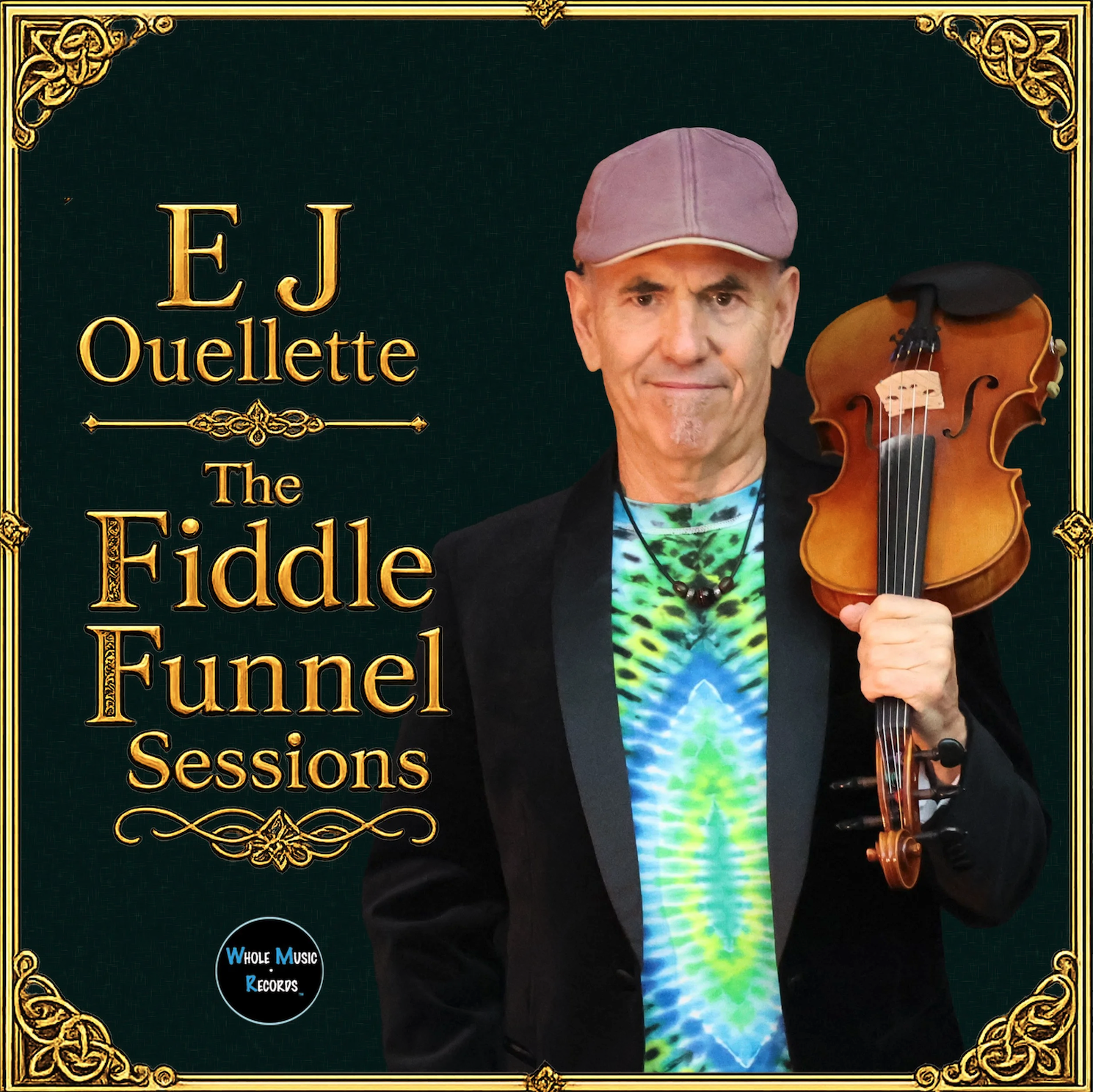
In this interview, E J Ouellette discusses The Fiddle Funnel Sessions, his deep traditional roots, global musical journeys, creative collaborations, and the evolving voice of his fiddle.
1. The Fiddle Funnel Sessions brings together New England, Celtic, Acadian, Scottish, Irish, and French-Canadian influences while also introducing original compositions. How did you approach balancing these traditions with your own contemporary musical voice?
Good question! I’m well versed in many styles of music. I have been an educator/producer for more than 4 decades. I love Trad Music most of all. It’s in my family tradition.
I have a band, E J Ouellette & Crazy Maggy that I formed on return from West Africa is 2001. I toured with Malouma in the summer of 2001. I played AfroCelt music with 8 Pular drummers & artists throughout Mauritania.
On my return I had a new plan. No boundaries! Being a multi- instrumentalist with a wide musical vision as a producer it comes natural to me. Have fiddle will travel.
2. The fiddle is at the heart of this project, but the album also features guitars, mandolin, banjo, organ, bass, piano, drums, saxophone, flutes, whistles, and percussion. How did you shape the arrangements to allow such a diverse group of instruments and musicians to work together organically?
The instruments you mentioned above have always been apart of New England dance hall music. Being a resident of the north shore Massachusetts with a half hour drive to Boston not only did I play Irish music in the pubs, music halls and folk festivals I also performed in the rock & blues clubs, country bars and country dance halls, jazz venues & concert halls. I toured consistently north through New England into Canada. All the while being a CEO &studio musician, educator running my Music Company/Music Academy Whole Music Studios/Records™ www.wholemusic.com.
Arranging music comes natural to me through my professional experience being a mult Instrumentalist among other things and I am surrounded by incredible collaborators.
Every time I perform and record with a different instrument I become a different artist. I am always arranging music. The artists that join me are just as creative.
Trad music speaks to me. I treat a trad fiddle tune like a concerto and sometimes a jam piece.
Having Maestro Drummer Dave Mattacks as a friend and collaborator really adds to the mixed. https://en.wikipedia.org/wiki/Dave_Mattacks
3. You describe the album as an attempt to create “fiddle joy,” while emphasizing natural performances and musical communication rather than perfection. What did you want to capture emotionally and sonically during these recording sessions?
Fiddle music is primarily dance music. It’s meant to levitate the spirit.
Throughout the last 150 years here in New England there were dance halls everywhere in the Nor’east. I grew up around them and played Franco American & Irish dance halls. That’s what a fiddler does…lifts the spirit high with joy, dance and camaraderie. It also relieved those hardworking jobs in the factory mills and farms.
4. “Maggy in Majorca” reflects your musical journeys across Ireland, Scotland, Canada, West Africa, and America. How have these experiences and collaborations influenced the way you play, compose, and understand the fiddle as a musical instrument?
“Maggy in Majorca” really reflects how I’ve come to understand the fiddle after a lifetime of traveling, performing, recording and collaborating with musicians from very different cultures. My foundation is in the fiddle traditions that came through Ireland, Scotland, Cape Breton, Quebec and New England, and you can hear that in my bowing, ornamentation and phrasing. But I’ve never believed the fiddle has to stay inside one musical box.
Travel reinforced that for me. Whether I was playing traditional music in Ireland and Scotland, absorbing the Cape Breton and Acadian connections in Canada, or bringing my fiddle into completely different musical environments in West Africa, I learned that rhythm and melody can create a common language very quickly.
One of the most profound examples was performing with Baaba Maal and playing my Celt-Acadian fiddle alongside African musicians. In Mauritania, I found myself playing with a group of Pulaar drummers—my Celtic fiddle language meeting West African rhythm in real time. Years later, I brought that same fiddle with me to perform with Baaba at the Zénith in Paris. Experiences like those changed the way I listen. They taught me not to abandon my musical identity when I enter another tradition, but to listen carefully and find where the traditions can meet.
That philosophy is all through “Maggy in Majorca.” There are Celtic ornaments and fiddle language at its core, but there are also elements of improvisation, Mediterranean and flamenco colors, jazz sensibilities and the rhythmic freedom I’ve picked up through decades of collaboration.
And Maggy is actually my fiddle—named after my band, Crazy Maggy. She has traveled with me, and I like to say that Maggy will go anywhere.
That may be the biggest influence all these journeys have had on me as a composer and fiddler: I no longer think of the fiddle simply as an instrument belonging to one tradition. I think of it as a traveling voice. I can carry my New England, Celtic, Acadian and American musical roots with me, walk into another musical culture, listen, communicate, improvise—and hopefully find some common ground.GO Reviews 082526 “Maggy in Majorca” is a musical snapshot of that journey.
5. You personally composed, arranged, produced, engineered, mixed, and performed on much of the album. How did wearing so many different hats affect your creative decisions, and was it challenging to step back and listen to the project objectively?
I’m getting more in depth here: Yes, I wore a lot of hats on this album— composer, arranger, producer, engineer, mixer and multi-instrumentalist—but that process is actually very natural for me. I’ve spent decades doing the same thing for other artists, helping take a piece of music from the initial idea through arranging, performance, recording and ultimately the finished master. So when I’m working on my own music, all of those disciplines tend to work together rather than feeling like separate jobs.
The challenge, of course, is maintaining objectivity. When you’ve composed the music, played several of the instruments, engineered the sessions and then sat down to mix it, you can get very close to the material. we are talking many hours in the studio.
That’s where my co-producer and partner, Lisa O’Donnell, is extremely important. Lisa has a great instinct for knowing when I need to step back, simplify something or stop tinkering. She helps keep me focused and provides another set of ears throughout the creative process. We’ve worked together long enough that there’s a lot of trust between us.
I also rely heavily on the musicians I bring into a project. I don’t want collaborators simply reproducing something I’ve already imagined. Musicians like Dave Mattacks, Deborah Offenhauser, Steve Baker, Don Gaudreau, Bob Cannon and Geoff Wadsworth bring their own musical personalities to the recordings, and I want that. Their contributions can take a composition somewhere I hadn’t anticipated.
Ultimately, wearing all those hats gives me the freedom to follow an idea from its beginning all the way to the finished recording. The key is knowing when to lead, when to listen—and when to get out of the way and let the music happen.
This just in on Sunday August 23. From my “Barefoot on the Gravel Walk”
6. You’ve received major recognition, including two Josie Music Awards for Musician of the Year, while your previous work continues to receive international honors. As The Fiddle Funnel Sessions introduces another chapter in your artistic journey, where do you feel your music is heading next?
As an artist I will be doing more songwriting and singing. I have things I would like to say song. Being a singer it is another one of my instruments. I have many songs in the can. With my instrumental music we are open to music sync possibilities. I have also a TV pilot in the can. More on this later.