
Syna Awel
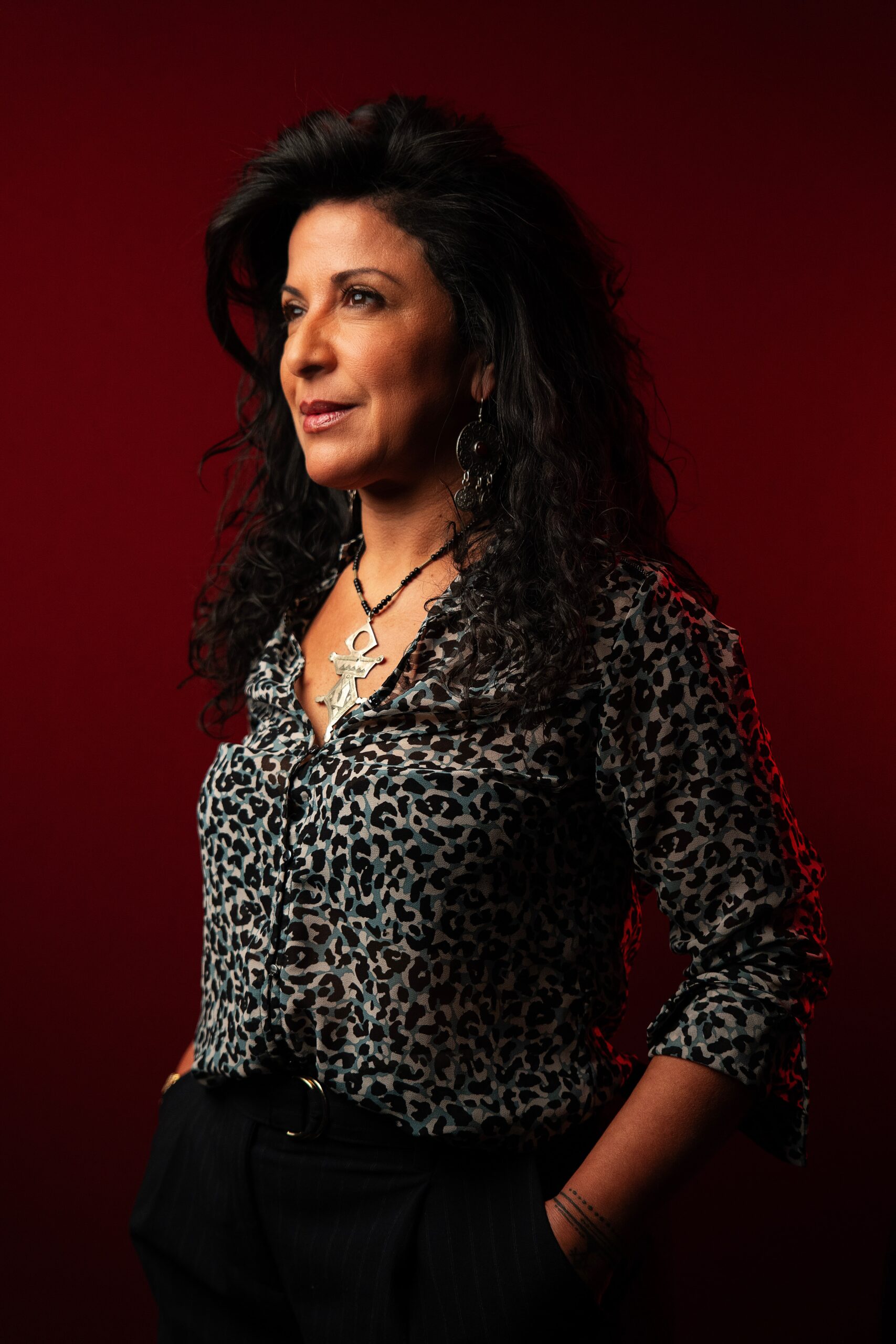
Syna Awel explores Amazigh heritage, identity, memory, and cultural transmission through an intimate acoustic session, blending ancestral traditions with contemporary music and a powerful message of connection.
1. Your new Live Acoustic Session brings together Amazigh culture, oral tradition, and contemporary world music. What inspired you to create this intimate performance, and what did you hope to communicate through it?
It was my son Darys, a young filmmaker and musician, who suggested filming one of my acoustic lives. He was convinced that streaming audiences would love to discover the atmosphere of a concert from the inside. He especially loves the alternation between the moments when I speak between songs and the moments when I invite the audience to take part. For me, that intimate atmosphere brings me back to the summer nights in my father’s village, in Kabylie, when I was a child: the women would would open up to one another, tell stories, sing together, dance. Those memories marked me from early childhood, and through this live session, I feel like I’m carrying the torch forward. The acoustic format puts the story and the voice back at the center, stripped of any artifice, like a return to the very essence of Amazigh oral transmission: just a voice, an instrument, a shared story.
What I wanted most of all was to share Amazigh culture through the lens of my Franco-Amazigh dual identity. My culture of origin, still far too little known, champions living together, freedom, knowledge, and rootedness as a source of strength. I also think of all the children of immigration like me, who carry a dual culture far from their origins. Our parents often preferred to anchor us in the host country, sometimes at the cost of the language, so we could better adapt to the codes of French society. For me, it had the opposite effect: for a long time I felt caught in between, a stranger to France as much as to the Kabyle people. It was only by placing both cultures on equal footing that I was finally able to root myself solidly, building bridges, and carrying the fight against racism and for women’s causes without ever being confrontational, and therefore more effective. I remain convinced that art is the best vehicle for spreading ideas of sharing and peace.
2. The session features songs such as “Isem-is Amazigh,” “Arioul,” and “Yemma Gouraya,” which are deeply connected to Amazigh heritage and memory. What do these songs personally represent to you?
“Isem-is Amazigh,” I wrote to bring back to mind the values of the Amazigh people: freedom, knowledge, sharing, respect for our ancestors and their struggle. It’s their fight that allows us today to be free to become who we want to be. I also speak to the benefits of knowing one’s history in order to better find one’s place on one’s own life path. That’s what I call rootedness.
“Arioul” tells the story of the donkey, an animal that’s everywhere in Kabyle society and has always had a place in my family home. Every summer I couldn’t wait to see it again. Among Kabyles, the donkey embodies courage, quiet labor, and resilience in the face of the harsh conditions of mountain life. In the West, by contrast, it symbolizes docility and ignorance, and sometimes, paradoxically, a form of spiritual wisdom. That gap made me want to point out how far our Western societies have drifted from that wisdom: without realizing it, we often behave like donkeys ourselves, following paths imposed on us (succeeding in school, for instance, even when we dream of a manual trade, getting married, having children, earning a lot of money, buying a house, having a dog, when what we might actually want is to travel and live without material abundance or belongings) and carrying burdens that aren’t our own. That conditioning pulls us away from who we truly are, from our deepest desires, from our own fulfillment. Yet we only have one life to learn who we are and move toward what makes us happy. And the verdict is there: unhappy people are more docile, more likely to follow negative leaders, fascists, all the way to war. This is, in fact, a form of political engagement all my own, in my own way because i despise politics as it’s practiced in our world today: a single law meant to apply to millions of people, never taking into account each person’s own subjectivity.
“Yemma Gouraya,” finally, is a tribute to the beautiful values of Amazigh culture. In France, you often hear the exact opposite said about North Africans. In Kabylia, I saw the complete reverse, and this site captured it precisely: no one feared anyone else, there was no notion of “the stranger,” only sharing, spirituality, and nature (monkeys are everywhere there, and the site, at 670 meters of altitude, offers a sweeping, unobstructed view opening onto the Mediterranean and the wider world). It’s also a stronghold built over the tomb of a female saint, patron of the city : a small touch of feminism, tucked in there too.
Each of these songs carries a different part of that family and collective memory, where the figures of my mother, my grandmother, and my ancestors matter deeply, especially that particular place held by women in Amazigh culture: the one who passes things on, and who, through that act of transmission, becomes rooted and strong herself, keeping our culture alive.
3. Compared with the studio versions, the acoustic arrangements leave much more space for your voice, silence, and improvisation. How did this stripped-back approach change the way you experienced and performed these songs?
Silence isn’t emptiness. It’s a space to breathe that draws the audience closer to the intimacy of the live moment. In the acoustic version, every imperfection, every hesitation becomes audible and true. The voice has nothing left to hide behind, on the contrary, it’s carried by the sounds around it: the wind, the interactions of each person in the audience and in that live moment, even the song of the cicadas. This is, in fact, the way I prefer to play. Unfortunately, it’s not what gets listened to most on streaming platforms, where everything has to sound clean, structured, tightly locked in place, hence studio recordings. I prefer improvisation, the energy of the moment, the musicians’ energy, but also that of the audience and of nature. It brings us back to something essentially Amazigh: being in the moment, telling our stories our own way, with whatever emotions move through us at that moment, without following a script, without being conditioned or feeling judged. The music becomes the fruit of these encounters on our respective life paths, for the space of an instant, going not just wherever the wind carries us, but wherever the music carries us.
4. You are joined by Mahir Bostandzija, Tony Sgro, Luc Lavenne, and Anis Agrebi, whose percussion, darbuka, guitar, and oud create a rich Mediterranean atmosphere. How did you develop the musical chemistry with the ensemble?
It happened very naturally. At the start, i simply wanted to create a session that came together under the simplest possible conditions, no artifice, no overproduction. It began with a concert I’d given in Nice, with musicians from Nice, that I called an “acoustic concert.” At the time, I felt like changing things up, doing something more stripped-down, closer to a gathering among close friends, the way I was raised within Amazigh culture. And seeing how much it resonated, how much people loved it, when my son suggested filming a live session, the idea came to me right away: to invite Mahir, Tony, and Luc to recreate a kind of rehearsal, the sort we might have had among ourselves, at home (to welcome Anis, who was joining us as a new member that day) but this time open to the public.
There’s a kind of magic that happens when things come together simply, without a set plan. It reminds me of the women in Kabylia, who gather spontaneously, without organizing anything, to express, release, or let out their emotions of the moment by singing together and playing the bendir. There’s no staging involved, just people coming together because they feel the need to, letting the music emerge on its own. That’s exactly the energy I wanted to find again with Mahir, Tony, Luc, and Anis: not a performance, but an encounter. The same simple, true alchemy happens between us, the kind found in traditional Amazigh music, when it’s made among close ones, with no other intention than to share.
5. Amazigh traditions have often been transmitted through stories, melodies, and oral culture from one generation to another. How important is music to you as a way of preserving and sharing this heritage with younger generations and international audiences?
That’s precisely why I make music, and why I also write stories, in French, set against illustrations drawn from Kabylia, weaving in a few Kabyle words along with a small glossary. It’s my way of opening a door for younger generations from immigrant backgrounds, so they stay connected to their roots. Our parents wanted to do right by us, fully integrating us into the society we were growing up in, even if it meant, without meaning to, distancing us from our culture of origin. For me, the result was an imbalance in my dual cultural identity, even though many Amazigh values lived on in them regardless, and I ended up naturally adopting them myself.
Today, through my music, I try to help others stay connected to their origins, or reconnect with them, since I myself had to relearn and reclaim everything. I want to show that it’s possible, at any age: you can learn a language even at forty, you can learn to dance, to cook, to weave, you can immerse yourself in your own history. It’s even essential to know it, because knowing your history is how you come to know yourself and how you better understand the world you move through. I’m not inventing anything new here: “You have to know who you are to know where you’re going,” and how to get there, in conditions that truly suit you.
That rootedness, I deeply believe, is what solidifies you. It makes you stronger, it lets you flourish more fully. And when you’re fulfilled, when you’re happy, that’s the beginning of a world at peace. It’s distress that pushes people to pick fights with their neighbor; conversely, when you’re fully rooted, at peace with your own history and with what you envision for your future, you tend to do good around you, even naturally so. You can even become an example for others, giving them hope. That’s the sense in which my message goes beyond Amazigh culture alone: it speaks to anyone who carries a plural identity within them.
6. The Live Acoustic Session has already attracted more than 44,000 YouTube views in its first week. Looking ahead, what would you like listeners to discover about Syna Awel and Amazigh music through this project?
I think the answer has already written itself, in the margins of all these questions. I actually found them very thoughtful, and I loved answering them. Thanks to your outlet for that. Art and culture have become, for me, a form of gentle resistance against a world that too often slides toward racism and machismo. But resisting, for me, is never about raising my voice against someone; it’s about reaching out a hand, and together singing louder the love and the beauty of who we are.
More than anything, I’d like people to remember that Amazigh music is alive. It isn’t a relic of the past, but a culture that still breathes and still dances. Through my art, I hope everyone discovers that movement: a culture capable of speaking with the whole world without denying its roots, building bridges that let us write the next chapter of the story. So I create for a little more love, for oneself, for the other, for everything that connects us. That, deep down, is the only thing I truly hope for…