
Neil C. Young Trio
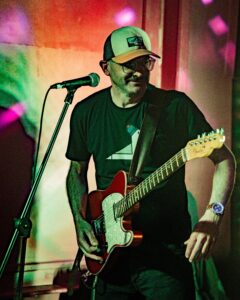
Neil C. Young Trio return with ReWorks Vol.3, transforming familiar songs through jazz fusion, post-rock, experimentation, and an ever-evolving approach to sound and arrangement.
1. ReWorks Vol.3 continues your long-running reimagining project, despite being the fourth instalment chronologically. What inspired you to keep developing this series, and how has the concept evolved from the earlier volumes?
It was always going to be an ongoing project as there’s always a song that crops up that for some reason resonates with me to do something with. It was decided that this 3rd EP would be the final one of a collection of 3 through a conversation with Rob Marshall who did the artwork and came up with an idea of making the artwork reflect a collection which would also show where the trio are musically by the 3rd EP. This 3rd EP is a reflection of the live versions, long form and with the use of FX pedals to expand the trio’s sound and introducing a post-rock element to the already existing jazz-fusion set up.
2. The EP transforms songs by Action Bronson, Elvis Costello, and Madonna into heavy Jazz Fusion and Post-Rock pieces. What attracts you to taking such different source materials and completely dismantling their original structures?
I think it’s a reflection of my musical upbringing and enjoying a wide musical landscape and then my enjoyment of composition and particularly arranging of material. Also, it ties in with my learning and playing jazz through the jazz standard repertoire, taking an existing song and then improvising with it, so I guess this project brings all the elements of my formative musical learnings together.
On a more specific level, with some tracks it is about the challenge whereas some it’s more immediate. Crazy For You was purely as I heard the track again after many years and it was immediately a thought of ‘we’re doing this!’ It is similar to the Action Bronson track; it is such a cool track with that cool riff that runs along throughout that was calling out to me. The Elvis Costello song was the different one, I’ve known it only as a classic jazz ballad but this was a challenge to find a way in but there was and it has worked out, I believe anyways!
3. Your guitar approach combines bass, chords, and melody while working closely with doubled bass lines. How did you develop this unconventional instrumental architecture, and what does it allow the trio to achieve that a more traditional setup might not?
It was developed through an earlier spell, pre-trio, where I was playing in a sax and guitar jazz duo and then as a solo guitarist at functions, where I was aiming to keep the 3 elements on the go in some form – the bass line, chords and then the melody over the top in its written form and then improvising with them. It was then through Covid and a solo guitar project called ‘Cactus Sessions’ that was (or is) for YouTube that that approach started to become something I thought that could be taken into the trio, and work on having a chunkier collective sound through doubled bass lines.
It enables us to have a clarity to our sound and also to focus in on the unique melodic nature of the track being worked on which then creates a further uniqueness to that particular track, as well as holding us truer to the original melodic lines, it also enables us broaden the collective expressive potential through texture and form rather than than the more traditional harmonic and rhythmic elements.
4. Tracks like “Baby Blue,” “Almost Blue,” and “Crazy For You” each take a very different emotional direction. How did you decide what elements of the original songs to preserve and which ones to transform?
The one consistent across all the ReWorks tracks is that the melodic element is to maintain the integrity of the melodic elements which then the other elements are worked from and are where the most transformative effects take place. Sometimes there’ll be a hook in the background somewhere that’ll catch the ear, which is the case with the Madonna track where the bass/guitar riff is a backing vocal part on the fade out at the end. The Action Bronson track is an example of a part or section that I want to use more than it was in its original form (the final brass section) which then has its own new twists and turns applied to create a larger outro. Then there is the new part creation from the harmonic elements as with Almost Blue, trying to imply the original harmony but through a single line or riff.
I guess the overarching ethos is about maintaining the original lyrical message but placing or crafting it into or around new contexts. Each of the ReWorks tracks across the previous releases has the same approach but as each track is unique then the ReWorked elements are then uniquely transformed.
5. Your use of wet and dry signal paths, heavy effects, freeze techniques, and organ/synth emulation creates a particularly dense yet spacious sound. How important is technology and experimentation with equipment to the trio’s creative process?
The creative process always starts with the musical elements rather than the technological or the pedal work that we use, they are added to expand away from the musical start point. If the musical structures are in place then the pedal choices and uses of them become easier to know when or what to apply to enhance the fundamental structures and overall experience.
The introduction and use of tech/FX pedals wasn’t a planned decision, it has come about over time due to hearing something in the arrangement that then asked questions about is that possible and how? Which has then led to the introduction and expansion of both guitar and bass pedal boards, we were a straight ahead plug direct in the amp trio a while back believes it or not!
6. Looking beyond ReWorks Vol.3, what can listeners expect next from Neil C. Young Trio, and are there any new musical directions or source material you are particularly excited to explore?
There will be an EP of original music called ‘AggenAnonAggen’ set for an autumn release later this year which is being worked on alongside a new 3 track ReWorks EP due out in 2027, and then there is a project involving strings that I have long wanted to do but we’ll have to see on that. Other than that, there will be a bunch of new tracks that will lodge themselves in my brain for further ReWorks at random points as the future unfolds I’m sure…