
Magdi Aboul-Kheir
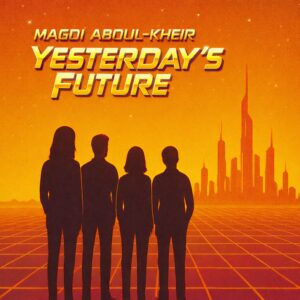
Composer Magdi Aboul-Kheir reflects on Yesterday’s Future, discussing 1980s nostalgia, cinematic electronic soundscapes, memorable melodies, and how the past continues to inspire fresh, forward-looking musical creativity
1. Yesterday’s Future captures the excitement of the future as it was imagined in the 1980s. What inspired you to explore that nostalgic vision, and what does that era represent to you creatively?
First of all: because it’s a lot of fun! Looking back, I see the 1980s with a certain fondness and a smile. But when it comes to popular music, that decade was incredibly influential, and a lot of what emerged back then is still very much alive today. That’s especially true for electronic music. It was a time of experimentation, when artists developed a musical vocabulary that we still understand and use today.
Back then, I listened to artists like Tangerine Dream, Kraftwerk, and Vangelis. Their music had a lasting influence on me and definitely shaped the way I think about electronic textures and patterns.
There’s also something fascinating about stepping back into a past era and imagining how people at the time envisioned the future—what they thought our present day might look and sound like. It’s charming, sometimes amusing, but it can also be surprisingly thought-provoking.
2. The album blends vintage synthesizers, drum machines, soaring guitars, and cinematic string arrangements. How did you approach balancing these elements to create a sound that feels both retro and fresh?
I wasn’t interested in simply recreating an old sound. The last thing I wanted was to make music that belongs in an ’80s synthesizer museum. Instead, I wanted to take elements from that era and use them in a contemporary way—mixing and matching them freely, with a sense of fun rather than strict authenticity. For me, it’s not about purism. It’s about taking a musical language that still resonates today and giving it a fresh context.
3. Across your discography, you’ve explored ambient music, orchestral works, piano compositions, and jazz-influenced instrumentals. How did your experiences in those different genres influence the writing and production of Yesterday’s Future?
I love the variety that comes with writing music, and I often jump between genres in ways that might seem unexpected. After a quiet, minimalist piano piece, I might write a percussion-driven orchestral track that feels like it’s from an action film, followed by a spacious ambient composition. Because of that, the different styles naturally influence one another, even if it’s rarely a conscious process.
One thing that always matters to me, regardless of genre, is finding melodies that are memorable and emotionally expressive. In the case of Yesterday’s Future, I really wanted to write a few unmistakable ’80s-style earworms.
4. Melody seems to be at the heart of your music regardless of style. When composing, do memorable melodies come naturally first, or do they emerge as you develop the overall atmosphere of a piece?
Both things happen. Sometimes the melody is there right from the beginning—it becomes the starting point of the whole piece and feels so natural that it almost seems as if I simply discovered it and wrote it down. But sometimes a melody only gradually reveals itself during the writing process. It needs time to take shape, and I have to refine and polish it until it reaches the point where it feels right.
5. Yesterday’s Future follows Into the Retroverse and pushes its retro aesthetic even further. Did you discover anything new about yourself as a composer while expanding on this sonic universe?
On the one hand, I became even more aware of how deeply we are shaped by the music of our youth and how strongly certain aesthetics become rooted in us.
On the other hand, I realized that you can still approach all this material in a free, fresh, and creative way. You can play with it, reinterpret it, and discover new aspects within something that might already feel familiar.
6. With such a diverse catalog already released this year, what creative directions are you most excited to explore next, and what would you like listeners to take away from Yesterday’s Future after hearing it from beginning to end?
I will continue to enjoy expressing myself through a wide range of genres. There will be another retro-electronic album with a sci-fi and space-inspired atmosphere, as well as an album of romantic chamber music.
As for the people listening to Yesterday’s Future, I hope they experience the same thing I felt while creating it: having fun!