
Peter Manning Robinson
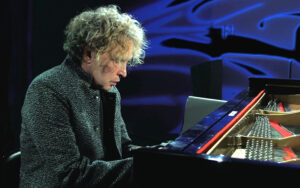
Visionary composer and pianist Peter Manning Robinson joins us to discuss Bent Out of Shape, overcoming adversity, reinventing musical expression, and the inspiring creative journey behind his upcoming album, Excursions.
1. Your latest single, Bent Out of Shape, was born from a period of personal struggle and reflection on world events. How did you transform those emotions into such an uplifting and joyful composition?
One of the principles that I live my life by is to be grateful… no matter what. After such a tough few years…both for myself and the world at large…it was important to me that I expressed light and the joy of life. There is a concept: “that what you put your attention to becomes larger”. I wanted this composition to represent rebirth and the wonderful things that we all have.
Klaus Hoch, my collaborator and the creator of the video, found a unique way of visualizing this in a playful and humorous way.
2. The music video for Bent Out of Shape, directed by Klaus Hoch, tells a surreal story of reconciliation and shared memories. How closely did the visual narrative align with your original vision for the music?
Klaus and I have an interesting, and I believe unique way of working. I never discuss my ideas for the video with him and he never discusses my music with me before we start the creative process.
I will send him three compositions. He picks the one that he most responds to. Then, without any initial discussion, he comes up with a script idea. If I like it, we might refine it a bit and then the process of actualizing occurs.
3. After being told you might never perform live again due to severe tendonitis, you completely reimagined your approach to piano playing. How did that challenging chapter shape the artist and innovator you are today?
Although it is true that I was told I would never perform again, I never believed it. I always knew that I would find a way to play at peak performance. During this period of time, I created several different acoustic and electronic instruments to help record my music, even though I could only play for a couple of minutes at a time.
After over 10 years, I met Professor Phil Cohen, head of the Leonardo Project in Montreal Canada. He told me that he could have me playing again, but I would have to unlearn everything that I knew about the piano.
His sincerity touched my heart, which was not easy at that time of life for me. He taught me a way of playing similar to a martial artist…My energy now originates from my back and my core…the largest muscles pull the smaller muscles, and finally the fingers.
Although it certainly took longer than six months, not only am I playing better than ever, but I learned about humility, being grateful, and new ways of expressing myself.
I even learned that occasionally, I could have a life away from the piano! It was an invaluable lesson.
4. The invention of the Refractor Piano™ has become a defining part of your artistic identity. What inspired you to create this unique instrument, and how has it expanded your creative possibilities as a composer and performer?
I have been creating Hybrid acoustic and electronic instrument at a very early age. I’ve always been searching for that elusive sound that has never been produced.
I was regularly using synths and samplers in my musical vocabulary, However, as so many musicians and composers started utilizing them, I wanted to do something totally different.
I decided to build a unique instrument around an acoustic piano that then was morphed into a hybrid beast with no synths, virtual instruments, overdubbing, or pre-recorded tracks. Slowly, the Refractor Piano™ was born.
In science, refraction occurs when sound or light passes through a prism. The original sound is unaltered, but is morphed, or refracted on the other side. I have found that limiting my musical toolbox has actually expanded my creativity. I am certainly not the only person who has expressed this. Many artists, including Stravinsky, have spoken about it.
5. Your upcoming album Excursions explores themes of grief, heartbreak, resilience, and hope. Was there a particular piece on the album that proved especially emotional or challenging to complete, and why?
I would not say that there is one particular piece that was more difficult or challenging.
In fact, I was so emotionally invested in this journey that Klaus who co-produced the album and myself had a difficult time picking the pieces from so many candidates.
The biggest challenge for me was not resorting to intricate passages, large crescendos, or rapid sections. I needed to utilize a slower, more melodic, and evocative approach.
This allowed the emotionality to speak without any cleverness or showing off.
6. With a career spanning film, television, orchestral music, and groundbreaking live performances, what continues to inspire you to push creative boundaries, and what do you hope listeners take away from Excursions?
You are very kind to say this.…thank you. For myself, I do not know any other way to exist. This is who I am and how I create.
I never want to do anything other than create music that inspires people. I do not wish to mimic or duplicate anything that has been done before…including my own music! It is not a journey for everyone… But it is mine. I would never tell another person how to respond to my music. There is no “correct” emotion or reaction.
However, I’m always gratified and touched by people who connect emotionally with something that I do, whether it is my music, or my personal journey. For myself, it is not about fame or money. It is about the communication with the great beyond and the inclusion of people who connect with this.