
Mad Painter
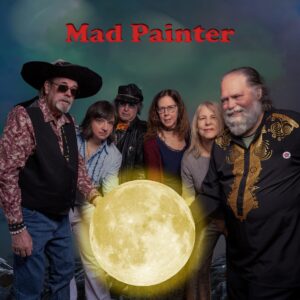
Mad Painter’s latest album Island Poetry is a vibrant celebration of classic rock’s adventurous spirit, blending Hammond-driven hard rock, progressive influences, and imaginative storytelling into a rich and captivating musical journey.
1. “Island Poetry” draws inspiration from a wide range of classic rock influences, from Deep Purple and Uriah Heep to Queen, Motörhead, and even space-disco pioneers Ganymed. How did you balance these diverse inspirations while maintaining a cohesive Mad Painter identity throughout the album?
The cohesion comes from the fact that these influences are not artificially imposed on the songs. They are all part of what I have listened to for most of my life, so they naturally enter the music through my own writing and through the way the band plays.
We never begin by deciding that we need one Deep Purple song, one Motörhead song and one space-disco song. A musical idea appears, and its character may remind us of something within that broad spectrum. The finished piece still passes through the same musicians, the same Hammond-and-guitar relationship, the same vocal approach and the same production process. That gives the album a consistent personality even when the individual tracks occupy very different stylistic areas.
The sequencing also helps. The album moves through those changes deliberately rather than presenting them in a random order. It begins with energetic rock and roll, grows heavier, moves into space rock and art rock, opens into more progressive and blues-oriented material, and then returns to dramatic balladry and heavy metal before ending with the grandeur of “Circle of Hands.”
The references are visible, but the underlying identity remains Mad Painter. The influences provide the vocabulary; the arrangements, performances and personalities of the band determine the final language.
2. The Hammond organ plays a central role in your music, often taking the spotlight rather than serving as a background instrument. What is it about the Hammond’s sound and character that continues to inspire you as songwriters and performers?
The Hammond has an enormous emotional and physical range. It can whisper, sustain, growl, roar or completely fill a room, and it can move between those states within a few seconds. It is capable of providing rhythm, harmony, atmosphere and a lead voice simultaneously, which makes it much more than a background instrument.
In Mad Painter, the organ is often present from the earliest stage of the composition. The song is not written as a guitar piece with keyboards added afterward. The Hammond may establish the riff, the chord movement or the entire emotional character of the arrangement. That immediately changes the architecture of the song.
It also creates a natural dialogue with the guitar. The two instruments can reinforce one another, answer each other or compete for the foreground. Deep Purple and Uriah Heep showed how dramatic that relationship could become, but once you begin working with it yourself, you discover many other possibilities.
The Hammond also gives our music a strong sense of continuity. Even when a track moves toward space disco, heavy metal, progressive rock or a piano-led ballad, the sound and personality of the organ help keep it within the Mad Painter world.
3. Each track on “Island Poetry” seems to explore a different musical landscape. Were there any songs that challenged you creatively or pushed the band into new territory during the writing and recording process?
We would never voluntarily enter uncharted stylistic waters merely for the sake of being “different” or “eclectic.” Every piece of music I write reflects my own influences and whatever I happen to be listening to at the time. That can lead us into almost any style or genre, but it does not feel forced because there are no rules governing what I choose to play on my stereo, whether I am at home or on the go.
Progressive rock naturally plays a major role. We had songs such as “Gone Gone Gone” in the past, and on this album there is “Nektarized,” which is an unusual homage to Nektar. All of its lyrics are made up of Nektar album and song titles.
There is a break in the middle featuring an odd, almost alien-like chant: “Automaton Horoscope, please cast your fate.” That phrase simply appeared in my head from nowhere. It was not an attempt to imitate anybody. The same applies to the space-disco element. If I listen to Ganymed for weeks, as I did when I was a child, or spend time with Dee D. Jackson or Sheila and B. Devotion, that influence will eventually emerge somewhere in a song.
“Two Horsemen” developed in a very different direction. The lyrics originated as a Russian poem by Soviet dissident poet Joseph Brodsky, translated into English by Natalia Belenkaya. They seemed perfectly suited to a free-roaming Wishbone Ash-type piece, something that could have come from the world of ‘Argus’ or ‘Pilgrimage’. The early-1970s British rock and blues-jam influence was already part of my musical palette, as was the Canterbury touch. On that track I like to approach the keyboard solos in a way that owes something to Caravan.
“I Am the King” followed a similar process and became something like an amalgamation of the Moody Blues and Barclay James Harvest. None of this was especially difficult because these sounds are all part of the same personal landscape. The band may enter different territories, but they are territories I already know and love.
4. Six songs on the album feature lyrics by writer and music journalist Dmitry M. Epstein. How did that collaboration come about, and what did Dmitry’s lyrical approach bring to the album that might have been different from your usual songwriting process?
The collaboration originally began with “Illusion,” which appeared on “Splashed”. I already had the melody and recorded it as an instrumental demo. I then gave Dmitry the general lyrical idea, and he wrote the words. The same process was repeated with the ballad “I’ve Been a Fool,” which is also on “Splashed”.
After that, the nature of the collaboration changed. Dmitry began sending me his own poems rather than waiting for me to provide a subject or concept. “Rock’n’Roll Samurai,” also from *Splashed*, was one of the first songs to emerge from that new approach.
Six of his poems have now become songs on “Island Poetry”, and there are more waiting for me to work on in the near future. When he sends me a completed poem, I have to discover the music already hiding inside it. That is quite different from beginning with my own melody and lyrical premise.
His writing can bring in imagery, characters, phrases and perspectives that I would not necessarily have invented myself. It gives me a different kind of stimulus and sometimes leads the music into a more dramatic, theatrical or unexpected direction. At the same time, I still have to make the words live naturally within the Mad Painter sound.
5. In an era dominated by singles and playlists, “Island Poetry” was conceived as a complete album experience. Why was it important for you to create a record that encourages listeners to engage with it as a full journey rather than a collection of individual tracks?
The album has always been the form that means the most to us. Singles can introduce individual songs, but a complete record allows a band to build a world, move through contrasting moods and reveal different parts of its identity.
The twelve songs on “Island Poetry” do not tell one continuous story, but they were arranged to create a progression. The album begins with eccentric and energetic rock and roll, becomes heavier, moves into space rock and art rock, and then opens into progressive, bluesy and free-roaming material. From there it reaches dramatic balladry, returns to heavy metal with “Stand Your Ground,” and finally concludes with the classic Uriah Heep grandeur of “Circle of Hands.”
That sequence matters. A stylistically varied record can feel arbitrary unless the order gives each change a purpose. The quieter or more expansive songs affect how the heavier ones are heard, and the final track feels more monumental because of everything that has led up to it.
The central image of the album also encourages that kind of listening: people gathered around a fire on a small tropical island, beneath a full moon, chanting, reflecting, meditating and perhaps praying to the stars. Each track is like another voice or vision arising from that same gathering.
6. Mad Painter embraces the spirit of classic 1970s rock without simply recreating the past. What do you hope modern listeners discover in “Island Poetry”, and how do you see the band carrying this musical tradition forward into the future?
I hope listeners discover that the language of 1970s rock is still capable of producing new music rather than simply functioning as nostalgia. We are not attempting to recreate an old record note for note or pretend that the decades since then never happened. We are using the musical vocabulary that feels most natural to us and writing our own songs within it.
That period allowed rock bands to be heavy, melodic, theatrical, progressive, humorous and emotionally direct without constantly worrying about whether those qualities belonged together. A Hammond organ could lead the arrangement, a song could develop over several sections, and an album could move from hard rock to balladry or something much stranger without apologizing for it.
Modern listeners may also discover the value of recognizable musical personalities. The guitar, organ, rhythm section and voices are not intended to disappear into a perfectly standardized production sound. Tom Hamilton recorded, produced and mixed the album digitally in Pro Tools, but the technology was used to recover warmth, depth and the smallest nuances associated with twentieth-century records rather than to remove the human character from the performances.
Carrying the tradition forward means remaining faithful to its sense of freedom rather than merely copying its surfaces. The future of Mad Painter is not about limiting ourselves to one approved version of classic rock. It is about continuing to write whatever emerges from our listening, our personalities and our interaction as a band, while making sure that the result remains recognizably our own.