
Love Unfold The Moon
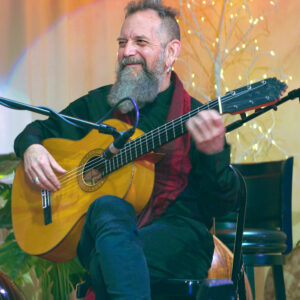
This interview explores the creative vision behind Love Unfold The Moon, a deeply personal and immersive work that reconnects past influences with present experience, blending improvisation, tradition, and artistic renewal.
1.Love Unfold The Moon marks a return to the acoustic and post-flamenco language that shaped your early career. What inspired you to revisit these musical roots at this point in your journey?
I went through a number of health issues a few years ago – cancer, followed by open heart surgery to remove a tumor – which put me in an interesting space.
I found myself a little reflective, but also extremely focused: cancer is fatiguing, full-tilt open heart surgery is Hella fatiguing and so I had no energy or patience or bandwidth for nonsense any more.
As a result, everything in your life gets stripped down and prioritized to the most vital: what truly matters? what’s your essence? Because there’s no longer room for anything else but that.
That in turn gets purified, condensed, intensified, then poured into the bandwidth you do have remaining.
This becomes your new core – you’re centered and streamlined in the vital, the vibrant. Everything in your periphery rotates around this, and the superfluous, the superficial is gone.
So, in that mode, I was also doing a little archival work, just in case the health issues persisted. And I remembered how the early work I was doing – exploring how free improvisation and modern composition might intersect with a pre-Paco de Lucia flamenco guitar vocabulary – seemed to resonate with people, how it was noticed, gave me wonderful opportunities. So, in listening to that body of work after 30 years, there was a certain vitality and spirit in those ideas that I reconnected with.
But I was also quite critical: this review was not a nostalgia trip. Some of those early performances don’t hold up, nothing’s been released from the vault yet (though some might). Rather than a retread, it became a component in the overall process of moving forward.
The intervening 30 years has a lot of life lived in it, and that brings something to the table.
2. The new quartet brings together experienced improvisers and younger musicians from Berklee and CalArts. How did this cross-generational collaboration influence the creative process and the final recording?
In any project I lead, I’m not interested in telling players what or how to play. I’m interested in creating environments, structures, canvases where a) players can be their best in, and b) that are also optimized around certain natural alignments in order for that to happen with some coherence.
It’s about laying down a fertile ground where everybody’s strengths can intersect and meet and grow.
With the generational span in this case, I was anticipating the possibility of a certain amount of intimidation, so I had to ensure that the framework I set up – the composition, the rehearsal process – had enough there to put them at ease. Enough for them to hang on to, and also enough for them to let go of, at the same time.
It came together beautifully. We rehearsed for three days, did the concert, then went into the studio – that was it. By the second rehearsal, everyone was finding their space and place with it. It just took off from there.
One of the interesting things about working with Ash and Thor is that they have this youth, and yet their source material, what they listen to, isn’t young. They’re listening to 60s and 70s progressive rock, early fusion, psychedelia, among other things. That’s stuff I grew up with, but they’re absorbing it a generation later, and how they work with and interpret that information is very very interesting.
Ash uses a fair number of pedals – wah, distortion, delay. He’s very much an electric violinist. But he does it from this very modern perspective – a 20 -ish year old from the historical vantage point in 2026, looking at and working with a timbral vocabulary that originated in the 60s and 70s. It’s youth + time + source, and that adds up to a very unique thing, because he doesn’t retread or just pay homage – he’s making it his own. Thor, too – how he transforms information is pretty remarkable.
I didn’t realize how much the effects were integral to Ash’s voice when we started rehearsing. The oud and the flamenco are very ‘straight,’ I’m not doing effects at all. So from an orchestration point of view, I think about what Ash is doing timbrally, how does that in turn inform my choices…it’s an interesting puzzle.
I’m thinking of how Peter Broetzmann worked with Toshinori Kondo in the Die Like A Dog Quartet (probably the best free jazz quartet of the past 30 years, btw); similar kind of context.
3. Your music has long blended Middle Eastern, Turkish, flamenco, and free jazz traditions. How does Hidden Promises In Joined Terrains, Apex Emerging expand or redefine that musical conversation?
I’ve always heard connections between these genres, and it’s not just the merely technical. In the flamenco element, for example, yes there’s a certain dissonance in the harmonic voicings that one can find aesthetically in common with improvised and/or ‘modern’ music, but also there’s the fluidity and elasticity of tempo, the high level of improvisational interplay between guitarist and singer.
Even back in the day I very much wanted to take that early solo work concept and put it into a group setting. It never happened then, so in a sense I have been waiting 30 years for this!
I hear a lot of connective tissue between all these worlds. Not parallel bundles but interesting, flexible hinges, joints, angles, sinews, tendons. And as you delve into it, this connective material – again – is more about common process or concepts than common results.
Here’s an example: What’s the thread (or threads) that ties together Stravinsky, Munir Bachir, Cecil Taylor, Melchor de Marchena, Alban Berg? I shan’t tell you, because discovery itself is the real learning, not just what’s discovered; but I will tell you it’s there.
4. The album consists of a single extended composition recorded just one week after the band’s first concert. What challenges and rewards came with capturing such a spontaneous performance in a one-day session?
The challenge is one of endurance, stamina. LUTM performances are long continuous arcs – anywhere from 45 to 70 minutes usually – and there’s never any moment where one can pre-plan or rely on laying out. Even not playing is an active, conscious, clear choice occurring in real time.
Form, development – that all unfolds organically, collectively, spontaneously, which in turn demands tremendous sustained focus, attention, awareness. You’re required to be on point at every minute in this music.
Do that for an hour? And then again for a second take?
But the reward from that intensity is pretty special, and we were prepped for it.
I very much wanted us to go through the crucible of the first live performance before we went into the studio and I’m glad that aligned. One performance is worth 10 rehearsals, in terms of what you learn from it.
5. You’ve described Ash Mattia and Thor Rodriguez as bringing fresh perspectives and wise musical choices to the project. Were there any moments during recording when their contributions took the music in an unexpected direction?
Oh yes…there’s lot of little moments everywhere!
In particular, there is a bonus track, “Makam Taos,” on the digital release, on Bandcamp. I debated long and hard whether to put it on the CD, because while it could fit time-wise, it ended up distracting from the large work. It lessened the impact of both, either in front or in back of the big piece.
Just because you can doesn’t mean you should, so it became a bonus digital track.
But how we ended that – very abrupt, sudden – is so different. Usually pieces like that, you wind it down.
I remember looking up at Ash when that moment happened, and we had this telepathic conversation: is it a pause, or is it done? And he just put the bow down. He made the call, and it was brilliant.
6. After the international response to Explode Yourself with Love Unfold The Sun, what do you hope listeners will discover in Love Unfold The Moon and its more acoustic, intimate approach to improvisation?
They’re very different experiences. Moon is more long form – a longer journey, more subtle, more abstract. And while it’s acoustic and intimate, it’s perhaps more intense in its own way than Sun, even though Sun may technically be “louder” in terms of decibels.
But it’s not about volume. It’s about the trajectory, the intent – your state of consciousness that you infuse the music with. And that in turn is prepped by the structures, how they’re conceived to facilitate and align those states, as I mentioned before.
I’ve been talking with a couple of presenters who have interest in a combined evening, and I’ve had to point out to them that the only way it can work as a paired experience is to have Sun be the first half.
Sun is immediate, urgent, it clears the deck, opens the pathways and realigns. It prepares: that’s its own intensity and journey and function.
That in turn allows the space and clarity for Moon to happen, which has its own arc and intent: concentric rings of contraction and expansion – time, breath, waves, hills, undulations. It can echo ritual, as well.
It’s also very sexual in its way. Sun has that too, though differently.
Between the two groups, it’s a wide body of work, though there’s cohesion connecting them as well.
And if you try to listen to either with your ears, you’re missing most of it. One should listen to this music through the body first – that’s how it enters. The rest follows from there.