Geese Da Goon
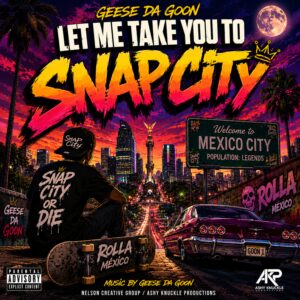
Geese Da Goon returns with SNAP CITY EP, a vibrant tribute to DMV skate culture, blending music, community, and personal growth while bringing the energy of Washington, D.C.’s rinks to listeners worldwide.
1. SNAP CITY EP is deeply inspired by Washington, D.C.’s skate scene. What made now the right time to return with a project that celebrates those roots so directly?
A few things came together at the right time.
One was my little brother, DJ Prodigy. When he told me he was heading to Mexico to DJ an event called Rolla México, it sparked something creatively. I started revisiting some earlier material and reimagining it for a new audience, which eventually became part of what listeners hear on SNAP CITY EP.
What’s funny is that some of these songs technically existed before. The thing is, these versions feel completely different. They don’t feel like songs anymore. They feel like anthems.
As I started working on the project, I realized I wasn’t just revisiting old music. I was revisiting a culture, a community, and a sound that helped shape me. The response from skaters and listeners confirmed it. People weren’t treating these records like background music. They were connecting to them the same way they connect to the records that define moments on the floor.
That’s when I knew the timing was right.
What amazes me is seeing how far these records can travel. This music comes from the skating culture of Washington, D.C., Maryland, and Northern Virginia. It’s incredibly local. Yet somehow that same energy can catch the attention of somebody in Mexico, Brazil, Japan, and apparently Iceland too.
To me, that’s still wild.
Something that started from experiences on our skate floors is now reaching people who may have never set foot in a rink in the DMV. That’s what makes this project special. It celebrates where I’m from while proving that good music and authentic culture can travel anywhere.
That’s really what SNAP CITY EP represents: honoring where I came from while letting the world discover it.
2. The EP captures the atmosphere of a packed skate session, from the music to the energy of the crowd. How did you translate those real-life experiences into the sound of these four tracks?
I wasn’t trying to capture a skate session. I was trying to crack the door open and give people a glimpse of the culture.
Not too much. Just enough to make them curious.
You know how in Narnia somebody opens a wardrobe and suddenly discovers there’s a whole world behind it? That’s closer to what I was aiming for.
SNAP CITY EP is rooted in the skating culture of Washington, D.C., Maryland, and Northern Virginia. If you’re from here, you know every area has its own flavor, its own DJs, its own style, and its own way of moving on the floor. The music is part of the identity.
A packed session was definitely part of the inspiration, but so were the people, the sounds, the conversations, the regional slang, the skate styles, and the energy that’s unique to this area. I wanted somebody outside the culture to hear these records and think, “What is this?” and then want to learn more.
A lot of people outside the culture think skating is just skating. It isn’t. The music drives everything. It influences how people move, how they express themselves, and how communities connect with each other.
The goal wasn’t to explain the entire culture in four songs. The goal was to crack the door open, let people see that there’s a whole world behind it, and hopefully leave them wanting to explore more.
3. Tracks like “Prodigy Exclusive,” “Rolla México,” “Vault,” and “Let’s Ride” each have distinctive titles. Can you tell us the stories or inspirations behind these songs?
Absolutely.
DJ Prodigy is my little brother. When he told me he was heading to Mexico to DJ an event called Rolla México, I immediately started thinking as both a producer and a brother. There was no way I was letting him make that trip without taking some of my music with him.
I went back to an earlier song of mine and completely reformatted it for the occasion. That process ended up creating multiple versions of the same idea.
“DJ Prodigy Exclusive” became the bilingual version, featuring both English and Spanish. “Rolla México” is the fully Spanish version of the song. The Rearranged Version is exactly what the title suggests, a remixed and reworked take on that same musical foundation.
“Let’s Ride” has a connection to those songs as well. If listeners pay attention, they’ll notice it shares the same chorus. It was actually an earlier draft that I originally had no plans to release. It sat in the vault for a while, but eventually I decided there was no reason to keep it hidden. Sometimes the earlier versions have their own energy, and I wanted people to hear that part of the creative process too.
In a lot of ways, these songs show how one idea can evolve into several different records. What started as one song eventually became multiple versions, different languages, different arrangements, and ultimately a bigger story than I originally planned.
4. You mention that some people thought you had left the skate scene, but instead you spent time building something of your own. How did that period of growth influence your music and your perspective as an artist?
Let’s keep it a buck: I stepped away because the skate scene was starting to get boring to me.
Not the skating itself. I still love skating. I still love the music, the culture, and the feeling of being on the floor. But I felt like too many people were focused on the same conversations, the same arguments, and the same small circle of recognition.
Meanwhile, I wanted to see what else was possible.
So instead of spending all my time worrying about what was happening at one rink or one event, I started building. I learned the music business. I launched Nelson Creative Group. I started releasing music as both Geese Da Goon and R.Nelson. I got into licensing, publishing, radio promotion, press campaigns, and reaching listeners around the world.
The funny thing is that leaving for a while actually made me appreciate the culture more. When I came back, I wasn’t looking at it as my whole world anymore. I was looking at it as part of my story.
That’s why SNAP CITY EP feels different. It comes from somebody who loves where he came from but isn’t limited by it. The skate scene helped shape me, but my vision is much bigger than the skate floor.
5. Skate culture is often built on community, creativity, and resilience. How have those values shaped both your career and the message you hope listeners take from SNAP CITY EP?
For me, that’s exactly what skating has always been about.
The DMV will always be home. The skating culture of Washington, D.C., Maryland, and Northern Virginia helped shape me. But one of the things skating taught me is that there’s always something bigger than your own corner of the world.
As big as the DMV skate scene is, it’s part of an even bigger skate community. Chicago, Atlanta, New York, New Jersey, Philly, California, and communities all over the world have their own styles, traditions, music, and ways of expressing themselves. What connects all of us is the love of skating.
Everybody develops their own style, but you’re still part of something bigger than yourself.
Skating teaches you how to fall, get back up, adapt, and keep moving. It teaches patience. It teaches confidence. It teaches you to respect the people who came before you while still finding your own lane.
What’s funny is that I’ve had more than one person refer to what I’m doing as a “music career,” and honestly, that’s still a little strange for me to hear. I’ve always looked at myself as a skater, a producer, and somebody who creates. But when I step back and look at everything that’s happened, the music, the interviews, the radio stations, the press coverage, the licensing, Nelson Creative Group, and the people connecting with the music around the world, I can understand why they say it.
A lot of those lessons came directly from skating. You don’t quit because something gets difficult. You keep working. You keep learning. You keep building.
If there’s one thing I hope people take away from SNAP CITY EP, it’s pride. Pride in where you come from, pride in your culture, and pride in doing things your own way. The DMV skate scene helped make me who I am, but this project is also a reminder that we’re all part of something bigger. Different styles, different cities, different countries, but one global skating community connected through music, movement, and culture.
6. With SNAP CITY EP marking your return and Nelson Creative Group continuing to expand its reach, what are your goals for the next chapter of Geese Da Goon’s journey, both musically and beyond?
The next chapter is expansion on every level.
A lot of people know Geese Da Goon from the skate world, but Geese is only one part of a much bigger picture now. Through Nelson Creative Group, I’ve been able to grow multiple creative identities, including my R&B and soul project, R.Nelson, while continuing to push skate music through Geese Da Goon.
What excites me most is proving that these worlds can coexist. One day I’m releasing music inspired by packed skate sessions in Washington, D.C., and the next I’m releasing grown-folk R&B that’s being heard in countries I’ve never even visited. Both projects are helping me reach people in different ways, and both are helping me build something that lasts.
The goal is simple: keep creating, keep expanding, and keep putting independent music in places people never expected it to go. Whether that’s a rink in Maryland, a radio station in Brazil, a playlist in Japan, a club in Mexico, an interview in Iceland, or somebody listening in Antarctica, yes, I really mean Antarctica. There are scientists, researchers, support crews, and all kinds of people living and working there. They listen to music too. If something that started in the skating culture of Washington, D.C., Maryland, and Northern Virginia can make its way all the way there, I think that’s pretty incredible.
I’ve spent the last few years building infrastructure instead of chasing moments. Now it’s time to let the music go wherever it’s meant to go and see how far this journey can reach.
The rinks will always be home. But home isn’t the destination. It’s the starting point.