
Harry Kappen
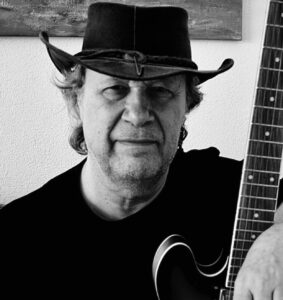
In this interview, Harry Kappen explores empathy, migration, and personal transformation, revealing how “Distant Shore” channels real-world struggles, cinematic influences, and his own journey into a deeply reflective musical statement.
1.“Distant Shore” reflects on the refugee experience with deep empathy—what was the emotional process like translating such complex, real-world struggles into music?
That is due to a number of factors; everyone is confronted with the refugee issue through the media, documentaries, the daily news, etc. Moreover, I likely possess an above-average capacity for empathy due to my work as a therapist. Additionally, I am a visual thinker and have no trouble translating information into images and, in this case, music.
‘Distant Shore’ came about after realizing that my own voluntary move from the Netherlands to Mexico is actually a luxury situation and stands in stark contrast to the terrible circumstances in which refugees find themselves. In my view, these are courageous people who leave their homes and everything behind to secure a better future for themselves and their families.
2. Having personally moved from the Netherlands to Mexico, how did your own “crossing” shape the perspective and message behind this song and the album After the Crossing?
As I outlined earlier; yes, certainly in the case of ‘Distant Shore’. But the other songs also relate to that move or to change. For example, ‘No Delays’ is about the moment I resolved to take matters into my own hands and take the leap, wherever it may lead. ‘While Life Is Rushing By’ is about the longing to be with my loved one, who was in Mexico at the time while I was still in the Netherlands. ‘Take a Step’ is about the fact that when you want change in your life, you have to take the first step yourself; if you set yourself in motion, the world around you changes too.
3. The track draws inspiration from Space Oddity—what elements of that influence did you reinterpret to create your own atmospheric and cinematic sound?
In my opinion, the atmosphere is mainly caused by the Mellotron I use. It creates a melancholic feeling that I enjoy. Furthermore, I wonder about Distant Shore: “…or will I fade into the night
and vanish from the sight…” which is, of course, directly linked to Major Tom, who has lost contact with earth and is floating in the infinite. In my case, crossing the Atlantic Ocean into a new phase in my life is somewhat comparable to that.
4. You’ve had a long career as a music therapist—how does that background influence the way you compose, especially when dealing with themes like displacement and resilience?
Musically, it has no influence whatsoever; I have been making music since my early years and have always composed my own songs. Lyrically, perhaps it does; having been able to guide my clients through their process for years, I have also gained more insights about myself and can talk about it more easily. I am trained to observe well and empathize with others, and I can also better adopt a position where I see connections more quickly. That helps when writing about the things happening around me. Even when it comes to displacement and resilience. These are never isolated phenomena; they are accompanied by a history and experiences. Naturally, my own life experience plays a part in this. I know by now that displacement is not a finite situation. Taking action myself and living more consciously in the ‘now’ helps with this.
5. Across your recent albums, you’ve been incredibly prolific. What has this post-Covid creative period unlocked for you artistically and personally?
The Covid period has made me particularly aware of how fragile life actually is. And how, as a human being, you are thrown back upon yourself. I had, and still have, a lot of unfinished music lying on the shelf, and during the pandemic I immediately resolved to finally work it out properly and finish it. To enjoy the ‘now’ more again, and not just wait around. As a result, I am already working on a new album that will be released next spring. I am proud of the current album, but that is no reason for me to sit back complacently. Not yet, at least. Incidentally, people can follow the new developments via my website www.harrykappen.com.
Additionally, I am in the process of forming a band with good Mexican musicians and hope to tour Europe next year to give a number of concerts, in cooperation with my management of MTS-records.
6. With “Distant Shore” carrying such a strong social message, what kind of conversations or impact do you hope the song will spark among listeners worldwide?
I am an observer of the things I see happening around me, and I provide musical commentary on them or express my opinion in an artistic manner. My goal is not to convey a message or to have an impact on people. What I do hope, however, is that the silent majority of people will start doing that more as well: making themselves heard, whether through an artistic means or not.
Nowadays, you hear more often in the media about extreme opinions; the left and the right shout the loudest and receive a lot of attention as a result. But ‘the middle’ is the place where compromises are reached through democratic means, and I believe that place deserves to be heard a bit louder. I created ‘Balance’ about this subject, the opening track of “After the crossing”.