
JUICE THA BLACK BEETHOVEN
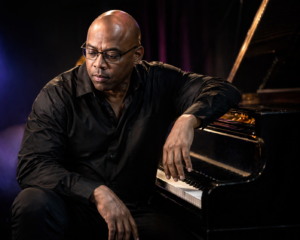
Blending Blues, Gospel, classical sophistication, and powerful storytelling, JUICE THA BLACK BEETHOVEN reflects on his rich musical upbringing, creative evolution, and the inspiration behind his vibrant new single “BIG BOY DRAWERS.”
1. You come from a strong musical lineage and a background deeply rooted in Gospel, Blues, and R&B. How did growing up in that environment shape your identity as JUICE THA BLACK BEETHOVEN?
This is a great question, but I must interject that both of my parents, Inez and Julius Sr., profoundly laid a rich treasure trove of other genres before me, including Classical Piano, Opera, Jazz, Afro-Cuban/Latin Jazz, Classical Guitar, and Church Music, including traditional hymns and sacred choral music.
Just as an example, my Father loved opera, and he also loved the Blues. My mother loved classical piano music and Classical Spanish Guitar music, as well as Latin/Brazilian jazz artists like Sergio Mendes & Brasil ’66. So, on any given day in my house, you might hear excerpts from Act I of Puccini’s Tosca or La Bohème, followed by several songs by B.B. King or Bobby “Blue” Bland. Follow that with Arthur Rubinstein playing the Chopin Nocturnes or Franz Liszt’s Piano Concerto in E-flat, then some Andrés Segovia, finally concluding with the latest album by Sergio Mendes & Brasil ’66. Add church every Sunday from the time I was born until I graduated from college, and that’s my complete musical lineage.
I hope that wasn’t too drawn out, but I needed to establish that my musical roots were definitely and firmly planted by my parents. To specifically answer your question, all of these genres prepared me to become JUICE THA BLACK BEETHOVEN. However, I didn’t know it back then, but I know it now. The reason that I fully embrace my musical upbringing today is because I want the world to know that when they hear a song by JUICE THA BLACK BEETHOVEN, they won’t know exactly what to expect. But what they WILL get is a well-written, musically satisfying song that tells a story and makes them cry, holler, scream, shout, laugh, think, or perhaps experience some combination of all those emotions.
2. With formal classical training and a career that spans multiple genres, how do you balance technical precision with the raw emotional feel that defines Blues music?
I hope this doesn’t sound too “cut and dry,” but the short answer is this: I am a musical perfectionist. I absolutely demand my very best work at all times in every aspect of my creative body of work, lyrics, song structure, arrangements, musicianship, production, PERIOD!
The other part of this answer lies in the fact that I am also a musical historian. As a former music teacher, I taught music history as a vital part of my teaching career. My personal philosophy about music, music performance, creativity, and artistry is that you must truly know the genre you’re presenting, and you must RESPECT that genre.
So, technical precision, both musically and lyrically, MUST be fused together with the raw honesty of Blues music. And for me, it’s equally important that I tell a story.
3. Your songwriting gained major recognition when Gloria Gaynor recorded “STRIVE.” How did that moment influence your confidence and direction as a composer and artist?
Oooh, this is an absolutely “delicious” question…LOL.
Ms. Gaynor recorded my song “STRIVE” around 1983, and it was included on her CBS album I AM GLORIA GAYNOR.
This was incredibly empowering and a tremendous confidence booster, as well as real validation as a songwriter, because I had been seriously writing songs and submitting them to record companies, music publishers, and producers since 1979, only to receive rejection after rejection after REJECTION! But during that entire period, I kept writing, kept studying songwriting, kept reading books about the music industry, and continued getting better and better at my craft.
So, when I got the call from her manager, Linwood Simon, who managed Ms. Gaynor at that time, he expressed tremendous optimism about the song and believed it had the potential to become a monster hit. Well, it didn’t become a monster hit, but it WAS released as a single, it reached #84 on the Billboard Hot 100 in the Summer of 1984, AND it was played on Dick Clark’s American Bandstand.
It was a wonderful experience, but it also taught me a great deal about both the music industry and life itself.
But I kept on writing songs…
4. Your latest single, “BIG BOY DRAWERS,” leans into humor and storytelling. What inspired the narrative behind the song, and how important is storytelling in your approach to Blues?
The truth is, you never EVER know where or when the creative inspiration for a song will come from, nor exactly what inspires it.
I actually started writing “BIG BOY DRAWERS” while waiting to board a plane at LAX Airport last November. I had just attended a music conference and left inspired to continue honing my craft. Also, I have always been somewhat of a “frustrated closet comedian” who never got his chance to be on stage, so I naturally try to inject humor, along with great storytelling, into my songs.
Ultimately, I just want to be totally unique so that, once again, when you hear a song written by JUICE THA BLACK BEETHOVEN, you know you’re going to hear something different and memorable.
I have always believed that songs, and especially song lyrics, should tell a story, hopefully one that listeners can personally relate to.
5. The track blends honky-tonk piano, Gospel harmonies, and a soulful groove. Can you walk us through your creative process when building such a rich and dynamic sound?
Yet ANOTHER GREAT QUESTION, and thank you for this one, too!
I firmly believe that every songwriter, whether it’s the late great Prince, Elton John, Stevie Wonder, Billy Joel, Mary Chapin Carpenter, Willie Nelson, Smokey Robinson, or JUICE THA BLACK BEETHOVEN, has his or her own unique creative process.
For me, at least 99% of my songs begin with the lyric. All I need to begin my songwriting process is a potential title or a verbal phrase that I can place into a musical rhythm. That’s it. Ironically, for me, that is also the most difficult part of songwriting.
After I have carefully, thoughtfully, and even prayerfully crafted the lyric, then I must match it with the best possible musical structure.
“BIG BOY DRAWERS” was actually somewhat simple. I had often heard the phrase, “Put on your big girl panties,” from television and everyday conversations, and part of my internal creative process was asking myself, “Hmmm…if women have big girl panties, why can’t men have BIG BOY DRAWERS?”
And then, BAM! I had a title.
After building the lyric and constructing the story to confirm the lyric’s validity, I knew the music itself had to be hard-hitting, dynamic, and in-your-face. I also wanted a somewhat traditional Blues sound, complete with harmonica, acoustic piano, and kick-ass vocals.
Since acoustic piano is my primary instrument, and because I also produced the recording, well…there you have it!
6. With your return to a more roots-oriented Blues style, what do you hope listeners take away from “BIG BOY DRAWERS,” and how does it represent the next chapter of your artistic journey?
WOW, again, a truly GREAT QUESTION. However, this answer is actually pretty easy.
I sincerely hope that anyone who listens to “BIG BOY DRAWERS” enjoys both the musical and lyrical journey. I hope listeners are gradually lured into the fabric of JUICE THA BLACK BEETHOVEN’S songwriting and storytelling, and then, at just the right moment, the musical and lyrical twist completely throws them off balance. Suddenly, they realize they were “set up” musically and lyrically all along, but they enjoyed every second of it and immediately want to hear more.
Here’s my final statement, for whatever it’s worth:
When I was sixteen years old, I wanted to become the greatest living concert pianist in the world…and honestly, a part of me still does.
But today, even more important to me than that…
I WANT TO BE THE GREATEST LIVING SONGWRITER.