
Mt. Kili
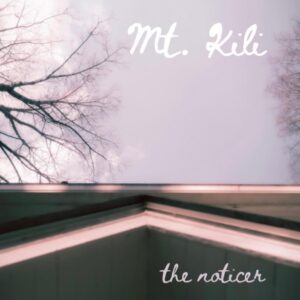
Mt. Kili explores the journey from intimate lullabies to profound reflections on love, life, and existence, blending heartfelt songwriting, cinematic arrangements, and a deeply personal independent artistic vision.
1. Mt. Kili began as a collection of home-recorded songs written for your twin daughters, eventually becoming a more developed musical project. How has the meaning and direction of Mt. Kili evolved since those early recordings, and what has remained at the heart of your songwriting?
The first record was giving: lullabies written at home for my daughters, meant for an audience of two. What’s changed is the direction of the questions. The Noticer turned the same attention outward — seeing the world and my own place in it — and the album I’m writing now asks the biggest questions I know how to ask. What hasn’t changed is the heart of it: every song still gets written for one person at a time, as honestly as I can manage, without dressing it up. If it wouldn’t be true sung in a kitchen, it doesn’t belong on a record. Life is about how much love we can create — that’s the whole reason the songs exist.
2. Your second album, The Noticer, moves between intimate voice-and-guitar arrangements and fuller, cinematic compositions. How did you decide which songs needed a more expansive sound, and how did working with Matt Shepard and Laney Barnett influence the final arrangements?
The songs decided, mostly. Most of them arrive whole — something tells me to hit the record button, hours pass, and the bones of the song are just there. Then it’s about protecting that. Some songs wanted to stay close — voice and guitar, nothing between the listener and the words. Others kept asking for room, and that’s where Matt and Laney came in. Matt’s drumming is foundational; he gives the quiet songs a pulse without ever pushing them, so a track can grow around him and still feel intimate. Laney’s violin and voice became the second narrator on the record — she answers the songs as much as accompanies them. She’s focusing on her own band now, and we’re grateful she was in the room for this one.
3. Songs such as “Kyle” and “The Weather Report” explore personal experiences through different emotional perspectives. How do you approach turning intimate feelings, memories, and observations into songs that listeners can connect with through their own experiences?
I try to write the specific thing as plainly as I can and then trust it. “Kyle” was written for a friend of mine who died young — he was charismatic, funny, loving, a light to everybody who knew him — and the song is about how short life can be, and enjoying right now instead of worrying about what’s to come. I didn’t write it to teach anyone that; it’s just true. “The Weather Report” comes from the other direction: ordinary observation. If I describe what I actually saw and felt, without inflating it, listeners seem to find their own memories waiting inside it.
4. “Her Song,” the album’s focus track, features a particularly delicate two-voice arrangement. What inspired this song, and how did you approach the vocal interplay to capture the intimacy and emotional atmosphere you wanted?
“Her Song” is about finding love only when the mind is quiet and you are not seeking — therein lies the ability to germinate. Most of us go looking for love with a noisy mind, checking and grasping, and the song is about the moment that stops. For the arrangement we wanted it to feel like that: unhurried, close, nothing reaching. Laney’s voice doesn’t sit on top of mine; it moves beside it, the way two people actually talk when they’re not performing for each other. We left air in it on purpose. The quiet is part of the song.
5. Recording at Echo Mountain Studio brought your songs into a professional studio environment, with Julian Dreyer engineering the sessions and David Glasser mastering the album. What was the most important lesson you took from this experience, and how did you preserve the direct, personal quality of your original home recordings?
The lesson was that a professional studio doesn’t have to cost you the personal — if you walk in playing the songs the way you played them at home, and you work with people who protect that. Julian engineered the sessions around the performances instead of building tracks around us, and David’s mastering kept the quiet parts quiet, which is rarer than it should be. We didn’t chase polish. The home recordings had one thing going for them: nothing to hide behind. We just carried that rule into a better room — and we’re carrying it back in this December, when we record Ikigai with Julian in the same room.
6. Your music has found an unexpectedly devoted international audience, particularly in the Philippines, while your next album, Ikigai, is already planned for release in 2027. How has connecting with listeners around the world influenced your perspective as an independent artist, and what can you tell us about the musical direction or ideas you’re exploring for the next record?
It still amazes me. Over one recent month, 888 of our 1,151 monthly Spotify listeners were in the Philippines — people on the other side of the world sitting with songs I wrote in Asheville. We published a letter to thank them properly: Maraming salamat sa pakikinig. It’s changed how I think about this work; the songs travel further than I’ll ever go, and they belong to whoever they reach. Ikigai, coming May 1, 2027, is the asking record. I wrote it alone in the Costa Rica jungle last summer, in a single night, on a children’s guitar — Matt had called me that day with the news that a close friend of his was dying, and the first song, “Rainbows,” just arrived. The songs that followed trace the biggest questions I know, in sequence. We record it this December at Echo Mountain.
Mt. Kili — Indie Folk from Asheville, NC | The Noticer (2026)