Michele Bettencourt
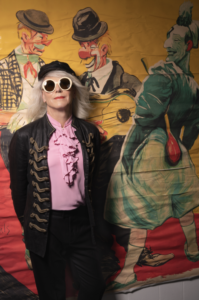
Michele Bettencourt reflects on her journey from Silicon Valley to music, exploring social inequality, personal transformation, powerful collaborations, and using art to amplify marginalized voices.
1. Your journey has taken you from the executive offices of Silicon Valley to finding your own voice as a singer-songwriter. Looking back, how has that transformation influenced the stories you feel compelled to tell through music today?
I was raised an only child in a lower middle class household in the 1960’s and saw how my parents struggled and saved and bought a house and lived on an income of $17,000 per year. Our life was blue collar. That experience was foundational.
Forging my way through Silicon Valley was transformative in that things moved so quickly, and my career evolved in ways I could have never imagined. I met with Steve Jobs on two separate occasions. I was on private jets with billionaires and opened stock markets multiple times. I saw how money moved and how it was horded by those at the top.
The juxtaposition of those two very different lives had a tremendous impact on me. It made the issue of income disparity and the inequities of tax policy crystal clear. Our songs Gilded Age, Jesus in a Red Hat, and Den of Thieves speak to these very issues.
2. Music surrounded you from an early age, with artists like Janis Joplin, Neil Young, and Crosby, Stills & Nash shaping your childhood. How have those early influences continued to inspire your songwriting and artistic identity?
When we were writing the album Vampire Time, the question I kept asking myself was if Neil Young, and Crosby Stills and Nash, and Joni Mitchell and Joan Baez, and the like, were in their twenties now- what would they been writing? How would they be speaking their truth?
The song “10,000 Flowers” is perhaps the closest we landed to emulating the smart story telling of the protest songs of the 1960’s.
3. Your documentary Beautiful Lie marked an important chapter in sharing your personal journey. What did the experience of making that film teach you about vulnerability, storytelling, and the power of being heard?
We shot the film “Beautiful Lie” in 2017 through early 2018. Personally, I was an absolute mess and probably over-rotated by not holding a lot back. For the longest time, I was afraid that the raw and unfiltered version of me would be repulsive.
I own the film outright and chose not to put the “Beautiful Lie” into distribution. Instead, I kept control of it and have shared it as an example of what a “a transition” looks like.
I am often surprised at the response I get from parents and grandparents of transgender children who have thanked me “for the context” if gave them. The fact that I was as honest and vulnerable as I could be made all the difference.
4. Your album with Vampire Time brought together an extraordinary group of musicians, including Carmine Rojas, Steve Ferrone, and Mike Visceglia. What was the creative atmosphere like during those sessions, and what did those collaborations bring to your music?
Every time I listen to the album, I am amazed at the quality of the musicianship and the production. For each of the songs, I showed up with lyrics and my thoughts on a melody. And then we’d get together as a band and work through the song.
For example, with the song “Taking Out the Trash” I recorded a demo in my home studio. It started out with an audio loop of heavy boots marching through a city. I added audio clips of speeches from Hitler and Trump. And then the lyrics and basic melody came rather quickly.
When recording at Flux Studio’s in New York City with Hendrik Hemlmer, Sari Greenberg, Everett Bradley, and Kerry Brown, we took a day and wrote and recorded the song together. I stayed in my lane with “strong opinions, loosely held.” Sari Greenberg had the brilliant idea of boot stomps in the studio- that we all did together. Kerry Brown had a drum set brought in and created the kick-snare beat that became the song’s backbone. Hendrik Hemler recorded the raw “slashing” guitar sound. Everett Bradley had smart vocal ideas that I followed and used. Each of us own an equal share of the song. It was a magical day.
When we moved the recording to Studio City Sound, Carmine Rojas created a searing bass track while Russ McKinnon added to Kerry’s kick-snare beat. Everyone came to the table to made the song better.
All the songs on the album have a similar collaboration story.
5. Your single “Gilded Age” reached number one on three charts. What does that achievement mean to you, particularly after everything you’ve experienced on the road to becoming the artist you are today?
We wrote the album wanting the music to be evocative and impactful and only recorded what we loved. Several songs did not make the cut.
Steve Ferrone played the drums on Gilded Age and told us afterwards that it would be a hit song, saying that he had the same feeling when recording “Ordinary World” with Duran Duran. This is heady stuff for someone who has such high regard for Tom Petty and the Heartbreakers.
When Gilded Age hit #1 and stayed in that position for four weeks on the NRH Top 40 chart, it was clear validation that we did something noteworthy, that our loose rubric of “evocative and impactful” was on point.
6. You’re currently working on new music and co-producing a documentary addressing the dismissal of transgender military personnel. How do you see your music and filmmaking coming together as platforms for the stories and issues that matter most to you?
In 2006 I founded a media company with Jerry Zucker (Airplane, The Naked Gun, Ghost, etc.) called National Banana. I was the founding CEO and Jerry was the founding Chief Creative Officer. We raised venture funding and I eventually helped to recruit a “media savvy” CEO as my expertise was in software. While National Banana didn’t do as well as we all hoped, Jerry and his wife Janet and I remained good friends from that experience.
It was Janet who got me involved with David Sigal and Richard Corman and the film “As You Are.” Given the topic of trans persons being treated unfairly and illegally, I could not look away. I initially wrote a small check to assist with editing costs and wrote the song “How Close” for the film as well.
I am now co-writing a song with grammy winning Chris Lennertz who is the film’s composer.
I got involved with the film because the topic and the film upset and moved me. Things have a funny way of evolving when done from the heart. I was also a producer of the trans-focused film “My Sunnyside” that was released in 2025.
When I was young, I wanted to be a writer. And I suppose I have grown into that as I write lyrics for songs that I help write. And that has morphed into my becoming a musician who enjoys playing a role in films that are important to me where I can be helpful.