
Usein Bekirov
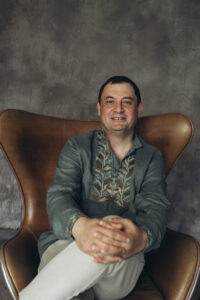
In this interview, Usein Bekirov discusses Dedication, a deeply personal album honoring his father’s legacy through jazz, fusion, Crimean Tatar traditions, and the emotional journey of grief and gratitude.
1. “Dedication” was born from the loss of your father, Riza Bekirov, who was also your first musical influence. How did his memory shape the writing and emotional direction of this album?
My father played an enormous role in my life and in the musician I became. He was the one who introduced me to music, and he shaped my relationship with it in many ways. After he passed away, I wanted to express things that are difficult to put into words. That is how “Dedication” came into being.
My father was not only my first teacher, but also a renowned musician who left a significant mark on the history of Crimean Tatar music. He was one of the founders of Sato, one of the first ensembles to bring Crimean Tatar folk music together with jazz. So, while working on “Dedication”, I was thinking not only about our relationship and personal memories, but also about the musical legacy he left behind. In a way, this album gave me the opportunity to continue a conversation with my father—this time in my own language, through my own music.
I did not set out to make an album about death. Rather, it was an attempt to preserve my connection with my father, with what he gave me, and with the memories that remain with me. Music became a way to process this loss and, at the same time, to thank him. Each composition reflects a particular state of mind, memory, or feeling, but at the heart of it all are love and gratitude.
2. Your music brings Crimean Tatar and Ukrainian musical traditions into dialogue with contemporary jazz, funk, fusion and classical influences. How do you approach balancing heritage with your desire to explore new musical territory?
For me, this is a very personal story because it all began with my family. My father, Riza Bekirov, was one of the founders and members of the Sato ensemble. I grew up listening to this music, and I was probably absorbing ideas that would later become part of my own musical language without even realizing it at the time.
So, turning to Crimean Tatar traditions is not simply an artistic choice for me. It is a connection to my roots, my father, and the history of my people. At the same time, I never wanted to limit myself to a single genre. I have been influenced by classical music, different schools of jazz, fusion, funk, and contemporary improvised music. I have always been interested in experimenting and searching for something new.
I believe a true legacy should not simply be copied—it should be developed further. My father and the musicians of Sato took a very important step in their time by bringing different musical worlds together. That approach resonates with me. I also want to explore new forms and sounds while preserving my connection to our culture. It is important to me that all these influences become a natural part of my music, rather than just a collection of different elements.
3. Rather than simply incorporating folk elements into jazz, you allow your cultural heritage to influence the architecture of the compositions themselves. What does that approach mean to you as a Crimean Tatar and Ukrainian artist?
For me, there is a big difference between using folk music as raw material and feeling it from within. Crimean Tatar music is part of my personal history, my childhood, and my family. I cannot see it simply as a collection of melodies or rhythms that can be added to a jazz composition.
When I work with folk traditions, I want to understand what lies inside the music: how the melody develops, how the rhythm feels, and what emotions are carried by its phrasing. Sometimes these very qualities shape the entire composition—its development, harmony, the interaction between instruments, and the character of the improvisation.
My father’s example is especially important to me here. He was one of the musicians who began exploring this path long before combining ethnic music and jazz became widespread. In Sato, Crimean Tatar folk music was not merely decoration for a jazz sound. It became the foundation for a new musical language. I would like to continue that line of exploration while speaking in my own voice.
My musical identity was also shaped in Ukraine. I received my classical education there, and it is where I live and work. Crimean Tatar and Ukrainian cultures do not contradict one another for me; both are part of my life and inner world.
I do not set out to combine these traditions deliberately. They already exist within me. What matters is finding a musical language through which I can express myself while remaining connected to my roots. If my music helps listeners discover Crimean Tatar culture, that is especially meaningful to me.
4. “Dedication” features an extraordinary international lineup, including Vinnie Colaiuta, Chris Dave, Hadrien Feraud, Keyon Harrold and Randy Jackson. What was it like bringing these musicians into such a personal and intimate project?
It was important to me that every musician bring something of their own to the album. I did not want everyone simply to play the parts I had written. I wanted to hear how different personalities and musical approaches would bring my compositions to life.
Working with musicians of this caliber is an extraordinary experience. Each has a distinct style, sound, and understanding of music. When musicians like these become part of the process, a composition begins to live in a new way. Sometimes the result is quite different from what you originally imagined, and that is precisely what makes collaboration so valuable.
With “Dedication”, however, the experience also carried a deeply personal meaning. The album is dedicated to my father, so it was much more than a professional collaboration for me.
I am sincerely grateful to Randy Jackson and Robert L. Smith for their contributions to “Dedication”. Special thanks go to Victoria Kohana, my longtime producer, for being by my side all these years. I also want to thank all the musicians and everyone who helped create this album. I am grateful to each of you for becoming part of this music.
5. The album moves through grief, tenderness, energy and even joy across its eight compositions. Was it important for you to show that remembering someone involves more than sadness?
Yes, absolutely. When you lose someone close to you, the pain is intense at first. But remembering that person is not only about sadness. It is also about love, gratitude, happy moments, conversations, and the seemingly ordinary things that take on special meaning over time.
I did not want the album to be devoted only to grief. Life is much more complex than that. Memories can be painful and full of light at the same time, and I wanted that to come through in the music.
For me, “Dedication” is not only a farewell, but also a continuation of my dialogue with my father. He is no longer here beside me, but so much of what he passed on to me continues to live within me—in my relationship with music, in my decisions, and in what I do today. Music allows me to express that connection without needing many words.
6. Looking beyond “Dedication,” what do you hope to carry forward from your father’s musical legacy, and what new chapter would you like to create for yourself as a composer and musician?
First and foremost, I want to preserve my father’s memory and what he left behind. For me, that means not only his music, but also his attitude toward his work, toward people, and toward life. It is important to me that his contribution to Crimean Tatar music is remembered and that this tradition continues to develop.
As for my own path, I want to keep growing as a composer, working at the intersection of classical music, jazz, and different cultural traditions, and searching for new forms and sounds. I am interested in trying things I have never done before and not resting on what I have already achieved.
I do not know in advance what the next chapter will look like. New ideas usually emerge in the process of working, and I like leaving room for the unexpected. “Dedication” has been a very important milestone for me, and I think it has changed a great deal in how I relate to music and to myself. But it is not the end of a journey. It is, rather, a continuation.