
Sarah Pillow
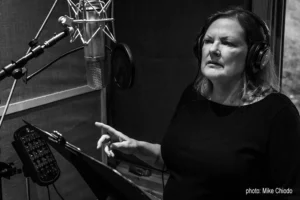
In this interview, Sarah Pillow explores Wanderer, her eclectic jazz album, discussing musical influences, creative collaborations, legendary composers, vocal improvisation, and the freedom to cross musical boundaries.
1. Your album Wanderer brings together compositions by artists as diverse as Charles Mingus, Dizzy Gillespie, Pat Metheny, and Sergio Mendes. What inspired you to explore such a wide-ranging repertoire, and how does the title Wanderer reflect your own musical journey?
I started my career as a jazz singer, then went on to study classical and opera, which also exposed me to 20th c. classical repertoire (n.b. ‘Café’ is a lyrical tribute to Erik Satie and the Dadaist movement). In New York I was introduced to ‘early music’ – both medieval and renaissance repertoire. I started working with Marc Wagnon in the early 90s and was introduce to the world of progressive rock, singing on his album ‘An Afterthought’. Wanderer is definitely a reflection of my musical journey, and it made sense for me to do a bit of wandering and exploration within the many genres of jazz as well.
2. Your career has taken you through jazz, classical singing, opera, and early music, including your work with Galileo’s Daughters and Nuove Musiche. How have these different musical disciplines influenced your approach to jazz improvisation and vocal interpretation?
There was a lot of improvisation happening in early Baroque repertoire. Musicians would take a composed melody and add a series of subdivisions within the notes to create a more interesting texture and color to their performance. This repertoire also was less tied to a ‘beat’ but to a ‘pulse’, and there is freedom within a pulse that you don’t have when following a strict beat. What we call opera today was created around that time as well, by a group of Florentine composers, poets and artists who wanted to bring back the art of Greek drama and declamatory speech, but set to music. That development became what we call a ‘recitative’ in opera – a reciting of sung text to move the story along. The text was always the most important aspect of early opera, not the sound of the voice, which you find in traditional opera singing. So I would say that coming from a jazz background made me more open to this way of interpretation of early music, and the concept of early opera and support of the text made me a better interpreter of jazz standards and the story in each song.
3. Your husband, vibraphonist Marc Wagnon, arranged the music for Wanderer and performs alongside an impressive ensemble featuring Donny McCaslin, Dave Kikoski, and Mike Clark. How did your creative collaboration with Marc shape the album’s sound, and what did these musicians bring to the recording process?
I wanted to do a recording of standards, but my collaborations with Marc have never been typical. We both always want to make something fresh and new, exploring the boundaries and getting as close to the edge as possible. Our two crossover collaborations, ‘Nuove Music’ and ‘Remixes’ put together early music with jazz and progressive rock, and featured members of Brand X, Percy Jones and the late great John Goodsall. Marc’s original jazz compositions usually incorporate horns, so he took up the challenge in writing all the horn arrangements for Wanderer. Dave Kikoski played on Marc’s first album, ’Shadowlines’, and Marc collaborated with Mike Clark on the album ‘Conjunction’ that is also on Buckyball Records. I have known Donny McCaslin since we were teenagers studying jazz in Santa Cruz, CA. We wanted musicians on the record who would invest in making something eclectic yet approachable, and we are very lucky to know all these guys.
4. The album features three rarely performed vocal interpretations of Charles Mingus compositions: Duke Ellington’s Sound of Love, Eclipse, and Tonight at Noon. What attracts you to Mingus’s musical universe, and what challenges did you encounter when writing your own lyrics for Tonight at Noon?
Charles Mingus is one of the most innovative and creative American composers in 20th-century music. We did three of his tunes on Wanderer simply because they are wonderful tunes. Mingus wrote his own lyrics to ‘Duke Ellington’s Sound of Love’ and ‘Eclipse’. Marc showed me ’Tonight at Noon’ and said, ‘we should do this one, too’. I was going to do it as a vocalese, but then I had a dream that I had a third eye….Marc thought I should incorporate it into the lyrics. And then I was further inspired after reading a quote that Sue Graham Mingus used in the prologue of her book, ’Tonight at Noon’: “Of course he knows he will be regarded as a madman from beginning to end, precisely because he is the exact opposite of a madman.” (Thomas Bernhard, The Lime Works) The babbling at the beginning, the mix of scat with text – Mingus wrote the tune as a reflection the midnight-to-dawn working life of a jazz musician, but I wanted to extend it into another universe.
5. Your interpretation of How High the Moon pays tribute to Ella Fitzgerald without attempting to imitate her, while A Night in Tunisia highlights your scat-singing abilities. How do you balance respect for jazz legends with the desire to establish your own distinctive voice when approaching such iconic compositions?
When I started to learn to improvise, I was encouraged to memorize the solos of famous artists like Ella and Dizzy. It’s the same concept that visual artists use in copying the work of master artists in order to find their own voice. I must have listened to the album ‘Ella at the Montreux Jazz Festival’ several hundred times. She would just, you know…go off. Scatting, paraphrasing, playing with her trio like an instrumentalist, it was breathtaking. So anything I learned, I owe to the legends. The way I make myself distinctive is by drawing on my own life experiences and what I can bring to jazz from my training in other genres.
6. From winning recognition for your vocal solo at the Montreux Jazz Festival to performing opera at Lincoln Center and Carnegie Hall, you’ve built a remarkably diverse career. Looking back on these experiences, what has been the most important lesson you’ve learned about artistic freedom, and what new musical territories would you still like to explore?
The most important thing I have learned about artistic freedom is to listen to advice, but spend more time determining whether or not you should treat it with a grain of salt. Artists make themselves vulnerable; they have to – but that can make a person too reactionary and defensive. Some very good advice I received early on was to separate the voice from the ego, because not everyone is going to like the voice, but that doesn’t mean they don’t like the person. One leap of faith I keep taking and will continue to take is melding old with new – songs written centuries ago that I treat with modern interpretations. I like the idea of pushing the envelope and making people question time itself, because in order to make time make sense to us humans, we treat it as a linear thing. But what we have conceptualized as ‘time’ is really all happening at once.