
Justin Pierce
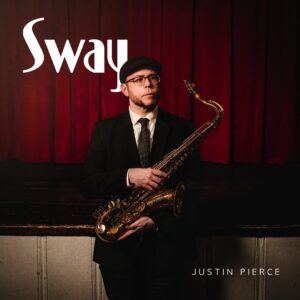
In this interview, saxophonist Justin Pierce discusses his debut quintet album Sway, his musical partnership with wife Ashley, jazz influences, creative arrangements, and future recording ambitions.
1. Sway marks the debut recording of your quintet, yet you and your wife, vocalist Ashley Pierce, have been performing together for more than 20 years. What made this the right moment to finally capture your musical partnership on an album, and how does the recording reflect the chemistry you’ve developed over those two decades?
Ashley and I met as music students at McNeese in Lake Charles, and we have been singing these songs together ever since: in supper clubs, at weddings, and at home with our five children. In 2024, while she was pregnant with our fifth, Ashley had a brain tumor removed. The surgery was a success, but it reminded us that time marches on. We wanted to share these songs with the world, with musician friends we have played with for a long time. Seven months pregnant, Ashley walked into a Dallas studio on May 5, 2025, and we recorded the album in one room.
2. Much of your musical journey has involved performing jazz standards for couples on the dance floor throughout the Dallas-Fort Worth area. How has that experience shaped your approach to swing, rhythm, and audience engagement, and how did you translate the energy of those live performances into Sway?
Jazz was originally social music. It brought people together in their moments of celebration, in dance halls and hotel ballrooms across the country. I learned that from my friend Ed Dix, who grew up in Kansas City in the 1940s and ’50s and heard Charlie Parker live. Playing for couples on the dance floor keeps you honest: the tempo has to feel good in the body, the groove has to be steady, and you read the room every minute. We cut Sway live in one room so that feeling would come through. “The Jody Grind” is for Ed, who died in 2020.
3. The album features imaginative reinterpretations of familiar compositions, including a faster version of Miles Davis’ “All Blues,” a samba treatment of “Meglio Stasera,” and parade-inspired rhythms on “L-O-V-E.” How do you decide which elements of a classic jazz composition to preserve and which to reinvent?
Jazz musicians have always used great compositions from popular music, classical music, and the American Songbook as canvases. We keep the harmonic framework and keep the melody recognizable, then bring our own cultural influences to it. Our years in Louisiana, playing lots of Mardi Gras balls, shaped that, and so do the second-line parades we play around Dallas-Fort Worth. That is where the parade feel on “All Blues” and “L-O-V-E” comes from. The Latin side, like the samba on “Meglio Stasera,” comes from a 2019 tour of Brazil.
4. Your rhythm section features pianist Sean Michael Giddings, bassist Young Heo, and drummer Matt Young, all connected to the University of North Texas’ celebrated One O’Clock Lab Band. What qualities made these musicians the ideal collaborators for Sway, and how did their individual musical personalities influence the arrangements?
Sean, Young, Matt, and I were all at North Texas around the same time, so we have built real chemistry. They also share our experience of playing for very different audiences: Sean in church and country music, Young with the Dallas String Quartet, and Matt touring with a rock band and engineering records for a lot of people. I love the precision they bring. Because of that chemistry and their focus, we were able to put this whole album together in the studio in one day.
5. Your playing combines the swing and bebop traditions, while your musical background includes studying at the University of North Texas and performing with artists such as Arturo Sandoval, Randy Brecker, and Bob Mintzer. Which experiences have had the greatest influence on your identity as a saxophonist, and how do you balance technical sophistication with the warmth and accessibility of your sound?
Rick Condit, my undergraduate mentor at McNeese, had a huge influence on me; he played with Stan Kenton. At the University of North Texas, being surrounded by so many jazz musicians was iron sharpening iron, alongside a world-class faculty: my mentor Brad Leali, who played with Harry Connick Jr. and the Count Basie Orchestra, and Steve Wiest, director of the One O’Clock Lab Band, who played with Maynard Ferguson and Doc Severinsen. They showed me what was possible in jazz. As for balance, I want audiences to hear the melody when I play, but I also want surprises, joy, and playfulness in it.
6. Sway moves naturally between joyful swing, romantic ballads, Latin rhythms, and soulful interpretations of songs such as “Just the Two of Us.” What do you hope listeners will take away from this collection, and what musical directions would you and Ashley like to explore together in future recordings?
I hope listeners find a vibrant collection of music that stands the test of time, brings back great memories, and brings them joy to accompany the best moments of their lives. Next, we definitely want to make a holiday record, record with our children who are musicians, and make a Latin album. We would also love an album leaning further into our Louisiana roots, and maybe a 1920s-themed record.