
Patrick Doval
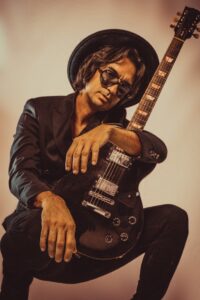
Patrick Doval blends rock energy with imaginative storytelling, combining melodic songwriting, cinematic influences, and creative visuals to explore themes of love, dreams, and the extraordinary possibilities of the human imagination.
1. “Rocket To The Moon” tells a surreal story about building a rocket, traveling to the moon, and falling in love with a mysterious robot. What inspired this unusual story, and what does the journey represent for you personally?
I’ve always been fascinated by the idea of chasing something that seems impossible, especially when it comes to love. I wanted to tell a story about someone who is so determined to find the love he has imagined that he literally builds a rocket and travels to the moon to find it. I liked the idea of taking a very human emotion and placing it in an unusual science-fiction world.
The robot becomes an unexpected part of that journey, and I wanted the story to feel a little surreal, romantic, and mysterious. Definitely inspired by Maria in Metropolis. For me, the journey represents the lengths we’re willing to go to find something we believe is missing from our lives. Sometimes we create an entire picture in our minds of what happiness should look like, and reality doesn’t always follow that picture. I like leaving room for people to interpret the story in their own way.
2. The song explores searching for someone you’ve dreamed about since childhood and taking a chance on the impossible. How do these themes connect with your own experiences, dreams, or approach to songwriting?
I think a lot of us grow up imagining what our lives will look like, who we’ll meet, and what we’ll eventually find. Those dreams can stay with us for years, even as life takes us in completely different directions. I’ve always been interested in that space between imagination and reality.
As a songwriter, I like taking an emotion or an idea and building a story around it rather than explaining everything directly. Sometimes a surreal situation can communicate something very real about the human experience.
I’ve also learned that pursuing a creative career means taking chances on things that might seem impossible at first. You have to believe in an idea before anyone else can see what you’re imagining. Whether it’s writing a song, making a music video, or pursuing an opportunity in film, there’s always an element of taking a leap of faith. That spirit is definitely part of Rocket To The Moon.
3. You collaborated with Pete Parada, formerly of The Offspring, on the track. How did Pete become involved, and what did his drumming bring to the sound and energy of “Rocket To The Moon”?
I’ve had a good working relationship with Pete Parada since “Soulless Machine”. I love his drumming, and his contribution to Rocket To The Moon was really important to the track. Pete has an incredible background as a drummer, including his time with The Offspring, and he brings a great combination of power, precision, and musicality.
I wanted the song to have that driving rock energy while still leaving room for the melodic and cinematic elements. The drums help give the track its momentum and bring the whole arrangement to life. Always grateful to have Pete play on my songs.
One of the things I appreciate about working with talented musicians is that they bring their own personality to a song. You start with an idea in your head, but another musician can add a dimension that makes the finished recording feel bigger and more dynamic. Pete’s playing helped give the song that energy.
4. The music video takes the song even further into the world of science fiction, with the rocket, the moon, and the mysterious robot. How did you translate the story you had in your head into a visual experience?
I approached the video almost like a miniature science-fiction film. I already had the story in my head, so the challenge was figuring out how to bring that world to life independently and make it feel cinematic without having a Hollywood production budget.
I used green-screen footage, compositing, Photoshop-created imagery, and AI-assisted visual elements to build the different environments. I enjoy experimenting with technology because it allows an independent artist to explore ideas that might otherwise be difficult or expensive to produce.
I also wanted the ending to leave the viewer with something unexpected. Without giving too much away, the journey doesn’t end quite the way you might expect, and there’s an underlying idea that we can’t always change certain things simply because we want to.
For me, the video is an extension of the song rather than just an illustration of the lyrics. I wanted people to be able to watch it and feel as though they’re entering a strange little universe of its own.
5. You’ve created more than 25 music videos and describe yourself as a visual storyteller as well as a songwriter and recording artist. How important is the visual side of your work when you are creating a new song?
It’s extremely important to me. I’ve always seen music and visual storytelling as closely connected. A song can create images in your mind, and a video can take those images and turn them into something tangible.
When I’m writing, I often find myself imagining scenes, characters, colors, and entire environments around the music. Sometimes those ideas become the foundation for a music video, and other times the visual concept develops alongside the song.
Having created more than 25 music videos, I’ve learned that visuals can open up another layer of meaning. You can tell a story through a character’s expression, a particular setting, or even a small detail that might not be obvious on the first viewing.
I also enjoy the fact that I can experiment and learn new techniques with each project. I’m not interested in making the same video over and over again. I want every song to have its own identity and visual world, whether the result is emotional, surreal, or cinematic.
6. You have released six albums and have several projects developing, including “Crush” appearing in an upcoming Hollywood feature film. Looking ahead, what new musical or cinematic ideas are you most excited to explore?
I’m currently working toward a new album, so I’m excited about continuing to develop my sound and seeing where the new material takes me. I have also recorded a new song and finished a new music video for a song soon to be released called “War of The Worlds” and inspired by the HG Wells novel. I want to keep the rock foundation of my music while exploring different atmospheres, textures, and storytelling approaches.
I’m also interested in continuing to push the visual side of my work. Every music video gives me an opportunity to experiment with new techniques and create something that feels different from what I’ve done before. I love the freedom of being able to take an idea from a song and develop it into a complete visual experience.
Having Crush featured in the end credits of Wounds, directed by Ron Krauss, has been a particularly meaningful milestone. I recently attended the film’s premiere at the TCL Chinese Theatre in Hollywood, and it was exciting to see my music connected to a feature film in that way.
I’d love to continue building that connection between music and cinema, whether through film placements, original visual projects, or future collaborations. Ultimately, I want to keep creating work that tells stories, takes creative risks, and connects with people emotionally. I still have a lot of ideas I want to bring to life, and that’s what keeps me excited about what’s ahead.