
Music by Jeremy
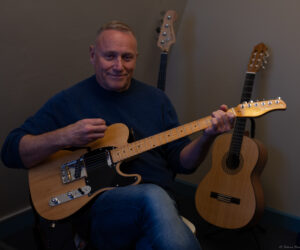
Music by Jeremy explores personal experiences, social inequality, philosophical questions, enduring love, and self-discovery on Scenes from a Well Worn Path (Side Three), the third chapter of a 24-track autobiographical project blending thoughtful songwriting with innovative arrangements.
1. Scenes from a Well Worn Path (Side Three) is the third part of a 24-track autobiographical project. How has creating the album as a four-part journey influenced the way you approach songwriting and storytelling?
As an autobiographical work, the approach has given me a framework to develop the songs within. The story is already there, so it’s been about finding the right words to tell it.
The album existed in a draft format before any of it was released, so the four parts were more about giving the space and time to focus on a manageable six tracks at a time.
2. Side Three turns outward, exploring wider social and philosophical questions while still maintaining a personal perspective. What inspired this shift, and why is it important for you to present questions rather than straightforward answers?
The shape of each Side was planned before all of the songs were written. It seemed right to give listeners an introduction and some background before looking further outwards.
The reason presenting questions is important is that the world is filled with binary commentators and opinions, but I’ve spent a long time in this world and I have yet to find anything that actually works that way. The beauty of life is the complexity and nuance; I wanted to celebrate that.
3. “Economic Possibilities for our Grandchildren” draws on Keynes and Macbeth to explore ideas about abundance, inequality, and fate. What sparked the song, and how do you balance complex references with accessible songwriting?
The spark was sheer anger. I came across Keynes’s 1930 essay recently and it really is worth reading. He mapped out a future where technology and productivity would solve the economic problem, gifting us leisure and abundance. I used to think the drift toward modern inequality and democratic feudalism was a tragic blunder, but reading Keynes makes you realize the abundance was always feasible; our systems simply chose to monetize and gatekeep it instead.
In a song, you can’t deliver a lecture, so you lean on storytelling and metaphor to balance the weight of the ideas. I truly hope I made it accessible enough for the core message to hit home, because that conversation matters far more than a few Spotify streams.
4. “I Don’t Know” approaches love through the unusual idea of a failed mathematical proof. What attracted you to using mathematics and philosophical ideas to express something as emotional and personal as love?
I’ve been married for a very long time, and I wanted to write a piece celebrating just how enduring and beautiful that partnership is.
My starting point was the folly of the analytical mind, the instinct to calculate, solve, or rationalize a relationship, only to discover that love defies formal proof. In a three- or four-minute song space is at a premium so you need metaphors that do heavy lifting quickly. Mathematical logic was the perfect foil: it sets up this rigid framework only to show that genuine devotion lives completely outside of it.
5. Your songs begin with acoustic guitar, voice, and often a guide lyric before being developed through Ableton and AI-assisted arrangements. How has this recording process changed the way you experiment with arrangements, structure, and performance?
The workflow came out of necessity because convening a full studio band wasn’t feasible, but it quickly became an incredible creative engine.
The biggest advantage is velocity. The debate around AI in music is fierce right now, but from a writer’s perspective, it functions as a phenomenal prototyping lab. I can take an acoustic idea in Ableton and generate a fully realized sonic sketch very quickly. It means I can take an arrangement into the car or listen on headphones to see if a structure, groove, or lyric truly holds water before committing to it.
Most tracks on this project went through rigorous iterations that simply wouldn’t have been practical or affordable in a conventional studio setup. While playing live with musicians is always a joy I look forward to, this hybrid setup gave me total autonomy to realize the vision for the record without compromise.
6. You describe yourself as someone who is aware of your own “frailties and contradictions.” Looking across Scenes from a Well Worn Path, what have you discovered about yourself through writing these songs, and where do you see the journey going next?
It has genuinely been a journey of discovery for me and I’m grateful for the experience. The biggest part has been to reconcile with my younger self, but the autobiographical approach has meant exposing things I felt shame or embarrassment about, so people’s positive reactions to those moments have been genuinely moving.
In making ‘Scenes’ I have learned an awful lot about songwriting both musically and lyrically, and I plan to continue with that journey. I have no shortage of ideas and there are musical styles I want to experiment with, so there will be new releases in 2027.
But right now, I’m taking a rest and just enjoying this release.