
Sef Fah
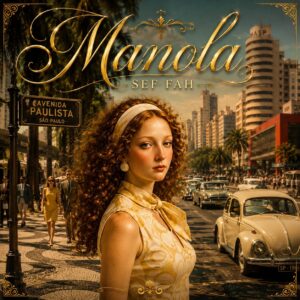
In this interview, Sef Fah explores the inspiration behind “Manola,” the challenges of songwriting, the creative possibilities of AI music, and the dream of sharing original songs with the world.
1. “Manola” began with a simple thought while you were sitting on a train, imagining what kind of song you might write for Madonna. The lyrics and melody appeared almost instantly, as if you were tuning into a radio station. Can you take us back to that moment and describe what it feels like when an entire song suddenly arrives in your mind?
First of all, I feel a little awkward giving an interview. I’ve never accepted any interviews before. I only started my promotion last July. I don’t think I’m important enough to give interviews, but a music writer from Nigeria contacted me recently and asked me some very clever questions, and I didn’t feel like turning him down. So I gave my first interview, and this is my second one. Maybe this is an opportunity for me to express myself a little better than I did during the first interview.
So, the thing is, I suddenly started hearing music in my head. At first, I thought it would stop. I was always thinking that maybe next week, or tomorrow, it would stop. It was like a happy schizophrenia, but, you know, it wasn’t something I was used to. I wasn’t born with it. So it was a little strange. It wasn’t unpleasant, but it was weird.
I was hearing what was like a private radio station, with lyrics and melodies.
One day, I was on a train, and I was bored. I felt that I couldn’t hear music voluntarily, that I had no control over the music I could hear in my head. So, I wondered: if a famous person asked me to write a song, would I be able to do it?
I was absolutely certain that I couldn’t. So, I picked someone. I picked Madonna, but I could have picked Barbra Streisand or anyone else. But I picked Madonna, and right away, within a few minutes, this song arrived in English.
So, it wasn’t different from the other songs I was hearing in my head. I cannot say whether it’s good or bad. It just comes, as if it didn’t belong to me. It’s very outside myself.
However, when I think about Madonna, I have this image of Frida Kahlo in my mind, and I also have the image of Madonna in the movie “Evita”. So, I think I was trying to connect with these two women, Frida Kahlo and Evita Perón, and I ended up with a kind of triangle.
2. You have explained how difficult it was to recreate the music you heard in your head when working with musicians and professional arrangers. Watching the documentary about George Michael helped you realize that other artists had experienced similar frustrations. How did these experiences change your understanding of your own creative process, and did you ever consider abandoning “Manola” altogether?
First of all, I’m a shy person. I like to please others, and I tend to make myself disappear. I’m not an accomplished musician. I hear melodies and lyrics, but I’m not a skilled musician, so perhaps I’m a little too humble in a recording studio. I don’t know how to assert myself or how to impose my point of view. And it’s a man’s world, although this has happened to me with women as well.
Sometimes I went into a studio, spent a lot of money on great musicians and a great recording studio, and then I didn’t like the sound at all. The whole thing went into the bin. I’m very polite, so I would say, “Oh, it’s great,” but I would never publish it because it wasn’t what I heard in my head. The version was simply too far away from mine.
If I tell skilled musicians that I don’t like what they’ve done, they might think I’m arrogant, when in fact I’m just trying to explain that I hear something very specific.
Imagine that nobody had ever heard “Twinkle, Twinkle, Little Star”. You sing it, and it has a very definite rhythm and melody. The words, the melody and the rhythm are so distinctive that you cannot really change them without changing the song itself.
Now imagine that the song isn’t famous yet, and I go into a recording studio and sing it. Everybody wants to improve it. Someone says it’s nothing special, just a little children’s song. Someone wants to make it jazzy, someone else wants to make it country, and others want to change the words or the melody.
But I hear “Twinkle, Twinkle, Little Star” as if it already existed in the world. I’m not saying it’s wonderful or fantastic. I’m simply saying that it’s already there. That’s what makes it difficult for me when everybody wants to improve it by changing everything.
The documentary about George Michael was fascinating for me because it helped me understand that this wasn’t necessarily something strange about my own creative process. He went to Nashville, which is a city I adore. I’ve been there, and I could imagine living there. He worked with some of the best musicians and recording studios, spent a fortune, and when he returned to London, he threw the recording away. It was for “Careless Whisper”, and eventually he found the saxophone sound that worked. But finding the right arrangement took a long time.
George Michael was a skilled musician who worked night and day on his arrangements and orchestration. If someone like him could experience those frustrations, perhaps I could forgive myself for having the same kind of difficulty.
That’s how the experience changed my understanding of my own creative process. I forgave myself. I was not so strange after all.
Yes, I abandoned “Manola”. I had recorded it in a recording studio with my own voice and a pianist, and it was written on sheet music with a registration number to protect it. But then I let it go. For years, I had this project of translating it into Portuguese, but I abandoned that idea too.
It wasn’t a new idea, though. I had had this project in mind for years because I fell in love with Seu Jorge’s Portuguese interpretations of David Bowie, and I listened to them hundreds of times.
Then, in February 2026, the idea came back, and I think it took me until the end of August to finally decide to publish it.
The melody and lyrics are exactly the same. In the English version, I simply removed the name Manola, or Madonna, and changed that part. I published the English version first. Later, the idea of translating the song into Portuguese came back.
I had already started publishing my songs in Portuguese, so this became the second song I translated into Portuguese and released. And, well, I think it wasn’t a bad idea at all. I really like the Portuguese version.
The English version is also from 2026
3. The song’s journey includes some fascinating possibilities, from imagining Madonna performing it to dreaming of a collaboration between Madonna and Seu Jorge. Eventually, the idea evolved into “Manola,” a character of her own. What made you decide to move away from the original concept, and how did transforming Madonna into Manola change the song’s identity or meaning for you?
So, I really follow Seu Jorge’s work. Any duet he would do with any singer, famous or not, I would be interested in hearing it.
I let go of the idea because it was too complicated, and it was just a game on the train. It was just an exercise on the train. I didn’t make it into something bigger than it was.
And the idea evolved into *Manola*. Yes, because I changed the name. Madonna is too heavy, and Manola, in fact, didn’t change much because the lyrics are still the same. But this is what is fascinating about music: it’s variation. You can vary whatever you want.
Manola, yes, she’s more 1960s São Paulo in my head. She has become a 1960s character from Brazil. She’s become different in my head.
The lyrics and melody are still the same only the name changed.
4. In February 2026, discovering AI music tools gave you a new way to experiment with orchestration and virtual voices without the financial limitations of traditional studio recording. You have also acknowledged the artistic and environmental concerns surrounding AI. Where do you personally draw the line between using technology as a creative tool and preserving the human identity at the heart of songwriting?
What I like about AI is that you can be anonymous. You don’t need to exist publicly. You can have your lyrics, melody and song without showing yourself, and this is something I really love, because you can have a serious job, or you can be, for example, a woman who was raised in a very conservative area and isn’t allowed to compose music. So AI is fantastic for a woman like that. She can do it anonymously. She can simply have an avatar, and she can live in a country where everything is forbidden and still exist as an artist.
I also work in the medical field with tetraplegic people, among whom there are lots of young men who have had motorbike accidents. And among these young men, there are lots of musicians and guitarists. I also worked in the field of autism, where you have people who are very talented but don’t always know how to communicate with the world. So I always have a medical perspective, too.
You can be a neurosurgeon who wants to release fun songs, but you cannot use your real name without jeopardizing your career. That’s why I think AI is an amazing tool.
I’m not sure I would have published my music so easily without it. I mean, the avatar helped me a lot because it meant I didn’t have to be as shy as usual. But I think a lot of people don’t want to be famous. A lot of people don’t want to show themselves, and a lot of people cannot do so. You can be a politician, a very serious politician, but have a song in your head that you want to release to the world, and you cannot do it under your own name. That’s why I think AI is fantastic.
Now, I don’t really understand this idea of *AI slop*. If you recreated *Wild Horses* by the Rolling Stones using AI, it would still be *Wild Horses* by the Rolling Stones. They would still own the copyright, and they would still receive the money from the songwriting.
It has already happened with quite a few songs, for example, *“Papaoutai”* by Stromae.
If you’re a songwriter, what has always been protected is the lyrics and the melody, never the orchestration or the voice. So, as a songwriter, you should have the right to use whatever you want. If you want to use a synthesizer, a violin or anything else, you can.
Now, if AI is able to write as well as Bob Dylan, hallelujah! I mean, if AI can write a song from a prompt, with no human being involved at all, and create a new song by Leonard Cohen or Bob Dylan, hallelujah!
But that hasn’t happened yet. And why do people call it AI slop? Because it’s not very interesting. When a song is generated from a prompt alone, it’s not very interesting. That’s why people call it AI slop.
But I don’t agree with calling the work of a real songwriter who uses AI *AI slop*. I’m sure that if David Bowie were still alive and, let’s say, he were very ill in a hospital bed, he would love using an avatar and AI.
When he started singing, he had a beautiful voice, of course. He was an amazing musician, but he always said that he would have cut off his arm rather than sing himself. He never wanted to sing himself. But if he were in a hospital bed somewhere, I’m 100% sure he would use AI.
And you couldn’t call it AI slop if the lyrics and melody were his, the orchestration was his, and even if the AI voice sounded 85% like his real voice. You could never call it AI slop.
5. You have contacted many singers in the hope that they might take your songs, interpret them in their own way and bring them to life, yet finding the right collaborators has proved challenging. Since you write your own lyrics and melodies and initially sing the songs yourself, what would your ideal collaboration look like? Is there a particular artist or vocalist, beyond Madonna and Seu Jorge, whose interpretation of one of your compositions you would love to hear?
I’ve contacted many unknown musicians, of course, but they all have their own projects. All of them, 100% of them, have their own projects. Even guitarists have their own projects. It’s very difficult to find a guitarist who is willing to play on someone else’s song or be part of a project that isn’t their own. They’re all songwriters, which is great, and I’m genuinely happy for them. But it makes it difficult for me to find people who are willing to work with me.
Sometimes, they prefer to do covers of songs by already famous artists. It’s a little sad, but that’s the way it is.
Something quite recent happened that illustrates this very well. I asked some elderly people and people with special needs who were part of a volunteer orchestra if they would help me rehearse. They weren’t interested, not even in listening to my music. They were already working on covers of famous songs. They weren’t interested in working with unknown musicians, or even in giving my music a chance. It made me feel very depressed.
So, when people say, “AI is taking jobs away from singers,” I wonder: which singers are we talking about? Where are they? I’ve contacted people who have even participated in “The Voice”, including someone who came tenth in a lesser-known part of the world, and they weren’t interested. So, tell me where these singers are, because I can’t seem to find them.
Of course, if my songs start reaching people, I’m sure I’ll attract more musicians who want to work with me.
My dream is for my songs to become part of the popular music of a country. I’d love for people to sing them in the streets, in bars, restaurants and hotels. I’d love to be walking down the street one day and suddenly hear a street musician playing one of my songs.
That would be the most wonderful thing imaginable. If that ever happened, I would consider it a real success in my life.
6. You have many unreleased songs waiting to be heard, and you are already exploring a new version of “Manola” with a more joyful, 1960s dance feel. Your music also reflects your international experiences and your love of different cultures and languages. What can listeners expect from your upcoming releases, and what would you ultimately like people to discover about you as a songwriter beyond the music itself?
The new version of *Manola* should have been released two weeks ago, and it’s ready. But I postponed it because I’m still promoting the first version. This new version is much more fun and danceable, with influences from the Brazilian Tropicalismo movement of the 1960s.
A Brazilian friend introduced me to Caetano Veloso’s *Superbacana*, and it hit me like a thunderbolt. There’s something about this song that I cannot quite explain. It has a certain charm that really stayed with me, and I kept it in my soul.
I also feel that I need to release a song featuring my own voice because it’s important for my credibility as an artist. So the next song after *Manola* will be in French, and hopefully it will be acoustic.