
Magdi Aboul-Kheir
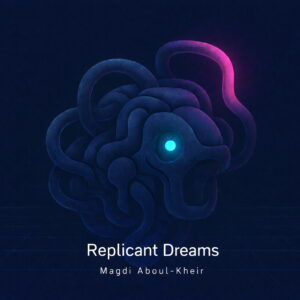
With Replicant Dreams, Magdi Aboul-Kheir explores retro-futuristic worlds through synthwave, orchestral textures, and emotional melodies, creating a cinematic journey where 1980s science fiction meets contemporary musical imagination.
1. Replicant Dreams takes listeners on a journey through the science fiction of the 1980s. What is it about that era’s vision of the future that continues to inspire you creatively?
These are visual and sonic worlds I grew up with, and they really spoke to me when I was young. Well, I guess, they still do 🙂 And of course, the stories, characters, and aesthetics of films like Blade Runner, Tron, and The Terminator have had a huge influence on pop culture. New films and series are still being made within these universes today.
Many of these works have become iconic, and their soundtracks have been hugely influential in shaping the sound and aesthetic of their respective eras. Exploring them creatively without simply creating copies or homages is incredibly fun.
What’s also interesting is that quite a few of those visions of the future have turned out to be surprisingly close to reality. In a way, we’re living in the “future” that was imagined back then. So for me, engaging with these worlds is about more than just nostalgia or retro aesthetics — there’s something about them that still feels very relevant today.
2. The album combines synthwave, orchestral elements, cinematic textures, and emotional melodies. How did you approach balancing these different sounds while keeping the album’s identity cohesive?
As I said, the idea isn’t to simply revive something from the past or stop at a straightforward homage. I carry all of these influences from that era with me, but I’m making this music today — and I’m approaching it in whatever way feels right, expressive, powerful, and emotionally resonant to me now. I think it’s the interplay of all these different elements that gives the album its own identity. At least, that’s what I hope.
3. You describe Replicant Dreams as a spiritual sequel to Yesterday’s Future, but also as something more expansive and emotional. What changed in your musical approach between the two albums?
To put it simply and in cinematic terms: this time, I used a bigger canvas. The music has more space to breathe, and especially through the more spacey elements, a new dimension has opened up.
4. Each of the nine tracks is described as opening up a world of its own. Did you have specific stories, images, films, or imaginary scenes in mind while composing these pieces?
I’m a little reluctant to answer that question too specifically, because I want every listener to imagine their own worlds when listening to the music. In some cases, I think the starting points are quite obvious — but they are always just starting points.
Sometimes it might be a particular image, an entire sequence, or simply the feeling I had while watching something. But sometimes it’s much more abstract and has more to do with an idea or an atmosphere than with a specific story or scene. Ultimately, I like the music to leave enough room for the listener’s own imagination.
5. Your background ranges from minimal and chamber music to ambient, jazz-influenced instrumentals and vintage electronics. How does being a pianist and composer across such different styles influence the way you write music?
I hope my roots as a pianist don’t shape the music I write too much. When you’re writing for strings or winds, I don’t think you should have a keyboard in the back of your mind.
What I really enjoy is finding the right musical form, the right musical language for whatever ideas, feelings, or thoughts I want to express. I find it enormously rewarding to move between different genres while still remaining true to myself. Because somehow, despite all the differences in style, all the music I write is connected.
6. Replicant Dreams mixes futuristic imagery with genuine human emotions such as romance, wonder, and nostalgia. What do you ultimately hope listeners feel or imagine when they reach the end of this sonic adventure?
You just said it: romance, wonder, and nostalgia.
But seriously, I like to think that every listener can go on a journey of their own with this music — wherever they want to go, and whenever they want to go there. It could be to another time, to distant worlds, or simply deep into their own inner world. If the music opens up that kind of space for someone, I couldn’t ask for more.