
Sergiy Bolotny
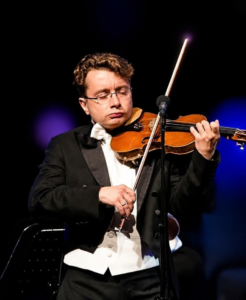
Violinist and composer Sergiy Bolotny explores Dutch musical heritage, Old-Viennese virtuosity, personal loss, and artistic authenticity in this intimate conversation surrounding his evocative Little Dutch Rhapsody No. 3.
1. Little Dutch Rhapsody No. 3 (“Capriccio Amsterdam”) draws inspiration from Pieter Goemans’ beloved “Aan de Amsterdamse grachten.” What attracted you to this particular melody, and what does it personally represent to you?
I love this melody. It carries that typical European post-war spirit: “Life goes on, and everything will be okay”. That is truly the motto of the song. There were many songs written in that era, but “Aan de Amsterdamse grachten” became uniquely iconic because of its warm, energetic melody.
Another reason is that Amsterdam is such a special city. The moment you arrive, you immediately feel the unique atmosphere of the canals. Just like Vienna has the “Blue Danube” and the Strauss waltzes, or Barcelona has Freddie Mercury’s anthem, Amsterdam has this song. And ultimately, I just want to interpret and express everything through my violin—like a true “Fiddler on the Roof”!
2. You transform this familiar Dutch theme through the tradition of Old-Viennese violin virtuosity, particularly the influence of Fritz Kreisler. How did Kreisler’s musical language shape your approach to the piece?
Fritz Kreisler was a genius. Only he was able to capture that uniquely charming “light classical” salon style on the violin. In piano literature, composers like Chopin created incredible salon masterworks, but violin music before Kreisler was almost always strictly academic, heavy, and intensely serious—virtuosic concert pieces meant to impress. Kreisler invented an entirely new genre.
After his Liebesleid, I feel there is little left to say in that exact violin-and-piano format—it is practically impossible to follow him literally without repeating what he perfected. However, I try to channel his warm spirit into my works for solo violin. And, of course, having lived and studied in Vienna for 14 years, that Old-Viennese musical dialect became an inseparable part of my artistic DNA.
3. The rhapsody combines lyrical cantabile playing, rubato, double-stop counterpoint and virtuosic variations. What were some of the biggest musical challenges in bringing all these elements together in a single solo violin work?
To be honest, I wrote this entire piece in just two hours. It came during the most painful moment of my life: August 2021, back in Ukraine just before the war started, when both of my parents passed away. My mother died on August 4th, and my father on August 29th.
Right after my father’s funeral, as I was packing to return to the Netherlands, I was sitting alone in my family home. Time felt like it had completely stopped. To find solace, I picked up my violin and started playing this sweet tune, “Aan de Amsterdamse grachten”. Suddenly, a deep feeling washed over me: I realized that the Netherlands has become my home now. The piece felt as if it was being dictated to me from above—perhaps by God, or by an inner voice. Because of that profound emotional flow, all the technical counterpoint, variations, and double stops came together completely naturally.
4. Your Little Dutch Rhapsodies explore Dutch regional culture and musical memory. How has living and working in Groningen influenced your perspective on Dutch heritage and inspired your compositions?
Groningen is a fascinating, proud city with a distinct character, its own dialect, and its own anthem. The people here carry a deep pride in their roots, and that touched me from my very first days here.
Every January, our Noord Nederlands Orkest plays a series of New Year concerts, and we always open each program with the “Grönnens Laid” (the anthem of Groningen). The moment we strike the first notes, the entire audience stands up and sings along at the top of their lungs together with the orchestra. It is an incredible, spine-tingling emotional moment every single year. That deep regional connection inspired my Little Dutch Rhapsody No. 4, which consists of variations on this very Groningen anthem.
5. You chose to record Capriccio Amsterdam acoustically, preserving natural room resonance rather than relying on heavy digital production. What do you want listeners to hear or feel in that more intimate and unvarnished sound?
There are two main reasons for this choice. First, I compose continuously, practically every day, and I frequently refine my pieces. Booking a commercial studio and a team of engineers every time I write something new would be impractical and financially unsustainable. Recording in my own acoustic space gives me total artistic freedom: if inspiration strikes today, I can record immediately.
Second, so many modern classical recordings have become overly edited, sterile, and artificial. You hear digital perfection, but you lose the human personality. In this recording, I am completely exposed and unvarnished—perhaps vulnerable, but it is 100% authentic Sergiy Bolotny.
6. With your work as a concert violinist, orchestral musician and composer, you move between several musical worlds. What would you like listeners to discover about you and your artistic identity through Little Dutch Rhapsody no.3?
A musician’s life can be wonderfully colorful and diverse. In the morning, you rehearse a Mahler symphony in the orchestra; in the evening, you might play in a jazz café; late at night, you compose a solo violin piece; and the next morning, you are back in your concert tails.
That constant motion—that kaleidoscope of moods and shifting colors—is the essence of Capriccio Amsterdam. I recently tested some of my pieces on SubmitHub to get raw, unfiltered feedback from other musicians. One reviewer wrote: “Your music is so weird… the mood keeps shifting constantly!” I laughed out loud—that is honestly the highest compliment! It is capricious, theatrical, and alive. That is who I am as a musician.