Hal Neink
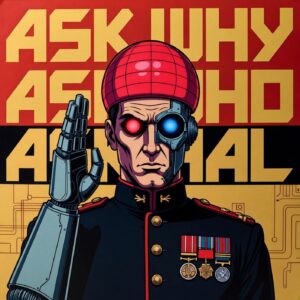
After two decades of private songwriting, Hal Neink steps into the spotlight, blending quirky influences, personal stories, social commentary, and heartfelt creativity.
1. “Ask Why, Ask Who, Ask Hal” is the result of a journey that began with you writing songs privately for around 20 years. What finally gave you the tools and confidence to bring those songs to life and share them with the world?
I don’t think I’ve ever outgrew my teenage shyness, haha. In some ways, I’m still sitting in my dirty childhood bedroom scribbling lyrics into a cheap dollar-store journal. Using a persona like Hal lets me set aside the anxiety and focus on making the sounds and verses that I’ve had inside for a while. But really, the biggest push came from my friends Remy and Steve. We’d made content together for years, where I preferred to stay behind the scenes. We stared using Ai and Synthesizers to make funny songs for their podcasts and it awoken that young songwriter in me. Through their encouragement, I decided to let Hal out to the world.
2. You describe Devo, Dick Dale, and Iron Butterfly as key influences on the album. What do you love about each of these artists, and how did you combine such different musical worlds into the Hal Neink sound?
The biggest visual influence was Devo. I love the over-the-top machine-satire and I think synth-pop blends well with everything, but especially the twangy sea sounds of Surf Rock. The first time I heard Miserlou, I was hooked. The Iron Butterfly influence is most prominent in my Road Trilogy: Cosmic Road, Road Unending, and End of the Road. Which is a story of a middle aged man discovering psychedelics late in life. I loved the combination of genres so much, I try to keep them in every song. I call it Nerd Pop, but I’m sure it has a better name out there.
3. As your debut album, “Ask Why, Ask Who, Ask Hal” represents a major milestone, even though you feel you have created stronger music since. Looking back, what does this first release mean to you today?
I am very proud of “Ask Hal” because it was the first album I released publicly. Also, telling a consistent story like the Road trilogy is great too, hopefully it leads to a solid concept album in the future!
I wasn’t sure if I’d ever release anything afterwards so I can definitely appreciate getting some of my music out. I don’t dislike Ask Hal at all, I was just saying there’s more to come! 🙂
4. Tracks such as “Projection” and “¼” take aim at what you describe as “terminally online hypocrites.” What inspired these songs, and how do you approach turning contemporary social observations and frustrations into music?
It’s embarrassing to admit, but I got pretty invested in an online-beef between a couple of tiny personalities and it had all the makings of a good soap opera… But I’d really hate to give them more attention here. It’s like a conman arguing with a panhandler in an alley. Sure, we’re going to watch, but who else will care?
As for social commentary, most of my songs are some sort of social commentary, even if I try to minimize it in the lyrics. I don’t want to preach or judge so harshly that I alienate anyone, especially since my own views are subject to change with time and evidence.
5. You are creating Hal Neink music not only as an artist but also as a single father, with the hope of eventually sharing your work with your daughter when she is older. How does that personal motivation influence the way you write and create?
Mostly, I started using substantially less curse words! My oldest is a much better musician than I am and I hope to inspire her to put her own work out there one day. She has fairly severe ASD, but I want to show her how capable she really is by carving even a tiny path forward for her.
6. After spending so many years writing privately and now having your music reach listeners, what have you learned about yourself as an artist—and what can we expect next from Hal Neink?
It’s still a little overwhelming! I’m really proud of it, but I don’t think I was in a place before now.
It’s very strange in a lot of ways. In the past, I’ve had to stop myself and ask “Is this how Dave feels or is this what X-character feels?” but by being honest with myself and others about my own emotions, I’ve discovered that the difference rarely matters to the end product. Sometimes a song is my thoughts on a subject, sometimes it’s an alternative POV, sometimes it’s a caricature of either or both. It will be interpreted however the listener wants to hear it, and that’s OK!
Art should have intent but once you give it to the world, everyone’s interpretation becomes how they enjoy it forever.
And I think that’s really cool, if a little intimidating.