
Trude and Soldiers
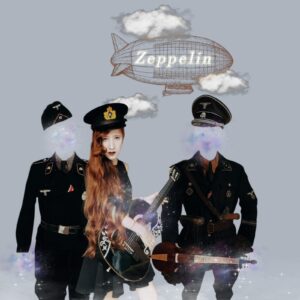
Trude and Soldiers explore history, imagination, and theatrical storytelling in this fascinating interview, discussing “Zeppelin,” their circus roots, and their distinctive musical universe.
1. “Zeppelin” takes inspiration from Ferdinand von Zeppelin and the pioneering spirit of early aviation. What drew you to his story, and what does his dream represent within the world of Trude and Soldiers?
First of all, I want to thank you for this interview. As for us—Zeppelin—we are drawn to that positive, innovative vibe of the past; it symbolizes the dreamer who brings an “impossible” idea to life through a tangible machine. Ferdinand von Zeppelin had to overcome economic, technical, and social hurdles to develop his airships; his early prototypes failed before the Zeppelin project achieved global recognition. This shows us that a massive, renowned project was once small and obscure—nothing more than a dream. A dreamer’s greatest ambition is to execute their ideas in a way that keeps their legacy alive for future generations. That is, without a doubt, what this song represents within the universe of Trude and Soldiers.
2. The song contrasts the creativity and ambition of the Zeppelin era with today’s technology-driven society. Why do you feel modernity can sometimes discourage originality and imagination?
The modernity we experience today was achieved, in part, through the labour and perseverance of past generations who contributed to the future; a process unfolded to allow us to enjoy the present state of affairs. People continue to innovate and make history, aided by the technology at our disposal—following a logical evolutionary path combined with modern creative tools. However, we also believe that modernity can undermine the arduous creative process of many individuals; they may abandon their work after being wrongly persuaded that ease, speed, and sheer volume are superior to an artistic process rooted in time-consuming, rigorous, and technical production methods. This fosters the illusion of a “liquid,” unstable society where, if the technology and creative tools were removed, these individuals would be unable to create even the basics—simply because they bypassed the process of personal artistic evolution.
3. Your music combines historical, political, and military themes with poetic and psychological storytelling. How do you approach transforming difficult subjects such as war and Nazi-era history into music without losing their emotional and human complexity?
Well, that is something we really enjoy doing naturally, but we believe that certain techniques—combined with a passion for history—lead us to musical territory. We have generally relied on philosophical verisimilitude to tell stories without losing that humanistic quality; I also think circus arts have taught us a great deal about this kind of immersion.
4. The lyrics move between English and German and introduce poetic figures such as Helio and his brother. Can you explain the symbolism behind these characters and how they contribute to the song’s surreal atmosphere?
Helio’s brother was a pivotal figure in making it possible for the Zeppelins to fly and the magic to unfold; however, Helio stole the spotlight—as the U.S. favored him over his brother for reasons of strategic convenience against the Third Reich—yet both played noble roles in the musical poetry of the Zeppelin. The German word *Freund* can mean “friend” or “boyfriend” depending on the linguistic context, but here, the term gains resonance through the historical duality of two brothers vying for Trude’s affections using the charms of the periodic table.
5. Trude and Soldiers began performing in circus shows in Frankfurt in 2012 before expanding into the digital world in 2025. How did those circus beginnings shape the band’s theatrical identity and storytelling style?
We believe that identity responds to the musical narrative in an active, intellectual, and cohesive manner. We also wish to thank the circus for the invaluable lessons of 2012; it was—and remains—a surreal experience. Circus arts provide a foundation that any artist should explore and immerse themselves in if they wish to shun amateurism.
6. With harmonica, flute, organ, synthesizers, guitar, clavichord, and extreme contrasts in the vocal delivery, “Zeppelin” has a very distinctive sonic world. How did you develop the musical atmosphere that makes the listener feel transported back to another era?
We believe that all the producers—whom we call “soldiers”—working with us are responsible for creating that unique, period-evoking musical atmosphere. As for “Geist von Hans,” the producer behind this track, together with Gertrude, creates a dreamlike, timeless synesthesia for each sonic chapter of our group.