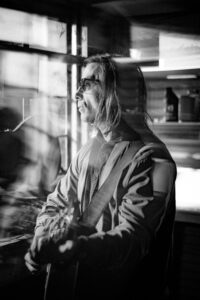
Frederick James
With his debut EP Let Me Give You A Good Day, Frederick James transforms hardship, family, fatherhood and hope into honest songwriting, while sharing the creative journey behind his growing catalogue and future album.
1. Your debut EP, Let Me Give You A Good Day, explores hardship, healing, family, fatherhood and hope. What was the emotional journey behind bringing these four songs together as your first EP?
The four songs weren’t originally written with an EP in mind. They came out of a pretty intense period of writing where I was trying to make sense of family, relationships and some difficult moments, but I didn’t want the record to feel bleak.
There’s hope running through all four songs. Let Me Give You A Good Day felt like the right title because that’s ultimately where the EP lands for me. Life can be difficult, but there are still good days amongst it.
2. The lead single, Pound of Flesh, is about those moments when life feels like it has taken everything from you while still believing better days are ahead. What inspired the song, and what does hope mean to you personally?
Pound of Flesh came from that feeling that life occasionally wants another piece of you when you don’t feel like you’ve got much left to give.
But I didn’t want to write a song that just wallowed in that. I’ve always been interested in that tension between acknowledging that things can be shit and still believing they’re going to get better.
Hope, to me, isn’t pretending everything’s fine. It’s believing that where you are today isn’t necessarily where you’re going to end up.
3. You wrote more than 300 songs, including over 230 in just six months. What triggered this incredible creative period in 2024, and how has writing so consistently changed the way you understand yourself as a songwriter?
Something just opened up creatively in 2024. I’d spent a long time away from music and then suddenly I couldn’t stop writing. I wrote more than 230 songs in around six months, and I’m at about 350 songs now, which sounds slightly ridiculous when I say it out loud.
Writing that much taught me not to treat every song like it had to be important. You write it, finish it, learn something from it and move onto the next one.
Inevitably not all of them will be hits but buried amongst them are songs I don’t think I could have written if I hadn’t written the hundred before them.
4. You also performed more than 75 open mic sets throughout 2025. How did playing your songs live influence your songwriting, and did any particular song evolve significantly because of the audience’s reaction?
The open mics were deliberate. I hadn’t performed properly for years, so rather than waiting until I felt “ready”, I decided the quickest way to learn was to get onstage constantly. I ended up doing more than 75 sets during 2025.
It taught me fairly quickly which songs survive when it’s just me, an acoustic guitar and a room full of people who aren’t obliged to listen. That’s quite a brutal test of a song, but a useful one.
It also made me much less precious about performing. You learn far more from doing it 75 times than thinking about doing it 75 times.
5. Your music draws inspiration from artists such as Noel Gallagher, Noah Kahan and Zach Bryan. What have you taken from each of these artists, and how do you make sure those influences become part of your own voice rather than simply sounding familiar?
Noel Gallagher is probably the earliest influence of the three. I love the simplicity and confidence of the songwriting and his ability to write huge melodies without making them complicated.
With Noah Kahan, it’s the conversational honesty and detail. Zach Bryan has that same willingness to leave some rough edges around things and let the story carry the song.
I’m not consciously trying to combine those three when I write, though. Influences are probably most useful when you stop thinking about them. Eventually everything you’ve listened to gets mixed up with your own experiences and hopefully what comes out sounds like you.
6. You describe this EP as the first chapter of a much bigger catalogue, with a full-length album already taking shape. What can listeners expect from the next chapter of Frederick James, and what kind of artist do you hope to become as this journey develops?
The EP is really the starting point. I actually start recording my debut album in two weeks, which is exciting and slightly terrifying in equal measure. That’s planned for next year, and between now and then I’m putting much more emphasis on the live side, proper shows, support slots and festivals.
I don’t have some grand idea of the artist I’m supposed to become. I want to keep writing songs that feel honest, get better live and build an audience that genuinely cares about the music.
If I can keep doing those things, I’m pretty happy to see where Frederick James ends up.