
Floyds Row
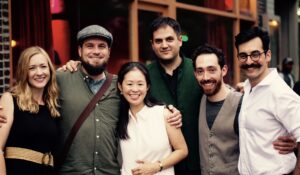
With The Carlisle Sessions, Floyds Row breathes new life into centuries-old melodies, blending tradition and innovation. We discuss the ensemble’s creative vision, collaborative spirit, and musical evolution.
1. Floyds Row brings together influences from early music, folk traditions, classical performance, newgrass, and world music. How did the vision for this unique musical collective first take shape, and what continues to inspire its artistic direction?
Chris Ferebee: Floyds Row grew out of a series of gigs and a recording project that I did as part of my doctorate at St. Hilda’s College, Oxford. I’d been listening to bands like Bellowhead and Punch Brothers, and for years, I’d wanted to start an ensemble which similarly reimagined really old English traditional music (music I dearly love) with a kind of classical bend. I was in the midst of a multi-year, multi-gig plan to eventually produce this recording when it dawned on me. I had just heard and met Early Musician Andrew Arceci, and I was gearing up to do the first of two gigs with Northumbrian traditional musician Alistair Anderson at St. Hilda’s College when I realised that this could be the makings of that recording—this could be that ensemble. I then thought even more audaciously and wondered if I could ask traditional musician Hannah James to sing. Fortunately, not only did all of these amazing folks sign on, St. Hilda’s backed us all of the way and the result was The Oxford Sessions.
Honestly, I think what drives Floyds Row is freedom. The tunes and stories we center on are indeed old, but to each of us, they’re just as vital as they ever were. So, there’s a marked freedom there; a freedom to bring our own individual approaches, from our own time and place, to this world-past. There’s no rules, no strict adherence to Historically Informed Performance, only that which a song ‘needs’ based on our individual, and collective, approach.
2. Your latest release has been described as treating centuries-old music as “raw material for something current” rather than aiming for strict historical authenticity. How do you balance respect for tradition with the freedom to reinterpret these works for modern audiences?
George Lykogiannis: This is such a fascinating question; on one hand, we give a lot of thought to how we arrange these tunes and how we approach them. Yet on the other hand, we are all so versed in historical performance and the idiosyncrasies of our instrumentation, we trust our training to keep us on track. Any time we decide to do anything markedly outside of the realm of acceptable performance practice, we discuss it amongst the group and decide if it would add to the piece at all. Like any good dish, you can’t overdo the spices!
3. The ensemble features musicians with remarkably diverse backgrounds, from medieval and baroque performance to jazz, ethnomusicology, and Middle Eastern traditions. How do these different musical perspectives shape your creative process in rehearsals and recordings?
George Lykogiannis: Because of our diverse backgrounds as musicians, we all bring interesting perspectives to the group as we build a piece and work to arrange it for the ensemble. The music we work from is generally very sparse- sometimes it looks like a lead sheet (one line of melody and chords) and sometimes parts are more fleshed out—but our music is always notated in an approximate way, giving the ensemble a lot of breathing room in how we arrange the piece. Generally, the music we are working with is very old, and we generally start with some faithful historic reading of the music (or as close to one with our instrumentation). But as we workshop ideas, we tend to lean into the fact that these tunes have been around forever because they are really good, catchy tunes; we trust ourselves and each other with our musicianship to strike the right balance between all of our backgrounds. Like a lot of ensemble work, it ultimately comes down to listening, trusting each other, and tastefully adding to the texture.
4. Many of your members are also educators, researchers, and scholars. How does your academic work influence the way you discover, arrange, and perform historical repertoire without making it feel like a museum piece?
Andrew Arceci: Asako Takeuchi, Emily Noël, and I are Baroque specialists, but Floyds Row isn’t an early music ensemble; we’re a collective that explores historical material through a contemporary lens.
We enjoy tracing a tune’s journey—how it traveled between lands, when lyrics were adapted, and how different cultures shaped the same piece. That research helps us understand its cultural context, but it’s just a starting point. Scholarship informs our artistic decisions, helping us make thoughtful choices about interpretation, arrangement, and ultimately, presentation.
5. Floyds Row grew out of collaborations at the University of Oxford before evolving into a recording and performing ensemble. Looking back, what have been the most rewarding moments in the group’s journey, and how has your sound developed since The Oxford Sessions?
Chris Ferebee: Speaking for myself, the first moment was the morning after we’d finished the majority of the recording for The Oxford Sessions. Though we were dog tired and at a local coffee shop trying to caffeinate before doing the last few overdubs, there was an air of both relief (that we’d made it to the finish line), but also of excitement; there was a feeling that something special had been done.
Another was at the final concert of the Winchendon Music Festival in 2018. It was a night where everything just musically and emotionally clicked; it was one of those fortuitous cosmic alignments between the audience, us as a band, and the anonymous composers lost beyond the veil. It was an amazing night.
With Floyds Row being an intentional ‘collective’ of different musicians from all over the world, I think that the sound will continue developing from person to person, gig to gig, recording to recording. It’s one of the things that make this ensemble special; there’s a host of people who love this music, who believe it has an important place in the modern world, and are prepared to give of themselves to that end.
6. As listeners discover your latest release, what do you hope they take away from the experience, and are there any new projects or musical directions that Floyds Row is excited to explore in the near future?
George Lykogiannis: As listeners hear the album, we hope that they come away feeling all the emotions we imbued in the album—joy, sorrow, yearning, hope, warmth, heartbreak—the scope of the album is quite broad, in spite of only having a handful of tracks.