Dan Higgins
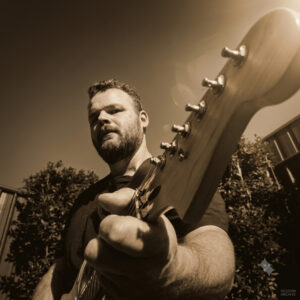
Welsh-born and Adelaide-based musician Dan Higgins discusses his debut album Twenty Twenty Six, his songwriting journey, creative recording process, and the inspirations behind his heartfelt indie rock sound.
1. For readers discovering your music for the first time, can you introduce yourself and tell us about your journey from Monmouth, Wales, to Adelaide, Australia?
Hi! I’m Dan, and I’m a songwriter and guitar player. I grew up in Monmouth, Wales – a picturesque market town on the Welsh border, with a huge amount of history! After I finished school, I moved to Australia. Spending my initial years in Sydney, I ended up moving around a bit after that, eventually settling in Adelaide in 2015. I met the woman that’s now my wife in the first few weeks of arriving in Adelaide, so we’ve set up our life together here ever since.
2. You started recording songs on a tape recorder and later a 4-track Portastudio. How did those early experiences influence the way you approach songwriting and recording today?
I think the biggest thing I picked up from those early recording experiences was a willingness to experiment, and to find interesting ways to work around limitations in equipment. I remember when I first got the portastudio, going from recording on a tape recorder to being able to replay 4 tracks at once felt huge.
3. Your debut album Twenty Twenty Six arrives on August 1st. What inspired you to take the leap from releasing individual songs to creating a full-length album?
Recording an album has always been a bit of a bucket list item for me, but up until recently, I felt like it was totally out of my grasp.
In mid-2024, I felt compelled to get back into writing and recording. I set myself the challenge to write and record at least one new song a month. I ended up building a small catalogue of 13 songs (admittedly of varying quality), before taking a break to refresh myself. At the start of 2026, I decided I wanted to attempt something a bit bigger. Having proven to myself that I can write and record a handful of songs, the idea of making an album didn’t seem like such an impossibility anymore.
4. The lead single, “Commuting,” was the first song written specifically for the album. What is the story behind the track, and why did it feel like the right choice to introduce the record?
This song was a fun one to write and record – It was all quite free flowing. I started with the rhythm guitar arpeggio/chorus. The lead guitar line was a one-take-wonder – I improvised it, and got lucky that it sounded half decent. It actually reminded me of my early recordings where I’d play a rhythm guitar line on the tape recorder, then play it back whilst improvising over the top of it.
The bass line was one I was particularly proud of, it’s quite fun to play, and contrasts nicely with the rhythm guitar arpeggio. As for the lyrics – I originally didn’t have anything for them. I took a day off work, and gave myself one goal: write and record the vocals by the end of the day. I found that time constraint really helped me avoid getting overly analytical.
5. The song explores the idea of the “third space” between work and home. Why did that concept resonate with you, and what do you hope listeners take away from it?
I realized when I started coming up with the lyrics for ‘Commuting’, that the portion of the day I spent sitting in my car was when I’d reflect on anything and everything that was going on in my life. Once I realized that, I thought it could potentially be an interesting topic, as I wondered how many other people felt exactly the same.
6. You challenged yourself to write and record at least one song every month. How did that discipline change your creativity and confidence as a songwriter?
I found the self-imposed challenge really helped me to build up a body of work, and gave me a chance to develop my skills in both songwriting and music recording. It also helped me become a bit less self-conscious about my singing/songwriting/recording. I knew that I’d be able to learn from the inevitable mistakes I’d make during the process. It also forced me to actually finish tasks, as opposed to making constant endless changes to a single song that would never see the light of day.
7. Twenty Twenty Six moves between distortion-driven indie rock tracks and softer acoustic moments. How did you approach balancing those different sides of your musical personality?
My main focus when I was trying to balance the tempo of the album, was to kinda follow the flow of a day. ‘Commuting’ starts like you’re waking up, and building up momentum for the challenges ahead. The harder driving tracks emulate hitting the ground running, then gradually calming down into some more mellow tracks as you wind down as the day ends.
8. Artists such as Green Day, Blink-182, Oasis, Feeder, Frank Turner, and Kate Rusby have all influenced you. Which elements from these artists have had the biggest impact on your sound?
The big thing I found with this list of relatively unconnected bands/artists, is that they’re all really good songwriters. I don’t think you could describe any of them as virtuosos, but their ability to serve the songs they write is amazing to me. The way they write music that is simple, yet able to make a strong connection with their audience, is something I aspire to.
9. This project is entirely a one-man-band effort. What were the advantages and challenges of being responsible for every aspect of the album, from writing to mastering?
Advantages: Logistically very straightforward, no one else to worry about, no arguments about creative differences, complete control over all aspects, 100% credit if everything goes well.
Challenges: 100% responsibility for the result (good or bad)! Having responsibility for all aspects required becoming a jack-of-all-trades, unfortunately, I’m a master at absolutely none of them.
But the biggest challenge by far? Finding the spare time and having a quiet enough house to actually record vocals!
10. You experimented with backing vocals through guitar amp simulators and used cassette-style saturation during mastering. Can you tell us more about these creative production choices and how they shaped the final sound?
So the idea of running vocals through an amp sim came about when I was trying to add some texture to my tracks. I found with the backing vocals and gang vocals (basically just many tracks of me singing from various spots in the room), that they lacked something. It was a pleasant discovery when I tried running them through the amp sim plugin, it gave it a nice gritty distorted tone, that separated it nicely from the lead vocals.
As for the tape saturation, I can’t recall where I read about the Tape Cassette plug-in by Caelum Audio, but as soon as I heard about it, I was keen to try it. I loved character it gave the tracks, so I’ve been using it for mastering ever since.
11. Recording an album in your living room with a Behringer interface, GarageBand, and a 2012 MacBook Pro proves that great music doesn’t always require expensive studios. What advice would you give to independent musicians working with limited resources?
There are so many amazing free resources out there when it comes to recording! I found ‘The Band Guide’ to be an absolute goldmine when I started getting back into it. I’m not sure I’m in a position to give advice worth listening to, but I’d say to anyone working with limited resources – Use what you have to the best of your ability, and get it out there! I think having a collection of imperfect songs is MUCH BETTER than having 1 absolutely beautifully produced track… that no one will ever hear.
12. This is your debut album and an important milestone in your artistic journey. Looking ahead, what are your goals for the future, and what would success for Twenty Twenty Six look like to you?
To be honest, I have no idea what to expect going forward, or what a realistic goal would actually look like. I just hope that anyone listening to ‘Twenty Twenty Six’ enjoys it, and can relate to some of the topics that the album touches on.
If it also happens to perform well enough to buy me a Ferrari, that would also be nice.