
About Aphrodite
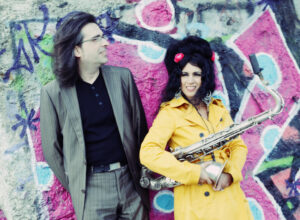
Blending cultures, genres, and emotions with remarkable elegance, About Aphrodite’s Songs Without Words transcends linguistic boundaries. In this interview, the duo discusses musical alchemy, Persian influences, artistic connection, and the universal language of music.
1. “Songs Without Words” blends Persian folk traditions, jazz, chamber music, synth-pop, and electronic textures into a remarkably unified sound. How did you approach weaving such diverse influences together while maintaining a cohesive artistic identity?
We are very familiar with the various stylistic elements that make up “Songs Without Words”; we have considerable experience with each one of them. That is why blending them — while simultaneously preserving or even forging a new identity — does not feel difficult. Of course, it involves a bit of musical alchemy, in the hope that the whole will amount to more than the sum of its parts, but when you know the individual elements and their effects well, the chances of success certainly improve!
2. The album’s title suggests communication beyond language. What emotions, stories, or experiences did you hope listeners would discover through these instrumental compositions?
What the six “Songs Without Words” have in common, among other things, is that they are all based on simple, highly lyrical melodies. Their harmonic structures are uncomplicated, too.
Frequently we break out of this framework through improvisation, yet we always return to it, making it very easy and inviting to follow our little stories.
Moreover, the musical category of “Songs Without Words” is deeply Romantic in spirit. It embodies the hope that there exists a form of poetry beyond spoken language — one that is deeper and fosters a stronger sense of connection than words alone allow. One might think of it as a reverse Tower of Babel: the possibility of telling stories and conveying emotions across all linguistic barriers.
Yet these emotional worlds remain open; they emerge in the space between the telling and the listening.
3. Gilda, your combination of theremin and soprano saxophone is highly distinctive, while Hanzō’s piano and synthesizer work creates rich sonic landscapes. How did your individual musical backgrounds shape the creative dialogue at the heart of this record?
Let me start with a little anecdote: one night, I actually dreamt that I could play the theremin, and the next morning I had an overwhelming desire to turn that dream into reality. I told Hanzō about it, and he initially thought I was crazy. But no sooner said than done! In a way, the theremin found its way to me; ever since, I’ve been a saxophonist and thereminist — or the other way around.
Hanzō is an experienced jazz pianist who also studied classical composition. He has always had a keen interest in electronic music, too. Building on this foundation, we’ve embarked on so many musical journeys — spanning acoustic jazz, world music, techno, ambient, and every conceivable crossover project. The current chapter of our shared story is “Songs Without Words”.
4. Several tracks draw inspiration from Persian culture and history, including “Sartschubeh,” “Newrusi Cats,” and “Taraneh.” Could you share how these cultural references influenced the compositions and why it was important to bring these stories into the album?
As a Persian woman who grew up in Germany, I am naturally shaped by both Eastern and Western culture and history. That may sound like a cliché, but it is simply the case.
While there is much to be said about this multicultural background, one aspect is particularly important to me: we never actually set out to create an album with such a distinctively Oriental influence. It just happened organically; looking back, it might seem as though we had deliberately chosen a specific theme, but that wasn’t the case.
Many subconscious processes were at play. Of course, we aren’t prophets, but the fact remains that shortly after we finished *Songs Without Words*, Iran increasingly moved to the center of global politics. Naturally, our positive sentiments and solidarity lie with the Persian civilian population — a people battered from both within and without.
5. A recurring theme throughout the project is the idea that “music has no passport.” In today’s increasingly divided world, what role do you believe cross-cultural collaboration and artistic exchange can play in fostering understanding between people?
We firmly believe in the unifying power of art in general, and music in particular. Simply because we have never known anything other than being musicians, we can easily jam with musicians from anywhere in the world and always find a common language.
Moreover, our tours through a wide variety of countries have taught us one thing for certain: people everywhere share more or less the same idea of what constitutes a fulfilling life. Yet the opportunities to achieve such a life are distributed so unfairly, and the problems are vast and far-reaching. They are global in nature and, of course, can only be solved globally.
If we had a common language at the level of global politics — the kind that comes so naturally and is so welcomed among musicians from diverse cultural backgrounds — the world would be a better place!
6. With “Songs Without Words” now reaching audiences worldwide, what do you hope listeners take away from this musical journey, and what are the next creative horizons for About Aphrodite?
After recording this album and listening to it in its entirety, we realized what we want to convey to our listeners. We aim to transmit a sense of lightness and the joy of living through our music, coupled with a touch of melancholy. Our music is meant to uplift, not weigh you down.
With About Aphrodite, we already have a fair amount of new, unreleased material. What might be the shared focus of these new tracks — and those yet to come? We’re excited to find out ourselves!