
Solar Flare Alert
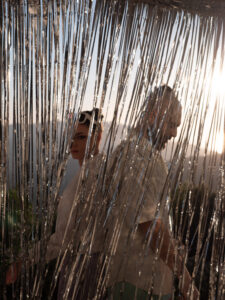
Blending Mediterranean warmth with irresistible disco grooves, Solar Flare Alert’s debut album Disco Au Soleil is a vibrant fusion of styles, storytelling, and dancefloor energy. We discuss its creation and future.
1. “Disco Au Soleil” blends nu-disco, funk, Italo-disco, and electronic influences into a distinctly Mediterranean sound. What was your vision for the album, and how did you ensure all these elements felt part of the same musical journey?
Honestly, it began as pure fun — no grand plan, just the two of us chasing a feeling. The record travels through the different shades of the genre we love: nu-disco, funk, Italo-disco, electronic. Above all we wanted music you feel in your body, something that moves you before you start to think. But we also had something to say, and that’s how the whole Solar Flare Alert world took shape — the alert, the cosmic story, the comic that grew up alongside the songs. The first twelve pages of that comic will be the booklet of the vinyl edition, out in September. So what really holds everything together isn’t a single genre — it’s that world, with the sun and the dancefloor running underneath all of it. And even when the styles shift, our vocals tie it all together — it still feels like one trip.
2. “Sott ‘e ‘Ngopp” is described as the most club-oriented track on the record. What inspired its energetic direction, and how did the Neapolitan phrase and multilingual lyrics help shape the song’s message about chaos and awareness?
“Sott ‘e ‘Ngopp” literally means “upside down” — chaos, basically. We write together, and we’ve lived on the southern coast of Campania for six years now; Davide is from the Cilento. This stretch of coast is a hugely popular summer destination, especially for people from Naples, so Neapolitan is the language we hear all around us in the most fun — and most chaotic — moments of the year. In summer our town goes from about 30,000 people to 120,000, and in every club along the coast you hear languages blending together. Mixing Italian, English and Neapolitan in the same lyric isn’t a concept, it’s about the groove already inside those words — the way they roll and collide. The energy in those summer nights is enormous, and we tried to pour part of that impact into a single song. The awareness underneath it is this: happiness can’t be stored up, you have to spend it all, right now. That’s why the track opens with “wake up — do you know where you are? Open your eyes.” The chorus is pure chaos, but those first words are the way in.
3. You mention that many tracks began as spontaneous jams during the sessions for the New Zone EP. Can you talk about the process of transforming those initial ideas into the fully realized songs that appear on the album?
To explain this we have to start with New Zone, which was made in a pretty particular way. Davide had sketched out at least twenty drafts and we picked five; when Maurice came to the studio we tried a few, and on the ones he felt most at home with he improvised around forty minutes straight per track — a kind of stream of consciousness, straight out of Chicago. New Zone was built by sampling those improvisations and giving them structure. But that left us with a lot of drafts full of good ideas and no vocals — and at heart we’re singers, so we just put two and two together. We wrote the lyrics, and once the tracks were properly structured we reached out to Salvatore Palermo, a Sicilian bassist, producer and multi-instrumentalist we’d heard a few years earlier on a project by friends. He came to our home studio for three weeks and recorded all the live instruments on the record — except the percussion, which his brother Christian Palermo recorded at their own studio in Sicily. From there Davide finished the production and the mix, and for the master he passed the ball to Andrea Pellegrini, a trusted professional we work with regularly.
4. Live instrumentation plays a major role throughout the record, from bass and percussion to horns and piano. How important was it for you to balance organic performances with electronic production techniques?
Hugely important. Both Davide and Erika have at least ten years of live experience behind us, often in large line-ups — funk, reggae, gypsy jazz, pop. We come from a musical world where having musicians who actually play is simply a given. The electronic side is Davide’s passion: he’s been experimenting with analog synths for years, and one instrument in particular runs through almost every track — the Moog Subharmonicon, a wonderfully versatile machine. There’s also extensive use of sampling, a technique Davide loves and one that was already central to New Zone. Bringing all of this together with genuinely played parts felt like the only possible way to find our own sound.
5. You’ve acknowledged comparisons to Nu Genea while describing Solar Flare Alert’s approach as more visceral and unpredictable. How would you define the unique identity of the band, and what do you hope listeners experience when they hear your music?
Solar Flare Alert’s identity is defined first of all by its core: Davide and Erika. We write, we produce, and all the vocals on the tracks are ours. The figures on the covers are us, in comic form. All of it really comes out of the interaction between the two of us — a playful musical exchange that’s grown over the roughly ten years we’ve shared a life together. We’re aware that some people compare us to Nu Genea, but from our point of view we’re completely different. Maybe the only thing we have in common is the purpose we give to music: making people move. We hope for a physical response from the listener — and we imagine they want exactly the same from theirs.
6. After a steady run of releases—from collaborations with Maurice McGee to three lead singles—Disco Au Soleil marks your first full-length album. Looking back on this journey, what have you learned as artists, and where do you see Solar Flare Alert heading next?
We haven’t just learned a lot — we’ve changed as people. Looking back, we sometimes did the right things for the wrong reasons: we turned down labels with decades of history because we felt their offers didn’t do justice to our work, but after months of releasing music on our own we understand how much we underestimated what they’d have brought.
Both New Zone and Disco Au Soleil came out on Katekatashe Records, the label we founded to handle those independent releases. The name means firefly — we chose it because we’re small right now, our light faint and fleeting, but a firefly is something you only need to see once to remember for life. In spring, the fields around our studio fill with them.
The workload has been enormous, but we’ve found our balance. We’ve just begun writing the next Solar Flare Alert LP, due in spring 2027; this September brings the vinyl edition of Disco Au Soleil, unveiling the first twelve pages of the comic that accompanies it. From October to February there’ll be several releases, including tracks featuring Lanavetro — another artist Katekatashe distributes and now produces — and a remix from New Zone. We’re working hard, but where we’re heading is something the music will tell us.