Paul Louis Villani
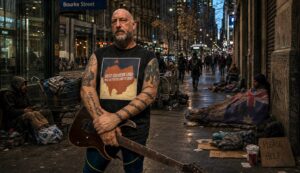
In this candid interview, Paul Louis Villani reflects on identity, belonging, and quiet unrest, unpacking the emotions behind a deeply personal track shaped by change, uncertainty, and introspection.
1. Who Do You Belong to Now? (Great Southern Land) feels like one of your most introspective and confronting releases to date—what was the emotional starting point that pushed you to write this song?
The emotional starting point was honestly a long term build up of confusion mixed with angst and the feeling of when is enough, enough?? I reached a point where I was looking around at the places I grew up in and thinking, “Why does this all feel so unfamiliar now?” Not unfamiliar geographically, but emotionally, culturally and in general, overall sensibilities. I’m not someone who sits around obsessing over politics all day, but I am someone who observes people, behaviour, lifestyle pressure, financial instability, diversity impacting equality, and the way everyday life around me is changing. The song came from that lingering feeling that something underneath the surface is shifting, and I couldn’t really ignore it anymore. For me, writing it wasn’t some grand statement, It’s definitely was more of an unload kinda like pressure leaving my being.
2. You’ve emphasized that this track isn’t about politics or telling people what to think, but rather about personal perception—how did you navigate expressing such sensitive themes without turning it into something overtly political?
Because the moment you start telling people what they should think, most people stop listening anyway. I am 100% one of those people. As soon as I hear the words ”You know what you should do” it’s as is a metaphorical brick wall is inserted between me and that person and I cannot hear or see them any longer. I think modern discourse is already overloaded with people screaming absolutes at each other. I wanted this track to feel human instead of ideological. The song is about my observations, my reactions, my discomforts. Someone else might hear the song and completely disagree with me, and honestly that’s fine. The song isn’t asking for obedience. It’s asking people to be absorbed in the music and lyrics for a few minutes and decide what it means to them.
3. There’s a strong sense of disconnection and uncertainty running through the song. Did writing and recording it help you process those feelings, or did it raise even more questions for you?
Ummmm maybe both! It definitely helped me process some things because songwriting has always been how I make some sense of the noise in my head. But at the same time, once you start really examining your feelings honestly, you usually uncover more questions than answers. That’s the crazy part of introspection. You can’t unsee things once you’ve acknowledged them. The song didn’t magically resolve anything for me. If anything, it reinforced how complicated identity, belonging and just being an Australian is right now.
4. The title itself poses a powerful and somewhat unsettling question. What does “belonging” mean to you today compared to how you understood it earlier in your life?
When I (and I reckon for most humans) was younger, belonging felt almost automatic. You didn’t really question whether you belonged in your own country, community, workplace, or culture. A lot of it, for me, was just part of my existence. Now it feels way more fractured and conditional. People are sorting themselves into “tribes” constantly, politically, socially, ideologically, culturally, and if you don’t perfectly align with one of them, you can feel strangely isolated and very much singled out as an outcast (for me it’s being a certain age and race) even while surrounded by people. I’m almost at the stage where I’d rather not acknowledge all the bullshit some Australians have created in order to justify their own existence and beliefs, and sincerely hope that some others around me still recognise, apply, and truly understand real values, good and honest behaviour, and non-attention-seeking attitudes around them.
5. The lyric video is described as fragmented and chaotic, deliberately avoiding polish—how important was the visual aspect in reinforcing the emotional weight and message of the track?
Massively important. I actually think the lyric video carries almost equal emotional weight to the music itself. I didn’t want polished cinematic beauty because the song isn’t emotionally polished. I wanted fragmentation, tension, visual overload, and moments that feel uncomfortable or unresolved. Modern life already feels like an endless stream of collapsing headlines, pressure, outrage, distractions, and noise. The visuals were designed to feel like psychological intrusion rather than entertainment. What people are watching is very much what I wake up to at 4am and begin rehashing moments of my previous days and life, especially my last 12 months of existence as a working Australian has been mentally challenging. If people feel slightly unsettled watching it, then it’s probably doing its job properly.
6. You mention that this song is more about asking difficult questions than providing answers—what kind of reactions or reflections do you hope listeners will take away after sitting with the song?
Honestly, I hope people reflect more than react. We live in a time where everyone is trained to immediately pick a side, attack, defend, label, dismiss. We have morons protesting about things that they have no understanding of. Potentially corrupt governments governing our lifestyles in ways that we almost have no control of. People with zero intelligence spreading their selfish and pathetic agendas to the masses via social media. I’m more interested in whether the song quietly follows someone home afterwards. Maybe they sit there thinking, “You know what… I’ve felt some of that too.” Or maybe they completely reject it. Both are valid. I’m not trying to recruit anyone into a worldview. I’m just documenting a human response to the place where I was born as I currently experience it. If the song creates genuine thought instead of instant outrage or blind agreement, I’ll see that as a success.