
Social Treble
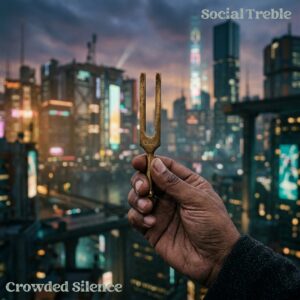
Blending cyber-prog ambition with immersive audiovisual storytelling, Social Treble crafts a dystopian world where cinematic sound design, personal experience, and technological paranoia collide in the haunting experience of Crowded Silence.
1. Crowded Silence feels more like a cinematic deconstruction than a traditional song. What inspired you to build the project as a precise 224.57- second “decommissioning sequence” instead of following a conventional album or single format?
See. All the songs, that I have released as Social Treble, will be a part of an album which will be released eventually. But the main objective of Social Treble is not just releasing music but to give viewers immersive in-depth audio-visual experiences that are based on real-life experiences.
The channel will eventually have audio and video essays too. So, as of now, I am just releasing music with conceptual videos to establish the channel’s identity.
2. The world of the Analog Ghost and the SOMA Network is incredibly detailed and unsettling. How much of this dystopian narrative reflects your thoughts on today’s surveillance culture, algorithmic labor, and digital identity?
To be honest, the concept of the video is completely based on a personal experience which was reimagined in a futuristic world to create impact and also to make people aware of what really goes on behind the scenes in the corporate world and society in general, albeit in a reimagined way. I have lived the concepts myself in my life. What viewers/listeners need to understand is that whatever concept is conveyed through the music or videos or audio/video essays on the Social Treble channel actually comes from a Big Tech insider’s perspective. Yes, I am the insider who has been through every concept that you see on the channel and will continue to see. And that is why I can never disclose who I really am and what I actually do in real life.
3. You describe the protagonist’s rebellion not as destruction, but as “reading the system more carefully than the system reads him.” Why was it important for you to frame resistance through intelligence and interpretation rather than violence?
I feel that rebellion, in the traditional sense of violence and destruction, is almost always not the right path to get what you want or need when you face a dire situation. Rebellion almost always leads to utter destruction which is not good for anyone. On a personal level, I have always stayed within the system to either change the system or escape from it if things went south. And how did I do it? By simply knowing every line of every policy and law there is. And believe me or not, every policy, every compliance document and every law have multiple loopholes. History has told us that these loopholes have always been exploited by bad actors for dire purposes. But what about the good actors? Why can’t they actually read through and understand everything to save themselves from exploitation? The message implied by the visuals, story and audio of “Crowded Silence” is: “Do your due diligence. Read and understand everything when it comes to papers or contracts that you sign. Because you never know when this knowledge will come in handy and you will need to use this knowledge to defend yourself.”
4. The binaural 3D audio approach plays a central role in the experience of Crowded Silence. How did spatial sound design help you translate the feeling of walking unseen through a hyper-monitored city?
See. The binaural 3D audio is designed to create a very immersive experience and actually defines and syncs with the structure of the instrumental itself. It is essential to convey the emotions through the sound. The way I see it, spatial audio is absolutely necessary for this project because I can’t convey the feelings and emotions, and create the intended audio-visual experience otherwise. The music that I create of Social Treble is never meant for passive listening. So, this type of a sound design is an absolute necessity.
5. Musically, the project blends progressive rock, industrial textures, cinematic electronics, and ambient post-rock. How did artists like Nine Inch Nails, Steven Wilson, Vangelis, and God Is An Astronaut influence the emotional architecture of the record?
I have always been drawn to music that makes people think. And music from artists like Steven Wilson/Porcupine Tree, Nine Inch Nails (along with the cinematic works of Trent Reznor and Atticus Ross), Vangelis, God Is an Astronaut, etc, is something that I am naturally drawn to. But to understand why I am drawn to such artists, you will need to understand how all of this came to be.
When it comes to inspirations for making music myself, I have always been inclined towards Progressive Rock/Metal, Psychedelic Rock, IDM, Cinematic Soundtracks and Industrial Rock/Metal, and you will see all these influences in the music of Social Treble. My go-to artists for my own creativity would be Steven Wilson for compositional style and overall sound, Mikael Akerfeldt for his guitar playing, Nick Drake for instrumental tuning, Trent Reznor for industrial grit in music, Ray Manzarek for keyboard and piano playing, and Gustavo Santaolalla for cinematic scoring and sound design. But if I had to name the deepest roots, there are three albums that changed my whole worldview and my life in the process, at very different stages. Pink Floyd’s “Dark Side of The Moon” was the first Western album I discovered, at the age of 9. Nick Drake’s “Pink Moon” found me when I was a young adult studying in university. And Steven Wilson and Mikael Akerfeldt’s “Storm Corrosion” arrived when I had started my career as a professional.
6. Social Treble operates entirely independently, with you handling composition, production, mixing, mastering, and visuals alone. What are the creative freedoms — and challenges — of building such an immersive cyber- prog universe completely by yourself?
The creative freedom is absolute and there are no challenges at all. And that is because doing everything by myself is an absolute necessity to preserve my vision as a sonic architect with absolute integrity. But why do I not face any challenges? It is because I am not a purist when it comes to making music. I combine creativity and technology efficiently and accurately to create what I want to create and deliver. I can play the instruments that I play. I can program music with my physical MIDI instruments. I can code and build softwares myself as well. I am also an expert in technological concepts such as workflow automation and integration. So, creating the way I create has never been a challenge. In fact, I actually choose to create the way I create because I have to manage time efficiently while delivering high quality output. I have a day job after all and it is quite a taxing one. So, efficient time management is absolutely necessary for me without compromising on quality.