
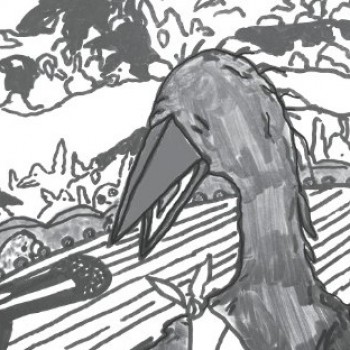
Blending dream-born melodies with shifting tones, Arn-Identified Flying Objects and Alien Friends craft “The Sparrow,” a haunting, introspective piece where surreal imagery and emotion merge into a deeply personal sonic journey.
1. “The Sparrow” has such a vivid, dreamlike origin—can you walk us through how that dream translated into the final composition?
One morning I woke up with the melody for the chorus/hook ringing in my head along with words that, at that moment really didn’t make much sense: “I never left the temple where sorrow takes a breath”. I didn’t want to force the process but sat down by the piano to see what would happen. Part of the tune and lyrics grew organically, without me consciously interfering. Later in the process I of course had to organize it and give it a coherent musical structure of sorts.
2. The song moves through several tonal changes and mostly minor keys. How intentional was this in shaping the feeling of uncertainty and melancholia?
This pattern was there from the beginning and I was careful to maintain it, even underscoring it: Thus the chorus starts with the chord and in the key of A-minor. But the next chord isn’t the expected F major but an F minor, which gives the tune an eerie feeling – and one of that uncertainty mentioned in the question., as this unconventional chord change also changes the key. This was not all intentional, but rather a result of me plunking aimlessly on the piano. The following key changes, in the verse (with the first chords going from D minor to B minor), were more calculated
3. The narrative twist—that the dying sparrow might represent the narrator—is powerful. What inspired this introspective storytelling approach?
I’m not quite sure. The image of the dying sparrow came to me quite early in the process (but after the dreamlike words about the temple, that now ring in the chorus). When I was writing the third verse I thought I wanted to shift perspective from the narrator (me) to the sparrow, and I think I realized that I WAS that sparrow, as we all are in a way.
4. Elements like church bells and mellotron add a unique texture. How did you decide on these sounds, and what role do they play emotionally?
I played around with different sounds – there’s also honky tonk piano, slightly out of tune, underscoring that strange dream-like atmosphere. The church bells, well, I was not sure about them. The connection to the lyrics was in a way to obvious. But in the end I decided to keep them!
5. How did Andreas Quincy Dahlbäck’s drumming contribute to keeping the track organic despite its atmospheric complexity?
His vivid drums are absolutely necessary here. In my demoversion I used sampled and digital drums and the song simply didn’t come to life. It was as dead as the sparrow in the lyrics (in a bad way). I actually doubted that I would be able to finish the recording. Andreas’ drumming changed all that!
6. Featuring Stefan Petersson on the high-pitched “Fly, sparrow fly” lines is a striking choice—how did that collaboration come about, and what did he bring to the song?
Stefan is great singer, and although he loves soul and root rock, he originally sang hard rock and metal. His voice has a really wide range. In the higher notes (we’re talking soprano here) he has a sharpness and a vocal projection that few singers have. I think it adds an extra edge these lines, preventing them from being to “sweet”. And it’s also nice to work with him – in spite of the “evil” tone in his singing he is a lovable guy!
Copyright © 2026 The Inteviewist