
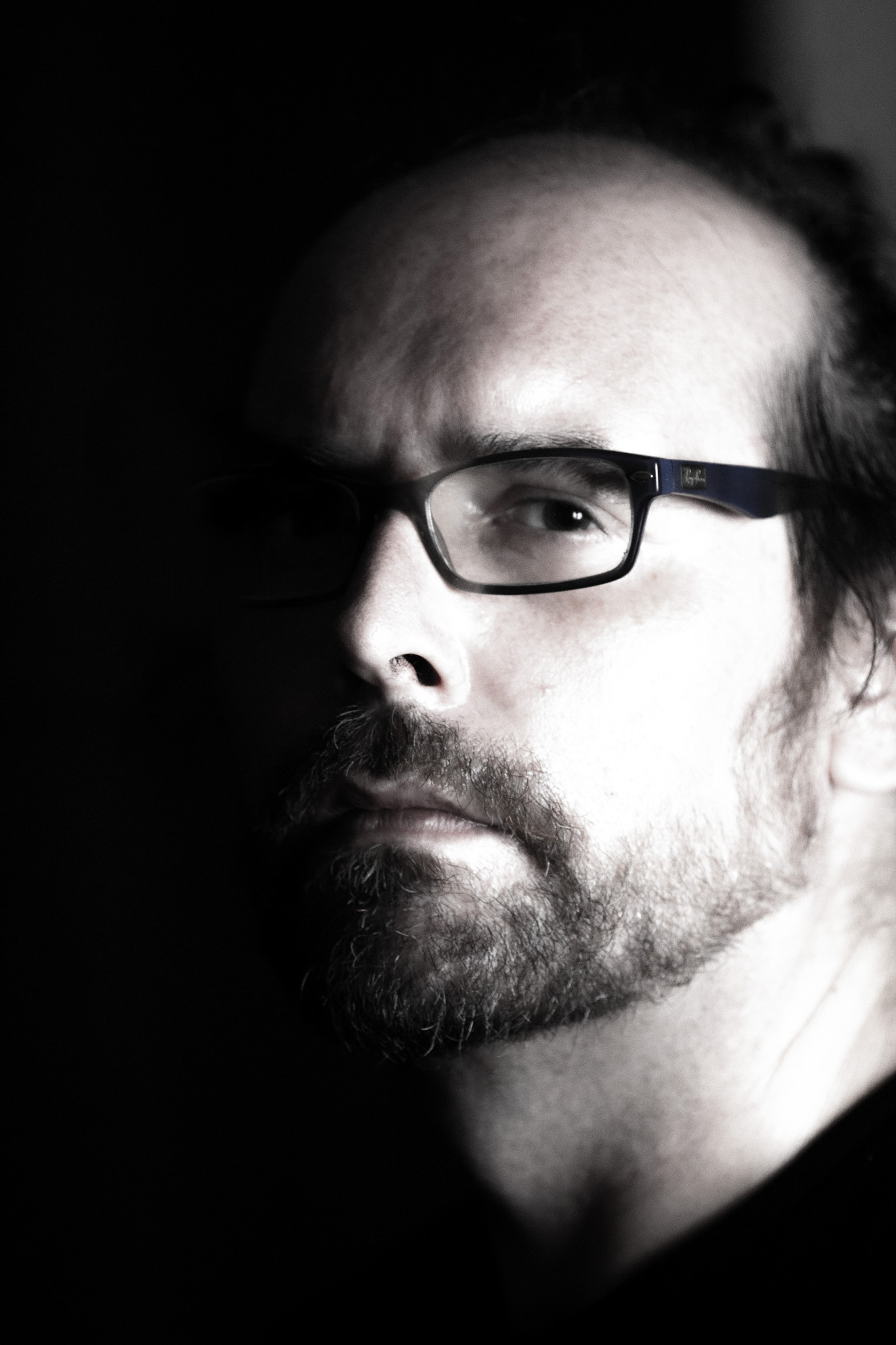
In this interview, Hachè Costa reflects on Memoria del Océano, blending minimalism, folk memory and electronics to confront political noise, environmental loss, and human goodness through beauty, responsibility, and love.
1. “Memoria del Océano” blends minimalistic piano, electronics, and Spanish folk traditions. What sparked the idea of uniting these distinct worlds to talk about environmental damage and collective memory?
Using folk music to invoke collective memory is a fairly transparent idea, since folk music is precisely the sounding part of people’s memories: to me, bringing back all those songs about seas, rivers and animals, seemed to be a remarkably poetic and accessible way of doing this. And precisely because folk music and the people who created it have always had their eyes on nature, it seemed to me that it was an effective way to draw attention to memory, to the need to exercise it and recall those aspects that we seem to be losing: the love of life, of nature, and for other human beings. It is a call to the listener:
‘Remember who you are, because what you are is something beautiful, don’t lose it!’
As for unifying these musical genres, I believe there is a type of minimal that has always been linked to folk music and even electronic one. It is not the New-York-Counterpoint of Steve Reich, of course, but think about Mike Oldfield: when music seeks to be primarily emotional, it avoids rational construction and remains still.
2. You use historical voices of dictators, including more contemporary political references, as symbols of chaos and danger. How did you approach integrating such charged material into a musical narrative without overshadowing the emotional core of the work?
I wanted to show the chaos, the danger… and, above all, the excess, the excess that any human being can reach if not firmly restrained. And those restraints are always society, and the common goodness, which usually prevails over madness. We find ourselves in a historical moment in which it is urgent to remember that what has always united us is the love for other human beings, not hatred, racism, xenophobia or sexism. However, from my point of view, harmful ideas must be fought by showing beautiful things that act as a counterbalance, and that is why I believe that introducing the voices of dictators confronted with the beauty of music enhances that beauty: this good in the face of that evil. That is why I believe the emotional aspect of the work is not lost, but rather enhanced by this antithesis. Many people have said to me after a concert: ‘I loved it, but Hitler’s voice prevented me from hearing the music properly and it bothered me!’ That is what it is all about: remembering that Hitler, Mussolini or Franco are annoying things that prevent you from enjoying beauty.
3. Instead of focusing solely on the destruction of the oceans, you highlight beauty, tradition and the possibility of reconnection. Why is this hopeful perspective so important for you in this project?
In this regard, I completely agree with the philosopher and psychoanalyst Slavoj Žižek when he says that we must accept that damage to the environment is unstoppable and that the realistic goal is to study what is the maximum damage the world will tolerate. That is why we must speak positively: what are we going to do? We must avoid the NOES and work on the YESES, and this perspective requires reconnection: this river is no longer as big as it used to be because it is drying up; what can I do to stop damaging it so much? Why is this river so important? And, above all, the simplest question: Do I like this river? Fight for the world you love, and spend your time being happy instead of theorising about ideas of hatred, resentment and denial.
4. Your work spans film scoring, reorchestration (like “Changin’ Vivaldi”), and contemporary art collaborations. How did your past experiences shape the sound and concept of “L’Atlantique” and the wider album?
Probably the work that has most influenced this one is the reorchestration of Vivaldi that we performed at the EDP Theatre in Madrid, since both works share the idea of degrading beautiful music to draw attention to the need to preserve it. However, all my contemporary music, in general, has always sought to highlight social issues such as sexual abuse (like in the opera “The Hand”), or the need to protect the individual self through the excesses of political discourse (as in the work “Tribute to Jacques Lacan: Surrealism 100 Years”), so I suppose its influence must also have been significant. With regard to my film music, I think it has influenced the overall structure, which is profoundly narrative.
5. The single was mastered at Abbey Road Studios and the orchestral version premiered in Portugal. How have these international collaborations influenced the identity and reception of the project so far?
The premiere of ‘L ́Atlantique’ in Portugal was absolutely decisive, as the expectation of presenting the work under the baton of the great maestro Filipe Cunha, conducting the Orquestra Filarmonica de Braga, carried more weight than many other aspects, primarily due to the language. Starting the project with the beautiful and lyrical Portuguese language in mind made the starting point even more emotional, and this was complemented by the role of the orchestra conductor, a charming person with an amazing musicality. Similarly, the two sopranos involved in the project, Liliana Nogueira and Regina Freire, heightened the most emotional aspects with their wonderful voices, which added enormous emotional depth to it. Imagine what the premiere meant, considering that nearly 900 people gave a standing ovation at the end of the work, something extraordinary for a premiere of contemporary music… Now that’s emotion!
And, of course, having worked as a bridge between London, Madrid, Torrejón de Ardoz and Braga in the early stages of the project has given ‘Memoria del Océano’ an international character. In general, I must say that my music has always been better received outside of Spain, but that evidently does not worry me: Do you know how many Spanish creators have had to leave the country? I am talking about huge names, the best: Nacho Duato in dance, Angélica Liddell in theatre… It is extremely common for any reasonably serious Spanish creator to be better appreciated outside their own country.
6. As the project begins its tour through both institutional spaces and alternative venues, what do you hope audiences take away from experiencing “Memoria del Océano” live?
Love. I want them to take away the love that springs forth when they remember the beautiful things the audience already have inside them. I want them to remember the beauty of nature and the brotherhood between human beings, and for that memory to make them more aware: to remember to be more understanding of other people’s pain and treat them more carefully; to avoid damaging a river if it is in their power to do something to take better care of it. What matters the least to me is that they remember the music they have heard: the music of ‘Memoria del Océano’ is not what is important; what is important is that this music has offered them the opportunity to reflect on how beautiful life is and our obligation to care for it, and this message is something that is understood equally in a state museum and in a concert hall. I firmly believe in human goodness, and goodness does not make distinctions of any kind.
Copyright © 2026 The Inteviewist