
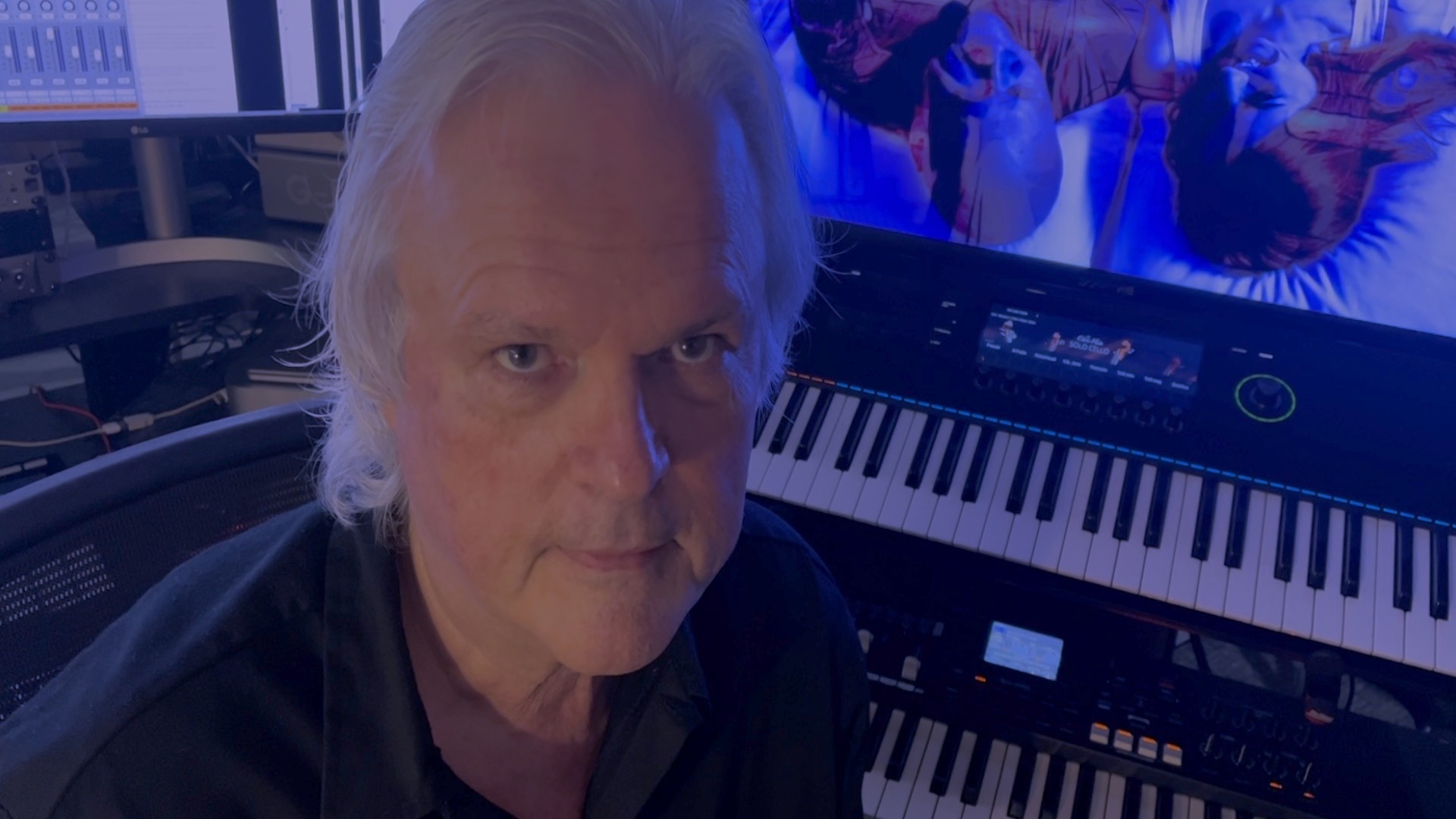
This interview explores Marc Soucy’s creative world—his “mini soundtracks,” genre-blending compositions, lifelong bond with technology, and the visual dimension that shapes his immersive musical journeys and ever-evolving artistic identity.
1. Your work is described as “mini soundtracks” that blend world music, electronic elements, and cinematic storytelling. When you begin composing, what usually comes first—an emotion, a visual scene, or a musical motif?
I begin by coming up with a musical motif. If I like it from a pure musical perspective, I’ll start to compose additional parts. As I’m doing it, it feels to me like I’m improvising. I have really good recall of music I’ve encountered my entire life, and I’m quite sure snippets of them all make their way into my thinking as I’m working. I believe this is how authentic music composition works anyway. Originality has become truly fragile and difficult to achieve, since so much has been done and is being done now. I do have the advantage of having studied classical piano for my entire childhood. This gives me a sense of structure, execution, and knowing when something’s right, even if it has nothing to do with classical music.
My growing music catalog is made up of many different mixtures of styles: unpredictable, and hopefully emotionally provocative. Getting back to your question, once the musical piece has developed some, I start to examine how it makes me feel, and what visual events might accompany that feeling. Is it ominous? Is it tense and stressful? Is it loving and nurturing? Is it surreal and otherworldly? …and on and on. This thinking gives me a direction to continue developing the piece and the concept I want it to convey. Once many of them were done, the pattern for me became “mini soundtracks”, because of the twists and turns each piece can take as it progresses.
2. You’ve been connected to music since childhood and have witnessed the evolution of music technology from the early days of MIDI to today’s digital tools. How has this lifelong relationship with technology shaped your creative process and the sound of your recent releases?
That experience with both music studies and music technology has allowed me to progress beyond what the normal approach to this technology is. As I said, I have a very improvisational approach to this, and finding “that sound” I think I need in a given passage is part of the process. I never let the sound library dictate anything. That’s not my thinking at all. I’ve been asked what sound libraries I prefer. I own seven or eight of them, plus a couple dozen virtual instruments, besides my keyboard rig. I find and use a sound without committing my self to any specific approach or formula on how each thing is used. This gives me even more freedom to create what I hear in my head.
The sound of my recent work is indicative of this process. Electronic sounds often appear almost anywhere, or a keyboard instrument from recent history—say a Mellotron or a Clavinet—might appear suddenly. Just because it captures the feeling for that moment. On top of all that, overall, I use organic “acoustic” sounds even more often than the electronic ones. Violin, trumpet, cello, string sections, French horns, tin whistles, you name it. Mixing it up constantly, and never sitting still with a style is what I’m all about.
3. Your compositions often feel like immersive journeys with influences from classical, rock, jazz fusion, world music, and more. How do you approach merging so many genres into a cohesive piece while still maintaining your unique artistic identity?
That question is a good one, and also a hard one to answer accurately. I guess
I simply refuse to follow ANY of the “rules” out there about how to arrange a song. Any piece of mine might start with a minute long soundscape and suddenly erupt into a dynamic musical thrust. A minute later, it might become introspective, or awe inspiring. It could go silent and crawl its way back. If anyone wants me to “get to the point” or “where’s the hook?” forget about it. You won’t get that from me. I am not a creator of “popular music” in any form. I might touch upon it briefly here and there, but that’s it.
4. Each track is accompanied by a music video and often carries elements of sci-fi, surrealism, or spirituality. How important is the visual dimension in your artistic vision, and what role does it play in deepening the listener’s emotional experience?
Creating my music videos is my hobby, whereas music itself is my art. Let’s be clear about what my intentions are. I consider my music “sync ready” and I am working to make it so for the entertainment industry. That said, I see the videos as just one possible interpretation (among many) of what the music implies. That “mini soundtrack” concept really kicks in when you watch the videos. Most listeners have a much more immersive experience when they watch them. The industry people may have little use for my music videos, but the public might. Plus they are fun to do.
5. Reviews have compared your work to cinematic giants like Hans Zimmer and Max Richter, yet highlight that your sound remains unmistakably your own. How do you navigate the balance between recognizable influences and forging a distinct personal signature?
I keep my distinct musical signature my being free of any rules. That constant exploration, and willingness to add another style to any piece is my approach. I never sit still in a given genre or sound. There are many very gifted music artists and composers out there that can cross stylistic boundaries, and really master them at a level that I can’t. I listen to people like that for enjoyment. For me though, it’s all about the constant change and unpredictability of my music that keeps it “me”.. You can’t listen to ANYTHING that I’ve done, and assume anything about other music I create. Over time there will be some patterns, but unpredictability is the real “secret” to this.
6. Having spent years as a producer and performer before focusing on releasing your own eclectic projects, what does this current phase of your musical journey mean to you—and what can listeners expect next from Marc Soucy?
My current efforts are the culmination of my life. It’s no less than that for me. Decades of absorbing music from many cultures, historical periods, and popular music from my life and before it, all make up a kind of “sea” of music that I navigate in. I’ve working with music technology—as you mentioned earlier—since it was invented so all of this time I have invested of my own life is coming to fruition… It has to happen. And so it is.
Going forward, I will be releasing singles throughout 2026 and I expect beyond. Meanwhile, more music that is more “cinematic” is in the works. All of it makes up what I’ve named my catalog “IMMERSIVE MUSICAL JOURNEYS”. The growing music catalog is being uploaded to my artist catalog on disco.ac, while being distributed to most streaming services.
Copyright © 2026 The Inteviewist